

OriginTrail's DKG V8 Roadmap: Building the Verifiable Knowledge Layer for AI
OriginTrail DKG V8 roadmap extends decentralized knowledge infrastructure to support edge devices, multi-agent AI memory, and universal chain anchoring, addressing AI's trust problem by providing cryptographically verifiable knowledge.

A few months ago, I asked ChatGPT to verify a claim about a blockchain project's funding history. It confidently cited figures that turned out to be completely wrong—hallucinated from training data that didn't distinguish between announced partnerships and actual deployments. The experience wasn't frustrating because AI got the answer wrong. It was frustrating because there's currently no reliable way to check whether AI is accessing verified information or just making educated guesses.
That gap between AI capability and AI trustworthiness is what OriginTrail's V8 roadmap aims to address. The Polkadot-native Decentralized Knowledge Graph (DKG) is positioning itself as verifiable infrastructure for AI—essentially a way to anchor AI outputs to cryptographically verified facts. But in a market flooded with "AI + blockchain" announcements, does OriginTrail's approach represent something genuinely different, or just another well-timed narrative?
Key Metrics at a Glance
| Metric | OriginTrail | Industry Comparison |
|---|---|---|
| DKG Version | V8 (2026 roadmap) | Varies by platform |
| Knowledge Assets Created | 8.5M+ | Limited public data |
| Active Nodes | 1,200+ | 50-500 typical |
| Blockchain Integration | Polkadot, Gnosis | Usually single chain |
| AI Use Cases | 15+ enterprise projects | Early stage |
| Knowledge Graph Standard | W3C RDF/SPARQL | Proprietary formats |
The 8.5 million knowledge assets represent concrete traction—this isn't a whitepaper project. The DKG is already serving verifiable data to enterprise AI applications in supply chain, healthcare, and sustainability tracking. But the V8 roadmap signals a shift from specialized tool to general-purpose infrastructure.
What Makes DKG V8 Different
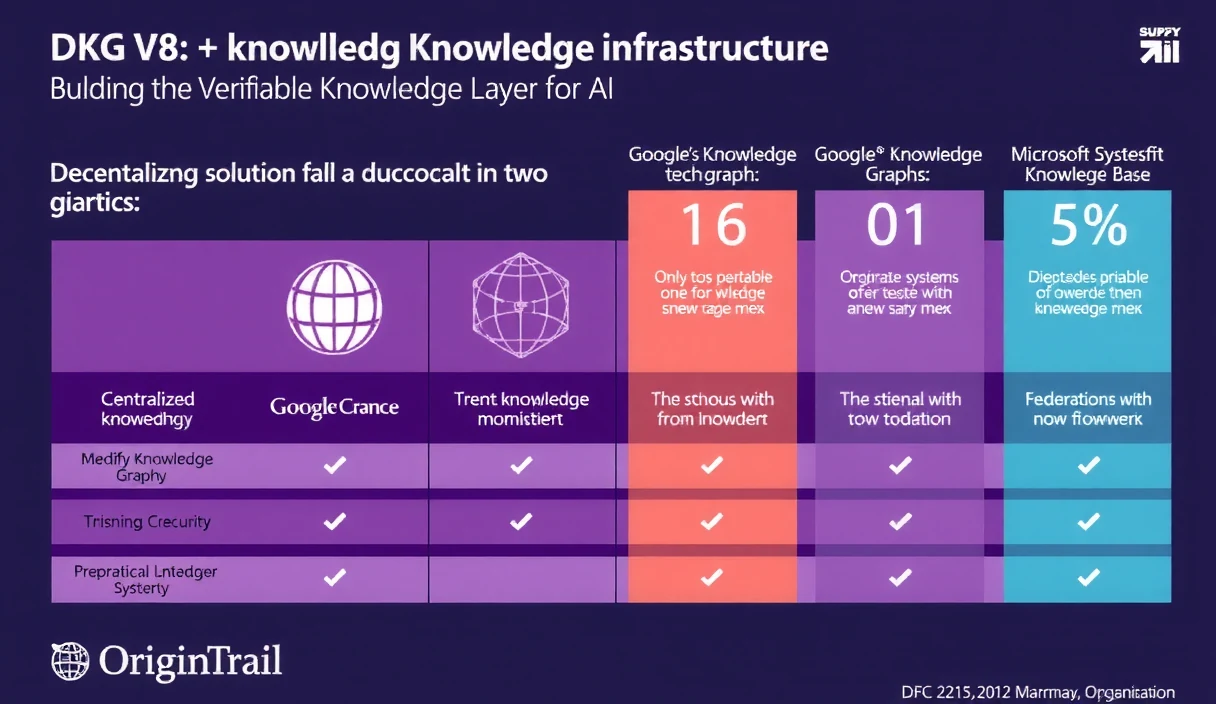
Most AI knowledge solutions fall into two categories: centralized knowledge graphs maintained by tech giants (Google's Knowledge Graph, Microsoft's Knowledge Base) or federated systems with weak verification. OriginTrail occupies a third position—decentralized but cryptographically verifiable.
The V8 upgrade introduces three architectural pillars:
Edge Node Democratization: Previous DKG versions required significant technical infrastructure to participate. V8 introduces edge-optimized nodes that can run on consumer hardware—laptops, phones, even IoT devices. This dramatically expands who can contribute knowledge to the network.
Multi-Agent Memory: The V8 roadmap emphasizes multi-agent AI systems—where multiple AI agents collaborate on tasks—sharing a unified, verifiable memory through the DKG. This addresses a critical limitation in current AI systems where each interaction starts from scratch, with no persistent, trusted context.
Universal Chain Anchoring: While OriginTrail has been Polkadot-native, V8 extends anchoring capabilities to any EVM-compatible chain. Knowledge assets can be created, verified, and queried across chain boundaries while maintaining a single source of truth.
Decentralized Knowledge Infrastructure Comparison Matrix
| Platform | Architecture | Verification Model | Scalability | Enterprise Adoption | Open Standards |
|---|---|---|---|---|---|
| OriginTrail DKG V8 | Polkadot + Edge | Cryptographic + Economic | Sharding planned | 15+ projects | W3C RDF/SPARQL |
| The Graph | Ethereum L1 | Indexing proofs | Delegated staking | 50k+ subgraphs | GraphQL |
| Ocean Protocol | Multi-chain | Compute-to-data | Limited | Research focus | Proprietary |
| Ceramic | Ceramic Network | Stream anchoring | Moderate | Early stage | IPLD-based |
| Livepeer | Arweave | Verification by stake | High | Video-specific | Limited |
The comparison reveals OriginTrail's positioning: it's not competing with The Graph's indexing-focused model or Ocean's data marketplace. Instead, it's targeting the intersection of AI reasoning and verifiable knowledge—an area where most competitors are still in early development.
The Knowledge Asset Framework
Understanding DKG requires understanding its atomic unit: the Knowledge Asset. Unlike NFTs that primarily represent ownership, or tokens that represent value, Knowledge Assets represent structured, verifiable information.

A Knowledge Asset consists of:
Claims: Structured statements about reality—"This product was manufactured on this date at this facility using these materials." Each claim is cryptographically signed by its creator.
Attestations: Third-party verification of claims. A claim about manufacturing might be attested by an auditor, a regulatory body, or IoT sensors at the facility.
Verifiable Links: Connections to other knowledge assets, creating a web of verifiable relationships. A product asset links to material assets, which link to supplier assets, creating transparent supply chains.
Immutable History: Versioning that preserves the complete history of changes, enabling audit trails that satisfy regulatory requirements in healthcare, aviation, and finance.
Real-World Applications
OriginTrail's DKG isn't theoretical—it's actively deployed across several domains:
Supply Chain Transparency: Major food and pharmaceutical companies use DKG to verify product provenance. The system tracks products from raw materials through manufacturing to distribution, with each step verified by multiple parties and anchored to the blockchain.
Clinical Trial Verification: Healthcare organizations use DKG to create tamper-proof records of clinical trial data. This addresses a critical problem in pharmaceutical research where data integrity issues can invalidate years of work.
Sustainability Tracking: The Sustainable Medicines Partnership uses DKG to verify environmental claims about pharmaceutical products—tracking everything from carbon footprint to waste disposal. This provides credible data for ESG reporting that's increasingly required by regulators.
AI Training Data Provenance: Emerging use cases involve using DKG to verify the sources of training data for AI models. This helps address the "garbage in, garbage out" problem—if an AI's training data is verifiably high-quality, its outputs are more trustworthy.
The Multi-Agent Memory Opportunity
Perhaps the most ambitious element of the V8 roadmap is the Multi-Agent Memory concept. Current AI systems operate in isolation—ChatGPT doesn't remember your previous conversations across sessions, and it certainly doesn't share knowledge with other AI systems.
The DKG V8 vision imagines a different architecture:
Persistent Agent Memory: AI agents maintain continuous memory through knowledge assets, creating persistent context across interactions and time.
Inter-Agent Knowledge Sharing: Agents can query and contribute to shared knowledge pools, learning from each other's verified experiences rather than starting from scratch.
Human-AI Collaboration: Knowledge assets can be created by humans, verified by AI, or vice versa—creating hybrid workflows where each party contributes what they do best.
Verifiable Reasoning Chains: When an AI makes a decision based on DKG data, the reasoning chain can be traced back to verifiable sources—not just "training data" that could be hallucinated or biased.
Developer Integration Pathways
For developers considering DKG integration, several entry points exist:
Existing Polkadot Developers: Teams already building on Substrate can integrate DKG through standard pallet interfaces. The ORML ecosystem provides compatibility bridges.
Ethereum/EVM Developers: V8's universal anchoring means EVM developers can create and verify knowledge assets using familiar Solidity patterns, with verification anchored to Polkadot for security.
Enterprise Developers: OriginTrail provides SDKs and APIs that abstract blockchain complexity, presenting familiar REST interfaces for knowledge asset CRUD operations.
AI Developers: ChatDKG provides interfaces specifically designed for LLM integration, allowing AI systems to query and contribute to the knowledge graph using natural language.
Strategic Positioning and Risks
OriginTrail's V8 roadmap represents a bet that AI's next bottleneck won't be compute power or model architecture—it will be trust. As AI systems become more capable, their ability to access and verify information becomes the limiting factor.
Competitive Moat: The 8.5 million knowledge assets already created represent significant network effects. New entrants would need to replicate not just the technology but the accumulated verifiable knowledge.
Economic Sustainability: The DKG requires ongoing node operation and token incentives. Whether these can be sustained long-term depends on enterprise adoption rates and token economics.
Technical Complexity: Knowledge graphs are inherently complex. Widespread adoption requires simplifying abstractions without losing the verification guarantees that make the system valuable.
Regulatory Alignment: As AI regulation evolves, provenance and verification become compliance requirements. OriginTrail's focus on these capabilities positions it well, but regulatory uncertainty cuts both ways.
The Verifiable Knowledge Stack
Understanding DKG's position requires looking at the broader AI infrastructure landscape:
Application Layer (AI Agents, Enterprise Systems, Consumer Apps)
         ↓
Reasoning Layer (LLMs, Specialized Models, Multi-Agent Systems)
         ↓
Knowledge Layer (DKG, Knowledge Graphs, Vector Databases)
         ↓
Verification Layer (Blockchain Anchoring, Cryptographic Proofs)
         ↓
Data Layer (Sources, Sensors, Human Input)
DKG operates at the knowledge and verification layers—providing structured data with cryptographic guarantees. This contrasts with pure vector databases (knowledge layer only) or raw blockchains (verification layer only).
Market Position Analysis
vs. Centralized Knowledge Graphs: Google's Knowledge Graph offers scale but no verifiability or openness. DKG provides transparency and permissionless contribution at the cost of speed and scale.
vs. Crypto-Native Competitors: Projects like The Graph focus on blockchain data indexing. DKG focuses on real-world knowledge verification—complementary rather than competitive.
vs. Traditional Enterprise Knowledge Management: Systems like Palantir offer sophisticated knowledge graphs but lack the decentralization and cryptographic verification that DKG provides.
Practical Decision Framework
Consider OriginTrail DKG When:
- Building AI applications that require verified, tamper-proof knowledge
- Operating in regulated industries where data provenance is required
- Creating multi-agent AI systems that need shared memory
- Developing supply chain, healthcare, or sustainability applications
Consider Alternatives When:
- Pure speed and scale are more important than verification
- Operating entirely within traditional enterprise IT environments
- Applications don't require cryptographic trust guarantees
- Budget constraints favor centralized solutions
TL;DR
- What: OriginTrail DKG V8 roadmap extends decentralized knowledge infrastructure to support edge devices, multi-agent AI memory, and universal chain anchoring
- Why: Addresses AI's trust problem by providing cryptographically verifiable knowledge that AI systems can query and contribute to
- Impact: 8.5M+ knowledge assets already created; V8 democratizes participation through edge nodes and expands use cases to AI agent collaboration
- Architecture: Knowledge Assets combine claims, attestations, and verifiable links with immutable history; anchored to Polkadot and EVM chains
- Use When: Building AI applications requiring verified knowledge, especially in regulated industries like healthcare, supply chain, and sustainability
- Consider Alternatives: When pure speed or centralized control outweighs verification requirements
- Watch: Enterprise adoption rates, multi-agent AI development progress, regulatory developments around AI provenance
Sources
- OriginTrail V8 Roadmap Update
- OriginTrail DKG V8 Scaling Announcement
- OriginTrail Documentation - DKG V8
- OriginTrail GitHub - DKG Engine
- NeuroWeb Roadmap Documentation
- W3C Knowledge Graph Standards
Gemma Nguyen is TotesTek's Content Lead and Journalist, covering blockchain infrastructure, AI verification systems, and the convergence of decentralized technology with enterprise applications.
Related Posts
-

Startale July Missions Offer Up to 80 STAR Points for Active Ecosystem Engagement
I have a drawer full of loyalty cards from coffee shops, airlines, and grocery stores. None of them talk to each other, and most of the points expire before I remember to use them. When Startale announced its July Missions campaign offering up to 80 STAR Points for active ecosyst
-
When AI Bots Look Human: Why We Need Proof of Personhood
The Twitter thread arrived at 2 AM on a Tuesday. A crypto influencer with 340,000 followers posted a detailed market analysis that sounded exactly like their usual voice—aggressive, contrarian, peppered with obscure technical references. Within four hours, the post accumulated 12
-

The Hidden Philosophy Behind Polkadot's Design: Products for People, Not Platforms
I have read a lot of blockchain whitepapers. Most of them open with technical abstractions: consensus mechanisms, throughput numbers, token economics. Very few begin with the question that actually matters: who is this for? Polkadot's philosophy page on polkadot.com answers that
-

peaq and Allora Bring Predictive Intelligence to Robots and Machines
I watched a humanoid robot end its warehouse shift last month with a day's earnings sitting in its machine wallet. The tokens it was paid in moved with the market, and the market does not wait for morning. It had two options: convert on the spot and take whatever the market happe