

Bifrost vDOT Governance: How Liquid Staking Meets Polkadot OpenGov Without Compromise
Last week I watched a DOT holder navigate Polkadot's governance interface with the kind of hesitation that tells a story. They wanted to participate in OpenGov votes but couldn't bear the opportunity ...

Last week I watched a DOT holder navigate Polkadot's governance interface with the kind of hesitation that tells a story. They wanted to participate in OpenGov votes but couldn't bear the opportunity cost of unbonding their stake. "I believe in the network's future," they told me, "but I also believe in earning yield while I vote." The tension between governance participation and staking returns has plagued Proof-of-Stake systems since delegation became standard. Bifrost's February 2026 update suggests we might finally have a solution that doesn't force that choice.
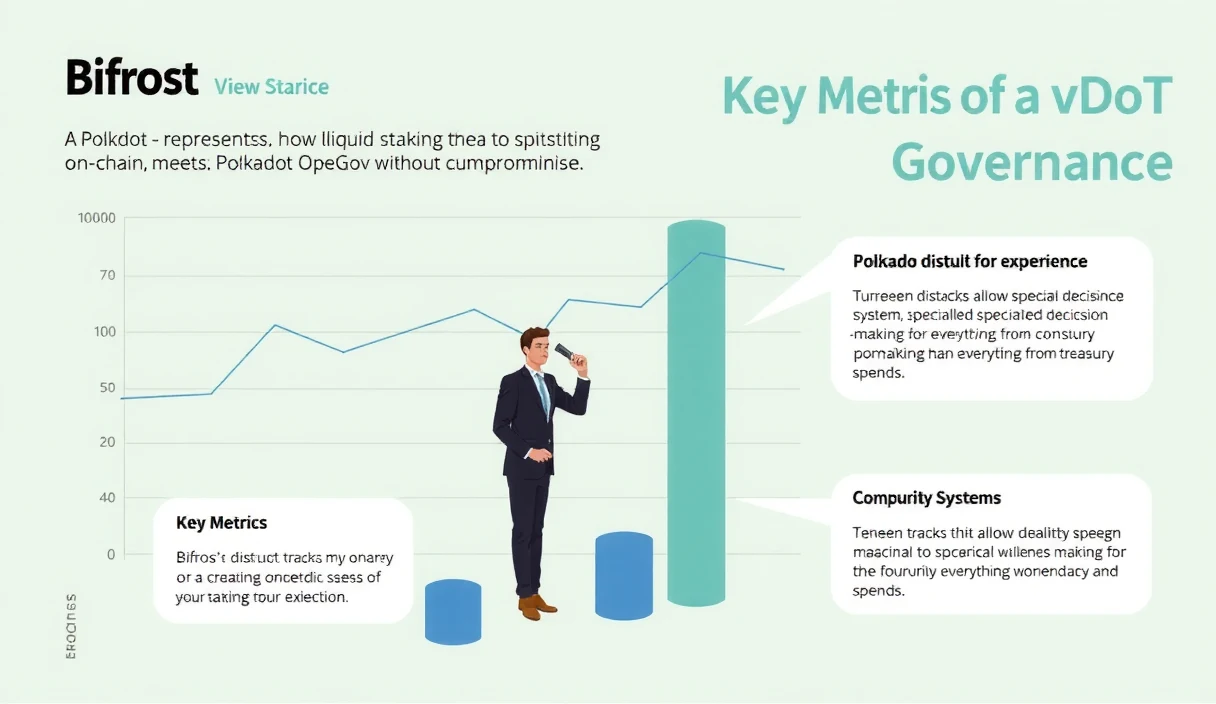
Key Metrics at a Glance
| Metric | vDOT Governance Value | Standard DOT Staking |
|---|---|---|
| Governance Participation | ✅ Full voting power | ❌ Requires unbonding |
| Staking Yield | 14.52% APR (maintained) | 14.52% APR (lost if unbonded) |
| Unbonding Period | None | 28 days |
| Liquid Position | ✅ vDOT tradable | ❌ DOT locked |
| OpenGov Tracks | All 14 tracks supported | Direct only |
The Governance-Yield Dilemma
Polkadot's OpenGov represents one of the most sophisticated on-chain governance systems in existence. Fourteen distinct tracks allow specialized decision-making for everything from treasury spends to runtime upgrades. But participation requires tokens to be in a non-staked state or delegated through complex mechanisms that sacrifice yield.
Traditional liquid staking solves the liquidity problem but creates a governance problem. When you stake through a centralized exchange or basic liquid staking protocol, your governance rights typically vanish into a black box. The protocol votes on your behalf, or worse, doesn't vote at all. Your economic stake in the network's success becomes separated from your voice in its direction.
Bifrost's approach is different. Instead of treating liquid staking and governance as competing priorities, they've built infrastructure that combines them.
How vDOT Governance Actually Works
The technical implementation is elegant in its simplicity. When you mint vDOT through Bifrost, your underlying DOT enters Bifrost's staking pool managed by validators across the Polkadot ecosystem. Nothing unusual there. The innovation comes in how Bifrost represents your governance rights.
Tokenized Governance Position: vDOT holders receive governance rights proportional to their staked position. These aren't abstract promises; they're implemented through Bifrost's runtime modules that interact directly with Polkadot's OpenGov pallets.
Delegation Without Yield Sacrifice: The system allows vDOT holders to delegate their OpenGov voting power to representatives while maintaining liquid positions. Your vDOT continues earning staking rewards; your governance participation continues through your chosen delegate.
Track-Specific Delegation: OpenGov's fourteen tracks serve different purposes. A developer might want direct control over technical upgrades (Root track) but delegate treasury decisions to financial experts (Treasury track). vDOT governance supports granular delegation choices.
Liquid Staking Governance Comparison Matrix
| Protocol | Liquid Token | Governance Rights | Delegation Support | Yield Maintained | OpenGov Integration |
|---|---|---|---|---|---|
| Bifrost vDOT | ✅ vDOT | ✅ Full | ✅ Track-specific | ✅ Yes | ✅ Native |
| Lido stDOT | ✅ stDOT | ⚠️ Limited | ❌ No | ✅ Yes | ⚠️ Partial |
| Parallel sDOT | ✅ sDOT | ❌ None | ❌ No | ✅ Yes | ❌ No |
| Acala LDOT | ✅ LDOT | ⚠️ Limited | ⚠️ Basic | ✅ Yes | ⚠️ Partial |
| Staked DOT Direct | ❌ N/A | ✅ Full | ⚠️ Limited | ❌ No (if unbonded) | ✅ Native |
The OpenGov Integration Deep Dive
Bifrost's February 2026 update didn't just add governance support; it integrated deeply with OpenGov's specific features. Understanding what this means requires looking at OpenGov's track structure:
Root Track: Runtime upgrades and critical parameter changes. vDOT holders can participate directly or delegate to technical experts. The 28-day unbonding period that normally prevents rapid response to urgent upgrades? Irrelevant for vDOT holders.
Treasury Tracks (Small Spender, Medium Spender, Big Spender, Treasurer): Funding decisions that shape ecosystem development. vDOT holders maintain voting power while their stake continues earning yield.
Referendum Canceller/ Killer: Emergency tracks for reversing malicious proposals. vDOT's liquidity ensures holders can react quickly to governance attacks without waiting for unbonding.
Fellowship Tracks: Technical decisions requiring specialized knowledge. vDOT holders can delegate to Fellowship members while maintaining economic exposure.
The integration isn't superficial. Bifrost's runtime modules verify vDOT holdings at each referendum's start block, ensuring voting power accurately reflects staked positions without double-counting.
Real-World Participation Patterns
Bifrost's February report includes early data on how vDOT holders are using governance features. The patterns reveal sophisticated participation:
High-Value Delegation: The majority of vDOT governance participation happens through delegation rather than direct voting. This suggests holders value expert input while maintaining economic stake. Treasury tracks show particularly high delegation rates, indicating holders trust specialized knowledge for financial decisions.
Track-Specific Strategies: Different tracks show different participation patterns. Technical tracks (Root, Whitelisted Caller) show higher direct voting rates. Treasury tracks show higher delegation rates. This granular approach to governance participation wasn't possible before OpenGov's track structure.
Retention Correlation: vDOT holders who participate in governance show higher retention rates than non-participants. The correlation suggests governance engagement strengthens protocol relationships beyond pure yield seeking.
The Validator Perspective
Governance participation affects validators indirectly but significantly. When DOT holders unbond to participate in governance, validator rewards decrease. When they stake through liquid staking without governance, validator influence concentrates in protocol hands.
Bifrost's approach distributes governance power while maintaining staking participation. Validators continue receiving delegated stake; token holders retain governance rights. The separation of economic and governance rights that liquid staking traditionally creates gets bridged.
The February report notes validator enthusiasm for vDOT governance adoption. Higher vDOT adoption means more stable stake delegation and more engaged token holders. Validators aren't just providing infrastructure; they're supporting a more participatory ecosystem.
Economic Implications for DOT Holders

For individual DOT holders, the math is compelling. Traditional staking offers 14.52% APR but sacrifices governance participation and liquidity. Direct OpenGov participation requires unbonding, sacrificing that yield. vDOT offers a middle path: maintain yield, maintain liquidity, maintain governance voice.
Scenario Analysis: Consider a DOT holder with 1,000 DOT. At current rates, direct staking generates ~145.2 DOT annually. Unbonding for governance participation sacrifices that yield for the unbonding period plus any delay in restaking. Over a year with moderate governance participation, the opportunity cost could reach 10-20 DOT in lost yield.
vDOT eliminates that trade-off. The 14.52% APR continues regardless of governance activity. For active governance participants, the cumulative benefit over time could be substantial.
The Cross-Chain Governance Vision
Bifrost's architecture extends beyond single-chain governance. As a parachain, Bifrost operates in Polkadot's multi-chain ecosystem. The vDOT governance infrastructure built for Polkadot OpenGov provides a template for cross-chain governance participation.
Imagine participating in governance across multiple parachains from a single liquid position. vDOT's architecture points toward that future. The February update focuses on Polkadot OpenGov, but the infrastructure supports expansion.
Other parachains watching Bifrost's implementation include networks with their own governance systems. Astar, Acala, and Moonbeam all have active governance. The technical patterns Bifrost establishes could become ecosystem standards.
Risk Considerations
No solution is without trade-offs. vDOT governance introduces specific risks that holders should understand:
Smart Contract Risk: vDOT governance depends on Bifrost's runtime implementation. Bugs or exploits could affect governance rights representation. The February report emphasizes audit completion and formal verification efforts.
Delegation Concentration: Track-specific delegation could lead to power concentration if many holders delegate to the same representatives. Bifrost's interface shows delegation distribution to help holders diversify.
Protocol Governance Risk: Bifrost itself is governed by BNC token holders. Changes to vDOT governance mechanisms require Bifrost governance approval, creating a meta-governance layer.
Liquidity Trade-offs: While vDOT provides liquidity, the token trades at market prices that may deviate from underlying DOT value. Governance participation doesn't eliminate market risk.
Decision Framework for DOT Holders
Choose vDOT Governance When:
- You want to participate in OpenGov without sacrificing staking yield
- You value liquidity for your staked position
- You prefer delegating technical decisions to experts while maintaining economic stake
- You participate in governance regularly enough that unbonding costs matter
Consider Direct Staking When:
- Governance participation is infrequent and planned well in advance
- You prefer maximum simplicity in your staking setup
- You don't need liquidity for your staked DOT
- You want to minimize smart contract exposure
Consider Alternatives When:
- You prioritize other liquid staking features (different yield structures, cross-chain bridges)
- You prefer centralized exchange staking despite governance limitations
- You're primarily a trader rather than long-term holder
The Broader Liquid Staking Implications
Bifrost's vDOT governance integration represents an evolution in liquid staking design. Early liquid staking protocols treated governance as an externality to be managed. Modern implementations recognize that governance rights are economically valuable and should be preserved.
The trend extends beyond Polkadot. Ethereum liquid staking protocols face similar governance challenges with validator set decisions and protocol upgrades. Bifrost's approach provides a template: tokenize governance rights, enable delegation, maintain yield.
For the liquid staking industry, this represents maturation. The "staking vs. governance" false choice that limited early adoption gets replaced by "staking with governance." Holders don't have to compromise.
TL;DR
- What: Bifrost's February 2026 update enables full OpenGov participation for vDOT liquid stakers
- How: Track-specific delegation maintains governance rights without sacrificing 14.52% staking yield
- Edge: First liquid staking protocol offering native OpenGov integration with granular delegation
- Impact: DOT holders can now vote on all 14 OpenGov tracks while maintaining liquid, yield-generating positions
- Why Now: Addresses the fundamental trade-off between governance participation and staking returns that has limited OpenGov engagement
Sources
- Bifrost February 2026 Monthly Report (2026)
- Polkadot OpenGov Documentation (Official)
- Bifrost vDOT Documentation (Technical specs)
- Polkadot Subscan Governance Statistics (On-chain data)
- Bifrost Runtime Implementation (GitHub)
Gemma Nguyen is Totestek's DeFi Infrastructure Analyst & Liquid Staking Correspondent. She writes about liquid staking innovations, cross-chain governance, and the infrastructure powering decentralized participation.
Related Posts
-

Soneium Score: Twelve Seasons, One Community
I was scrolling through my wallet history last week when I realized something unexpected. Between the airdrop claims and the bridge transactions, there was a steady rhythm of small interactions that had accumulated over months. Quest completions, streak badges, daily check-ins. I
-

Doosan Robotics and peaq Partner on Physical AI to Finance Robots and Monetize Their Spare Capacity
I have written about automated finance for years, but I have rarely seen a partnership that treats a machine as its own balance sheet. Most industrial robots are financed against the buyer's credit rating, depreciating on a schedule that has little to do with what the machine act
-

Startale July Missions Offer Up to 80 STAR Points for Active Ecosystem Engagement
I have a drawer full of loyalty cards from coffee shops, airlines, and grocery stores. None of them talk to each other, and most of the points expire before I remember to use them. When Startale announced its July Missions campaign offering up to 80 STAR Points for active ecosyst
-

The Machine Economy Needs Better Token Models
I still remember the first time I tried to understand Helium's tokenomics. I was staring at a whitepaper filled with burn mechanisms, mint schedules, and governance rights, convinced I was looking at the future of decentralized infrastructure. Six months later, the token had shed