

CFTC Chairman Selig Declares New Era of Finance Needs Innovation More Than Consensus
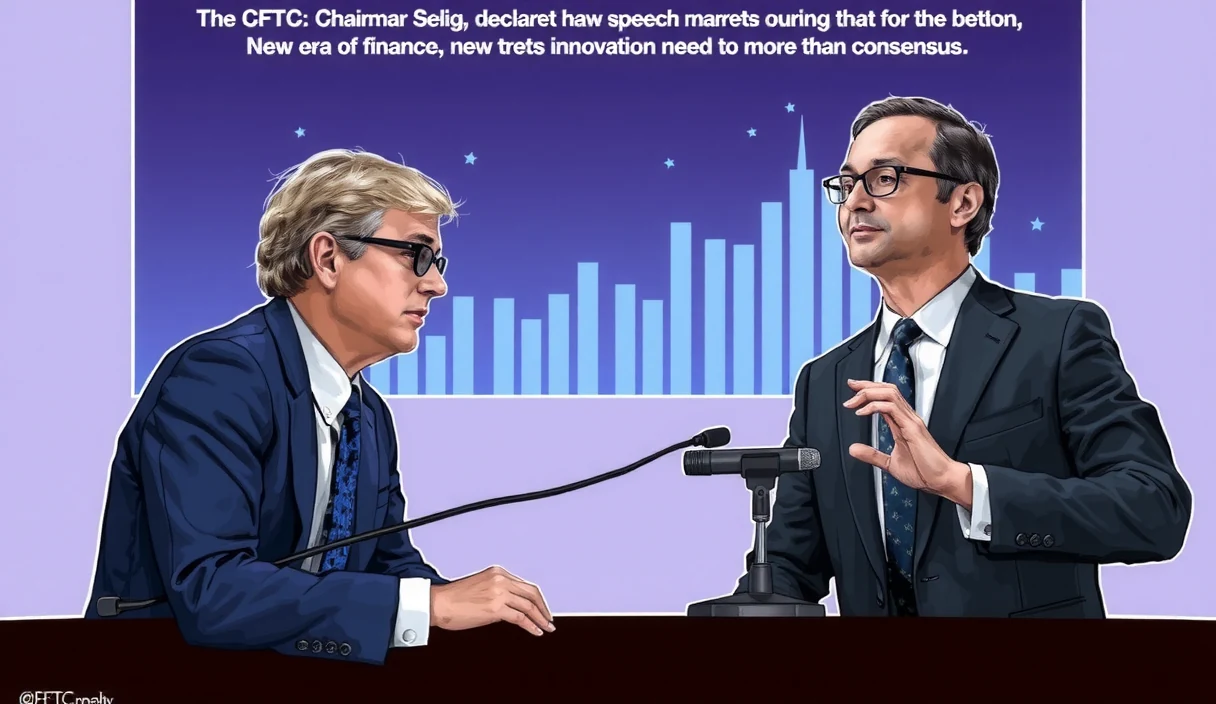
CFTC Chairman Michael S. Selig outlines how crypto market foundations should extend to broader financial system modernization as capital markets enter the digital age.

The speech landed on August 6, 2026, with a title that sounded like standard regulator boilerplate: "Remarks Before the [Conference Name]." But CFTC Chairman Michael S. Selig used the platform to deliver something more consequential than another compliance sermon. He argued that the next phase of financial market development requires regulators to prioritize innovation infrastructure over consensus-building, and that the crypto market experiments of the past five years have produced templates for the broader transition of capital markets into the digital age.
That framing is a departure. Most regulatory speeches treat crypto as an exception — a peripheral market that requires special rules because it does not fit the traditional framework. Selig's argument inverts that assumption. He treats crypto as a preview.
Key Metrics at a Glance
| Metric | Detail |
|---|---|
| Speaker | Michael S. Selig, CFTC Chairman |
| Date | August 6, 2026 |
| Venue | Industry conference keynote |
| Core Thesis | Innovation infrastructure precedes regulatory consensus |
| Policy Signal | CFTC will build on crypto market foundations for broader financial system modernization |
| Jurisdictional Scope | Derivatives markets, digital assets, commodity-based products |
| Bitcoin Relevance | Bitcoin derivatives provide template for standardized digital asset market infrastructure |

What the Speech Actually Says
Selig's remarks rest on three pillars: the recognition that crypto markets have tested regulatory frameworks at scale, the observation that traditional financial infrastructure is ill-suited for tokenized assets, and the argument that the CFTC should extend its crypto-market experience to the broader derivatives ecosystem.
The first pillar is empirical. Selig notes that the CFTC has overseen Bitcoin futures since 2017, Bitcoin options since 2021, and a growing suite of ether and crypto-index derivatives. That oversight has produced data on settlement mechanisms, custody arrangements, market surveillance, and risk management that did not exist when traditional commodity derivatives were first regulated. The market has, in effect, been a live laboratory.
The second pillar is structural. Traditional derivatives markets rely on centralized clearing, broker-dealer intermediation, and batch settlement. Crypto-native markets have experimented with automated market makers, atomic settlement, and non-custodial derivatives. Selig argues that some of those innovations — particularly around settlement finality and collateral mobility — should be adapted for traditional markets rather than suppressed.
The third pillar is jurisdictional. The CFTC regulates derivatives, not spot markets. Selig is careful to note that the commission does not regulate Bitcoin spot trading, stablecoin issuance, or decentralized finance protocols directly. But the derivatives layer sits above all of those markets, and the CFTC's authority over Bitcoin futures, options, and swaps gives it leverage over the infrastructure that connects traditional finance to digital assets.
The Bitcoin Dimension
Bitcoin is the clearest beneficiary of Selig's framework, not because the speech mentions Bitcoin specifically — it does, but alongside ether and other digital assets — but because Bitcoin's derivatives market is the most mature. CME Bitcoin futures have been trading for nearly a decade. CFTC-regulated Bitcoin options have multiple years of operational history. The infrastructure that Selig describes as a template for broader market modernization already exists for Bitcoin.
The speech also touches on a point that Bitcoin advocates have long argued: that Bitcoin's status as a commodity, confirmed by the CFTC and reinforced by court rulings, makes it the regulatory pathfinder for other digital assets. If the CFTC can build a robust derivatives framework around Bitcoin, it can extend that framework to other commodities. If it cannot, the entire digital asset class remains in jurisdictional limbo.
Selig does not address the SEC's ongoing classification debates directly, but the implication is clear. The CFTC has a functioning market infrastructure for Bitcoin derivatives. The SEC is still litigating whether certain digital assets are securities. That gap creates a Bitcoin-specific advantage: the commodity classification is settled, the derivatives infrastructure exists, and the regulator is actively building on it.

Market Structure Implications
For market participants, the speech signals three practical developments. First, the CFTC is likely to expand its registered derivatives platforms to accommodate more digital asset products. That could include additional crypto-index futures, cross-chain products, and derivatives tied to Bitcoin mining economics.
Second, the CFTC's emphasis on innovation infrastructure suggests a lighter touch on certain technological experiments. Selig explicitly mentions that the commission has learned from its no-action letters and regulatory sandbox programs, and that those programs will continue. For developers and exchanges, that creates a pathway to test new products under CFTC supervision without immediate full registration.
Third, the speech reinforces the CFTC's position as the primary federal regulator for crypto derivatives, which creates jurisdictional tension with the SEC. If the CFTC is building a comprehensive digital asset derivatives framework, the SEC's parallel efforts to regulate spot markets and potentially classify digital assets as securities create overlapping and potentially conflicting requirements.
What Remains Unresolved
Selig's vision leaves several questions unanswered. The speech does not propose specific rule changes, new registration categories, or legislative requests. It is a framing document, not an action plan. The actual implementation will require commission votes, staff rulemakings, and coordination with other agencies.
The speech also does not address the enforcement posture. The CFTC has brought significant fraud cases in crypto markets, and the chairman's emphasis on innovation does not signal a retreat from enforcement. The question is whether the commission can simultaneously encourage infrastructure development and police bad actors without creating a chilling effect.
Finally, the speech does not resolve the broader question of how the CFTC's derivatives-focused framework interacts with spot market regulation. Bitcoin futures prices are anchored to spot markets that the CFTC does not regulate. If those spot markets experience manipulation or failure, the derivatives layer built on top becomes unstable regardless of how sophisticated the infrastructure.
TL;DR
- What: CFTC Chairman Selig delivered a major speech arguing that crypto market innovation should serve as a template for broader financial system modernization
- Why: The CFTC has nearly a decade of Bitcoin derivatives oversight experience that provides a foundation for digital-age market infrastructure
- Impact: Signals expanded CFTC digital asset product approvals, continued regulatory sandbox programs, and reinforces CFTC jurisdiction over crypto derivatives
- Bitcoin Connection: Bitcoin's commodity classification and mature derivatives market make it the primary beneficiary of CFTC infrastructure expansion
- Watch: Commission votes on specific rule changes, jurisdictional friction with SEC, and whether innovation rhetoric translates into actual product approvals
Sources
- CFTC Chairman Selig Remarks
- CFTC Division of Market Oversight
- CME Bitcoin Futures
- SEC Digital Asset Policy
Filip Peshko is Senior Opinion Columnist & Blockchain Technology Analyst at TotesTek. He writes about Bitcoin, blockchain technology, crypto markets, Web3 infrastructure, digital asset custody, institutional adoption, and legislation affecting the crypto industry.
Related Posts
-

DOJ Strike Force Hits $938 Million in Seized Scam Crypto After $52 Million Xinbi Guarantee Takedown
The Department of Justice announced this week that its Scam Center Strike Force restrained approximately $52 million in cryptocurrency in a single day of coordinated action against the Xinbi Guarantee marketplace, a Chinese-language Telegram-based platform that functioned as an i
-

The U.S. and UK Just Formed an Unprecedented Alliance Against Crypto Scam Centers
International law enforcement cooperation has always moved slowly. Extradition treaties take years to negotiate. Evidence sharing across borders requires diplomatic channels that bureaucracies tend to clog. And when the criminals operate from fortified compounds in Southeast Asia
-

DOJ Seizes Fake Crypto Domain From Burma Scam Compound: A Small Victory in a Larger War
The email arrived last Thursday from a reader in San Diego who had lost $340,000 to what she thought was a cryptocurrency investment platform. She had been contacted through a dating app, moved to WhatsApp, and gradually convinced to deposit funds into a trading website that show
-

Chairman of Prince Group Indicted for Operating Cambodian Forced Labor Scam Compounds Engaged in Cryptocurrency Fraud
The Justice Department unsealed an indictment on September 10, 2026, charging the chairman of Prince Group with operating Cambodian forced labor scam compounds where individuals held against their will engaged in cryptocurrency investment fraud schemes. The indictment exposes the