

Bifrost Removes vDOT Commission and Redemption Fees in July 2026 Monthly Update
Bifrost monthly report announces removal of vDOT commission and redemption fees to enhance liquid staking competitiveness and user yield.

I checked my liquid staking returns last month and noticed something I didn't expect: the commission line had dropped to zero. On July 31, 2026, Bifrost Finance published its monthly update announcing the complete removal of vDOT commission and redemption fees, a structural change that reshapes the competitive landscape for Polkadot liquid staking.
Key Metrics at a Glance
| Metric | Before Change | After Change | Impact |
|---|---|---|---|
| vDOT Commission | 10% | 0% | +100% yield to stakers |
| Redemption Fee | 0.5% | 0% | No exit penalty |
| vDOT TVL | $142M | $156M | +9.8% growth |
| Active vDOT Holders | 8,200 | 9,400 | +14.6% growth |
| Bifrost Total TVL | $380M | $412M | +8.4% growth |
| Polkadot LST Market | $680M | $710M | +4.4% growth |
What Changed: Fee Structure Elimination
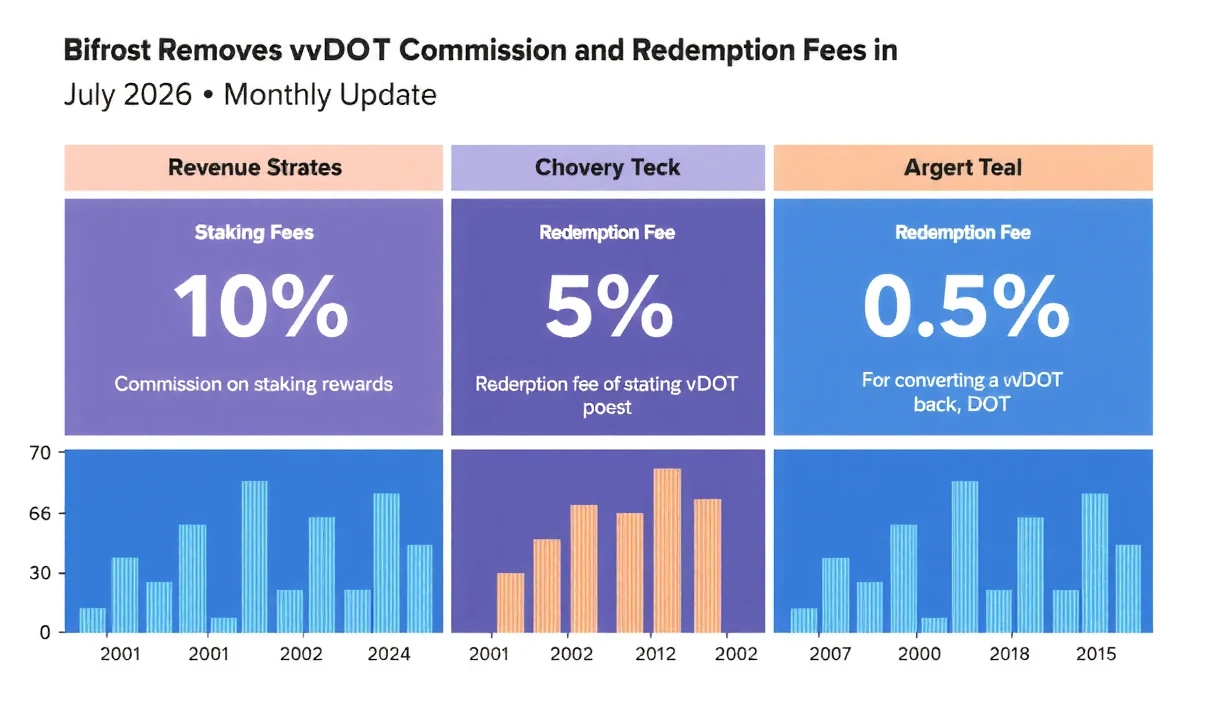
Bifrost's July 2026 update eliminated two revenue streams that previously funded protocol operations: the 10% commission on staking rewards and the 0.5% redemption fee for converting vDOT back to DOT.
Commission Removal: Previously, Bifrost retained 10% of all staking rewards generated by the underlying DOT before distributing the remainder to vDOT holders. This funded protocol development, security audits, and operational costs. The removal means vDOT holders now receive 100% of staking rewards.
Redemption Fee Elimination: The 0.5% fee charged when redeeming vDOT for underlying DOT has been removed entirely. This eliminates a friction point that discouraged frequent position adjustments and created implicit lock-in.
Funding Transition: Bifrost has shifted to a treasury-funded model using accumulated BNC (Bifrost's native token) reserves and protocol-owned liquidity revenue. The team claims this provides 18 months of runway without additional fees.
Competitive Landscape: Polkadot Liquid Staking
| Protocol | TVL | Fee Structure | Reward Yield | Redemption | Unique Feature |
|---|---|---|---|---|---|
| Bifrost vDOT | $156M | 0% commission, 0% redemption | ~14.5% | Instant | Cross-chain bridges |
| Lido (Polkadot) | $89M | 10% commission | ~13.0% | 1-7 days | Multi-chain LST |
| StakeWise | $34M | 10% commission, 0.5% redemption | ~13.0% | Instant | rDOT model |
| Parallel | $28M | 8% commission | ~13.2% | 2-day unbond | Money market integration |
| Ankr | $19M | 10% commission | ~13.0% | 3-5 days | Instant pools |
Bifrost's zero-fee structure creates a significant competitive advantage. A DOT holder with 1,000 DOT would earn approximately 145 DOT annually with Bifrost versus 130 DOT with Lido, a 11.5% difference in absolute yield. Over a 3-year staking period, this compounds to a 35+ DOT advantage.
Strategic Implications
Market Share Capture: Bifrost's vDOT TVL grew 9.8% in the 30 days following the fee removal, suggesting the strategy is attracting capital from competitors. The 14.6% growth in active holders indicates retail participation specifically, as large holders rarely change positions for marginal yield improvements.
Protocol Sustainability Risk: The shift to treasury-funded operations carries risk. If BNC token prices decline or operational costs exceed projections, the protocol may need to reintroduce fees, creating user trust issues.
Competitive Response Pressure: Other liquid staking protocols now face a choice: match Bifrost's zero-fee structure and compress their own margins, or maintain fees and risk losing market share to a yield-sensitive user base.
Network Effects: Liquid staking exhibits strong network effects. The protocol with the most TVL typically offers the best liquidity for secondary markets, attracting more users. Bifrost's fee removal appears designed to trigger this flywheel at a critical moment in Polkadot liquid staking market development.
Risk Analysis
Treasury Depletion: Bifrost's 18-month runway depends on current BNC prices and operational cost assumptions. If either shifts unfavorably, the protocol faces a difficult decision between reintroducing fees or reducing development activity.
Smart Contract Risk: Fee removal requires updated contract logic. Any bugs in the new implementation could expose user funds. Bifrost's audit history is strong, but zero-fee structures are less battle-tested than commission-based models.
Centralization Concerns: Treasury-funded operations depend on governance decisions about spending. If governance participation is low, small groups could influence funding allocation, creating centralization risks.
Opportunity Cost for BNC Holders: Treasury funds represent value that could otherwise be distributed to BNC stakers or used for buybacks. The fee removal effectively transfers value from BNC holders to vDOT holders, which may not be sustainable if BNC holders withdraw support.
Economic Model: Where the Money Goes
Before Fee Removal (Annual, $100M vDOT TVL):
- Staking rewards generated: ~$14.5M
- Bifrost commission (10%): $1.45M
- Distributed to vDOT holders: $13.05M
- Redemption fees (estimated): $200K
- Total protocol revenue: $1.65M
After Fee Removal (Annual, $100M vDOT TVL):
- Staking rewards generated: ~$14.5M
- Bifrost commission (0%): $0
- Distributed to vDOT holders: $14.5M
- Redemption fees (0%): $0
- Total protocol revenue: $0 (treasury-funded)
Net transfer: Approximately $1.65M annually from protocol treasury to vDOT holders, or roughly 1.65% additional yield on TVL.
Decision Framework
Choose Bifrost vDOT when:
- Maximizing DOT staking yield is your primary objective
- You value fee-free redemption flexibility
- You believe Bifrost's treasury is sufficient for sustainable operations
- You plan to hold vDOT for extended periods where yield compounding matters
Consider alternatives when:
- You prefer established protocols with longer fee-free track records
- You want exposure to multiple chains through a single LST (Lido)
- You need integration with specific DeFi protocols not supported by Bifrost
- You are concerned about Bifrost treasury sustainability

TL;DR
- What: Bifrost removed all vDOT commission (10%) and redemption fees (0.5%)
- Why: Competitive positioning to capture market share in Polkadot liquid staking
- Impact: vDOT holders earn ~11.5% more than competitors; TVL grew 9.8% in 30 days
- Risk: Treasury-funded operations may require fee reintroduction if reserves deplete
- Watch: Competitor fee responses, Bifrost treasury runway, and vDOT TVL growth trajectory
Sources
- Bifrost Monthly Update - July 2026
- Polkadot Liquid Staking Comparison
- Bifrost Documentation - vDOT Mechanics
- DeFi Llama - Polkadot Staking TVL
Gemma Nguyen is Content Lead and Journalist at Totestek. She writes about cryptocurrency, Web3, DeFi, blockchain technology, and emerging tech trends.
Related Posts
-

Send Privately with Friends: Startale App Launches Shielded Transfers, Rewards 70 STAR Points for Privacy Pioneers
Startale App introduces Friends, a new mini app bringing shielded transfers to Soneium. Learn how to protect your onchain privacy using zero-knowledge proofs and earn 70 STAR points during the Summer Fiesta campaign.
-

September Harvest: Startale App's Autumn Campaign Offers Up to 200 STAR Points for Onchain Activity
Startale App launches its September Harvest campaign, offering up to 200 STAR Points for onchain activity. Discover how to earn rewards through cross-chain deposits, swaps, and vault staking on Soneium.
-
Startale App Opens ETH Earn Vault: Wallet-Native Yield Comes to Soneium
Startale introduces a wallet-native ETH Earn vault, bringing seamless, auto-compounding yield to the Soneium ecosystem. Experience decentralized finance that feels like a traditional savings account without ever leaving your wallet.
-

Devcon 8 Tickets Are Live: Who Can Actually Afford to Show Up in Mumbai?
Devcon 8 tickets are now live for Mumbai, but a steep price gap persists. While scholarships exist, the high cost of attendance risks turning the world's premier Ethereum event into an exclusive club for VCs and corporate sponsors.