

Hyperbridge's Economic Engine: How $BRIDGE Rewards Secure Cross-Chain Messaging
Hyperbridge, a Polkadot parachain for cross-chain messaging, detailed its dual-incentive system: consensus relayers earn $BRIDGE tokens for submitting verifiable consensus proofs, while messaging relayers earn stablecoin fees plus a quadratic decay incentive for liveness. The system includes a meritocratic path from relayer to collator (200,000 $BRIDGE bond) and creates a buy-back flywheel where relayer stablecoin earnings generate organic $BRIDGE demand. Governance-adjustable rewards span 10 chains with Ethereum receiving the highest allocation at 25%.

I spent last Tuesday trying to explain to a friend why cross-chain bridges keep getting hacked. His response: "So it's just a really expensive game of telephone?" Not exactly. But his intuition about incentives was closer than he knew.
Cross-chain interoperability is only as strong as the economic incentives keeping it alive. Hyperbridge, a Polkadot parachain specializing in cross-chain messaging, has published a detailed breakdown of its dual-incentive system. The mechanism is elegant: pay operators for security, pay them for speed, and create a natural career path from relayer to collator. Here is how it works.
Key Metrics at a Glance
| Metric | Value |
|---|---|
| Protocol | Hyperbridge (Polkadot parachain) |
| Native Token | $BRIDGE |
| Relayer Types | Consensus + Messaging (permissionless) |
| Collator Bond | 200,000 $BRIDGE |
| Daily Consensus Rewards | 10,000 $BRIDGE (estimated) |
| Top Chain Allocation (ETH) | 25% (2,500 $BRIDGE/day) |
| Messaging Incentive Rate | $0.03 per byte |
| Daily Messaging Budget | ~6.51KB target (then flips to fees) |
| Supported Chains | 10 (ETH, BNB, BASE, ARB, POLYGON, UNI, OP, Gnosis, Soneium, +more) |
| Fee Asset (Messaging) | Stablecoins (e.g., DAI) |
| Last Updated | September 24, 2025 |
The Two Pillars of the Relayer Economy
Hyperbridge operates a permissionless relayer network. Anyone can participate without staking or whitelisting. This design choice maximizes decentralization but creates an economic challenge: why would anyone run the infrastructure?
The answer is a two-pillar incentive system. Each pillar serves a distinct function with its own reward mechanism.
Consensus Relayers monitor connected blockchains and submit verifiable consensus proofs. They are the bedrock of network security, ensuring Hyperbridge always has an accurate, cryptographically secure view of each external chain's state.
Messaging Relayers act as couriers, delivering specific user-initiated requests and responses between chains. They handle the actual cross-chain communication that users and applications depend on.
Consensus Incentives: Rewarding Proof-of-Liveness
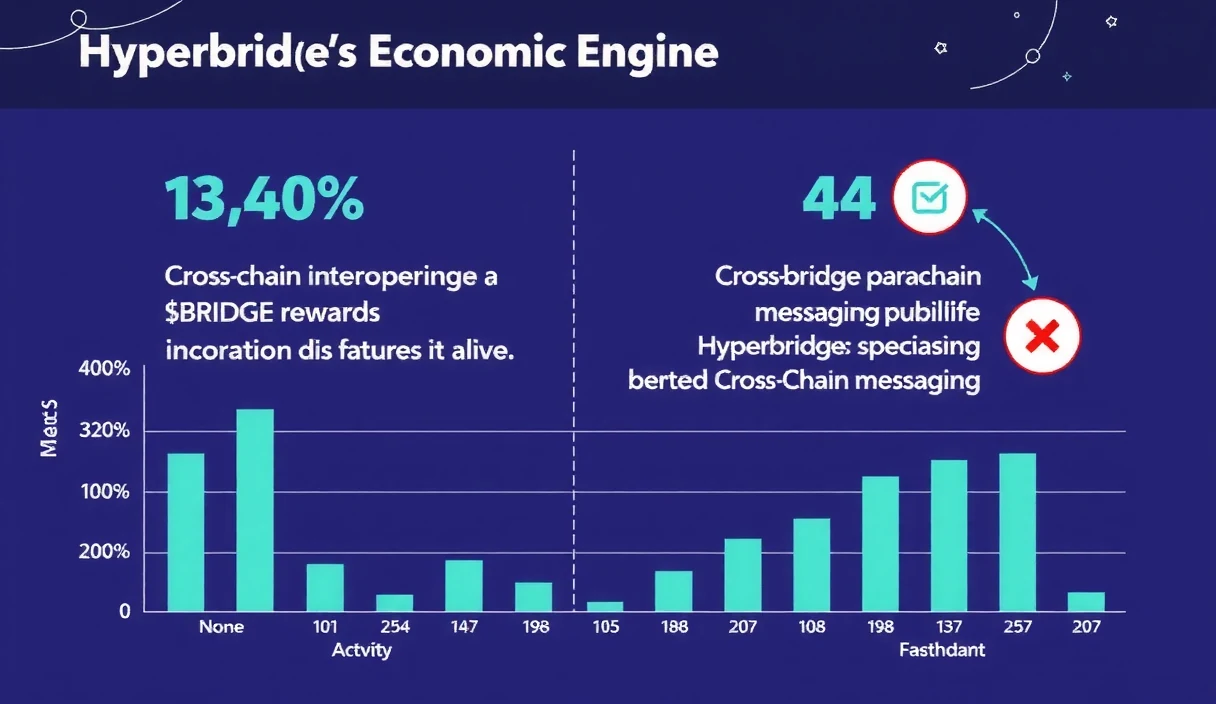
Consensus relayers earn $BRIDGE tokens directly from the protocol treasury. The mechanism rewards the first relayer to submit a valid consensus update for each new finalized block.
The process works in three steps:
- Monitor: The relayer watches a connected chain (e.g., Ethereum, which produces blocks every 12 seconds).
- Wait for Finality: Ethereum blocks take up to 20 minutes to finalize. The relayer must wait.
- Submit and Earn: Once finalized, the relayer submits a consensus proof. The Hyperbridge runtime verifies it, emits a
StateMachineUpdatedevent, and automatically issues $BRIDGE tokens to the relayer's wallet.
The reward formula is straightforward:
Total Reward = (Latest Finalized Height - Previous Finalized Height) × Reward Per Block
This creates a competitive environment. The first relayer to submit valid proof earns the reward, encouraging efficiency and low latency. Miss the window, and someone else collects.
Chain-by-Chain Reward Distribution
Hyperbridge allocates daily consensus rewards across supported chains based on strategic importance and network activity:
| Chain | Daily Allocation | Block Time | Blocks/Day | Reward/Block ($BRIDGE) |
|---|---|---|---|---|
| Ethereum (ETH) | 25% (2,500) | 12 sec | 7,200 | ~0.347 |
| BNB | 10% (1,000) | 1 sec | 84,600 | ~0.012 |
| BASE | 10% (1,000) | 2 sec | 43,200 | ~0.024 |
| Arbitrum (ARB) | 10% (1,000) | 0.25 sec | 345,600 | ~0.003 |
| Polygon (POLY) | 10% (1,000) | 2 sec | 42,300 | ~0.024 |
| Unichain (UNI) | 10% (1,000) | 1 sec | 84,600 | ~0.012 |
| Optimism (OP) | 8.33% (~833) | 2 sec | 43,200 | ~0.019 |
| Gnosis | 8.33% (~833) | 5 sec | 17,280 | ~0.048 |
| Soneium | 8.33% (~833) | 2 sec | 43,200 | ~0.019 |
These percentages are governance-adjustable. The community can adapt allocations through on-chain proposals, adding support for new chains or rebalancing based on market conditions.
Messaging Incentives: The Quadratic Decay Model
Messaging relayers operate differently. They are paid by end-users in stablecoins (like DAI), not by the protocol. But Hyperbridge adds a liveness incentive on top: a per-byte reward that decays quadratically as the daily target is approached.
The formula:
Base Reward = Per Byte Fee × Message Size
Final Reward = Base Reward × Decay Factor
Decay Factor = ((Target Size - Bytes Processed) / Target Size)²
Example with a 128-byte message at $0.03/byte:
- Base Reward: 128 × $0.03 = $3.84 = 76.8 $BRIDGE (at $0.05/BRIDGE)
- At start (0% processed): Decay = 1.0² = 1.0 → 76.8 $BRIDGE
- At midpoint (50% processed): Decay = 0.5² = 0.25 → 19.2 $BRIDGE
- Near end (90% processed): Decay = 0.1² = 0.01 → ~0.77 $BRIDGE
The daily budget distributes fully after approximately 6.51KB of message data. Beyond that target, the incentive flips: relayers must pay a message aggregation fee to the treasury for each message they deliver. This dual-mode system ensures economic sustainability and protects against spam.
The Buy-Back Flywheel
Here is where the tokenomics get interesting. Hyperbridge creates a closed economic loop that generates constant buying pressure for $BRIDGE:
- Users pay relayers in stablecoins for message delivery.
- Relayers earn stablecoins when they successfully deliver messages.
- Relayers must spend $BRIDGE to submit transactions and interact with the network.
- This spending creates buy-back pressure on $BRIDGE, aligning relayer interests with token value.
Relayers effectively become automated buy-back agents. The more they earn in stablecoins, the more $BRIDGE they must acquire to continue operating. This transforms protocol revenue into organic token demand.
From Relayer to Collator: The Career Path
The incentive system includes a progression mechanism. The most reliable, economically active relayers can become collators—the block producers for the Hyperbridge chain.
The transition requires:
- Accrue Reputation: Active, reliable participation as a consensus and/or messaging relayer builds on-chain history.
- Bond 200,000 $BRIDGE: This economic stake aligns the operator's incentives with network health. The bonded account must be the same one that earned the relayer reputation.
- Register as Candidate: Using the established relayer account, register with account keys (sr25519) and session keys (aura) for block production.
- Join Active Set: The network selects active collators from the candidate pool. Higher reputation increases selection probability.
- Run Collator Node: Produce blocks for the Hyperbridge chain, earning network rewards and transaction fees.
This meritocratic model ensures that those who secure the chain have proven track records. It is a career path, not a lottery.
Competitive Landscape: Cross-Chain Infrastructure
Hyperbridge operates in a crowded interoperability space. Here is how major players compare:
| Protocol | Type | Security Model | Token | Messaging Standard | Chains | Key Differentiator |
|---|---|---|---|---|---|---|
| Hyperbridge | Parachain | Optimistic + ZK proofs | $BRIDGE | ISMP | 10+ | Governance-adjustable incentives, relayer-to-collator path |
| LayerZero | Omnichain | Oracle + Relayer (DVNs) | $ZRO | Omnichain messaging | 50+ | Ultra-light nodes, configurable security |
| Axelar | Cosmos chain | Validator set (PoS) | $AXL | GMP | 50+ | Cosmos ecosystem hub, cross-chain smart contracts |
| Wormhole | Guardian network | 19-of-19 guardian multisig | $W | Generic message passing | 30+ | Solana/Ethereum focus, NFT bridge leader |
| Chainlink CCIP | Oracle network | DON-based validation | $LINK | CCIP | 15+ | Institutional adoption, Chainlink reliability |
| Stargate | Omnichain DEX | LayerZero + STG incentives | $STG | Unified liquidity pools | 15+ | Focus on stablecoin/asset transfers |
| Across | Intent-based bridge | UMA optimistic oracle | $ACX | Intent-based fills | 10+ | Capital efficiency, fast finality |
Hyperbridge differentiates through its Polkadot-native architecture and its explicit economic design. The relayer-to-collator progression creates a sustainable operator pipeline. The dual-mode messaging incentives (subsidized early, fee-based late) balance liveness with sustainability.
Risks and Watch Points
| Risk Factor | Assessment | Mitigation |
|---|---|---|
| Relayer centralization | Medium | Permissionless entry, but hardware requirements may concentrate operators |
| Consensus proof delays | Low-Medium | Multi-chain support, finality-aware rewards |
| Messaging incentive exhaustion | Low | Automatic flip to fee mode after target |
| $BRIDGE price volatility | Medium | Buy-back mechanism, stablecoin-denominated user fees |
| Collator set capture | Low | Reputation-based selection, bond requirements |
| Competition from LayerZero/Axelar | High | Polkadot ecosystem integration, ISMP technical advantages |
The biggest risk is operator concentration. While entry is permissionless, running a reliable relayer requires infrastructure investment. If a small set of operators dominates, decentralization suffers despite the open design.
Decision Framework: Evaluating Hyperbridge
Are you a DeFi user needing cross-chain transfers?
├── YES → Compare fees/times vs. LayerZero, Axelar, Stargate
│   └── Hyperbridge ISMP may offer specific chain advantages
└── NO  → Are you a developer?
    ├── YES → Evaluate ISMP integration for your dApp
    │   └── Check supported chains and messaging costs
    └── NO  → Are you an operator?
        ├── YES → Run a relayer (permissionless)
        │   ├── Consensus relayer: steady $BRIDGE rewards
        │   └── Messaging relayer: stablecoin fees + incentives
        └── NO  → Monitor as infrastructure investment

Interested in $BRIDGE token?
├── YES → Relayer buy-back creates organic demand
│   └── Track network usage for fee/reward dynamics
└── NO  → Watch for collator opportunities
    └── 200k BRIDGE bond, reputation-based selection
What Comes Next
Hyperbridge continues expanding chain support and refining incentive parameters through governance. The messaging incentive model's quadratic decay and automatic fee flip represent a sophisticated approach to sustainable network economics.
For the Polkadot ecosystem, Hyperbridge provides critical cross-chain connectivity. As parachains like Soneium, Astar, and Moonbeam grow, the demand for secure, incentivized messaging increases. Hyperbridge's economic engine is designed to scale with that demand.
For operators, the path is clear: start as a relayer, earn rewards, build reputation, bond tokens, become a collator. It is one of the few crypto infrastructure projects with an explicit, meritocratic career ladder.
TL;DR
- What: Hyperbridge detailed its dual-incentive system for consensus relayers (protocol-paid $BRIDGE) and messaging relayers (user-paid stablecoins + quadratic decay incentives)
- Why: Economic incentives secure network liveness and create a meritocratic path from relayer to collator (200k $BRIDGE bond)
- Impact: 10 chains supported, governance-adjustable rewards, buy-back mechanism creates organic $BRIDGE demand
- Edge: Explicit operator career path and dual-mode messaging incentives (subsidized early, fee-based late) differentiate from competitors
- Watch: Operator decentralization, chain expansion, competition from LayerZero/Axelar, $BRIDGE token dynamics
Sources
- Relayer and Collator Incentives — Hyperbridge Blog
- Hyperbridge Documentation
- ISMP Protocol Specification
- Polkadot Parachain Overview
- Hyperbridge Network Explorer
Gemma Nguyen is TotesTek's Content Lead & Journalist, covering cryptocurrency, Web3, DeFi, blockchain technology, and emerging tech trends.
Related Posts
-

First Returns From the Token Gateway Exploit: Hyperbridge's Recovery Playbook Offers a Template for DeFi Incident Response
Hyperbridge has received the first voluntary return of funds following its Token Gateway exploit. Discover how their unique no-questions-asked recovery playbook is providing a new template for DeFi incident response.
-

Fearless Wallet Browser Extension Leaked Private Keys: What Polkadot Users Must Do Now
A critical security breach in the Fearless Wallet browser extension leaked private keys for over 20 months. Find out if your Polkadot assets are at risk and the immediate steps you must take to secure your funds.
-

SBI, DigiFT, and Startale Prove Yen Stablecoins Can Power Real Capital Markets
SBI Group, DigiFT, and Startale have successfully demonstrated how JPYSC, Japan's first trust-based yen stablecoin, can enable instant settlement and automated dividends for tokenized securities. This breakthrough could open Japanese equity markets to global institutional investors.
-

Startale App Opens Its Doors: 16 Mini Apps, Zero Waitlist, and the SuperApp Vision Takes Shape
I remember the first time I tried to get into the Startale App. It was invite-only, shrouded in mystique, and I spent weeks refreshing my inbox hoping for that golden email. Last week, that frustration evaporated. The waitlist is gone. Everyone can finally step inside. Startale,