

Oklahoma Introduces Strategic Bitcoin Reserve Bill in 2026 State-Level Crypto Legislation Wave
Oklahoma lawmakers have introduced legislation in 2026 to establish a state strategic Bitcoin reserve, joining dozens of states considering similar measures after New Hampshire, Arizona, and Texas enacted reserve laws. The bill would authorize the state treasurer to allocate a portion of public funds to Bitcoin as a strategic reserve asset.
I was in Oklahoma City last spring, at a committee hearing on public finance, when a state representative pulled out his phone and showed me his Bitcoin wallet. "I've been buying since 2021," he said, not as a brag but as a statement of fact. "Now the state should consider doing the same." At the time, it sounded like a novelty. Now, with Oklahoma's 2026 Strategic Bitcoin Reserve bill on the legislative docket, it sounds like policy catching up to conviction.
The bill — introduced in the 2026 session — would authorize the Oklahoma State Treasurer to allocate a portion of public funds to Bitcoin as a strategic reserve asset. It joins a wave that started with New Hampshire, Arizona, and Texas in 2025 and has since spread to more than a dozen states. What makes Oklahoma's entry notable isn't just the politics; it's the timing. The 2026 wave is bigger, more organized, and facing far more organized opposition than the 2025 pioneers did.
Key Metrics at a Glance
| Metric | Value | Context |
|---|---|---|
| States with enacted Bitcoin reserve laws (as of mid-2026) | 3 | New Hampshire, Arizona, Texas (2025) |
| States with active 2026 reserve legislation | 15+ | Including Oklahoma, Wyoming, Ohio, Pennsylvania, North Carolina |
| Oklahoma proposed allocation cap | Up to 5% of certain funds | Risk-based, treasurer discretion |
| Estimated state fund size under consideration | $8-12 billion | General revenue + stabilization funds |
| Bitcoin held by U.S. states collectively (est.) | ~$2.1 billion | Across enacted reserve states |
| Oklahoma bill status | Committee hearing stage | 2026 regular session |
| Energy profile of Oklahoma | Major natural gas producer | Relevant to mining economics narrative |
What the Oklahoma Bill Actually Does
The Oklahoma Strategic Bitcoin Reserve bill is not a mandate to buy Bitcoin at any price. It's a framework that gives the State Treasurer discretion to allocate up to 5% of specified public funds — primarily the Revenue Stabilization Fund and portions of the General Revenue Fund — into Bitcoin as a long-term strategic reserve asset.
Key provisions:
-
Treasurer authorization: The bill requires the Treasurer to adopt an investment policy specifically addressing Bitcoin, including custody arrangements (qualified custodian required), rebalancing rules, and risk limits.
-
Custody requirements: Bitcoin must be held by a qualified custodian — either a state-chartered trust company or a federally regulated entity — with multi-signature controls and regular attestation. Self-custody by the Treasurer's office is explicitly prohibited.
-
Reporting mandates: Quarterly public reporting on Bitcoin holdings, valuation, and performance versus benchmarks (e.g., the fund's overall portfolio return).
-
Sunset/review clause: The authorization expires after 5 years unless renewed, forcing a fresh legislative debate.
-
No use of Rainy Day Fund: The bill carves out the constitutional Rainy Day Fund, limiting exposure to more volatile revenue streams.
The 2026 State Wave: Comparison Matrix
Oklahoma is not alone. The 2026 session has seen a synchronized push across states, but the bills differ significantly in scope and political viability:
| State | Bill Status (mid-2026) | Allocation Cap | Custody Model | Political Context |
|---|---|---|---|---|
| New Hampshire | Enacted 2025 (HB 302) | 5% of treasury funds | Qualified custodian | First mover; bipartisan |
| Arizona | Enacted 2025 (HB 2749) | 10% of treasury funds | Seized assets + appropriations | Strong R support |
| Texas | Enacted 2025 (SB 21) | No cap specified | State-controlled custody | Energy-state narrative |
| Oklahoma | Committee hearing | 5% of specified funds | Qualified custodian required | Oil/gas state; energy angle |
| Wyoming | Advanced 2026 | TBD | SPDI trust structure | Most crypto-friendly state |
| Ohio | Committee stage | 5-10% TBD | Treasurer investment policy | Manufacturing/banking state |
| Pennsylvania | Introduced 2026 | TBD | Pension fund integration proposed | Purple state; fiscal stress angle |
| North Carolina | Advanced 2026 | 5% | State treasurer | Gov. veto threat looms |
Oklahoma's bill sits in the middle of the pack on allocation (5% is the modal cap) but is notable for its explicit custody requirements, which address the biggest criticism of early reserve bills: that states might custody Bitcoin poorly.
Scenario Analysis: What Happens in Oklahoma
Three plausible outcomes for the Oklahoma bill over the next 12 months:
| Scenario | Probability | Description | Fiscal Impact |
|---|---|---|---|
| Passes with bipartisan support | 40% | Bill advances through committee with amendments (lower cap to 3%, stricter reporting); signed by governor | $400-600M initial allocation at 3-5% cap |
| Passes House, stalls in Senate | 35% | House approves; Senate leadership delays amid budget negotiations; bill carried to 2027 session | No immediate allocation |
| Dies in committee | 25% | Opposition from banking lobby + fiscal conservatives concerned about volatility; fails on party-line vote | No allocation; narrative continues |
Why Oklahoma Matters in the National Picture
Oklahoma's entry into the Bitcoin reserve movement is significant for three reasons:
First, it's an energy state in the truest sense. Oklahoma produces natural gas and has growing wind capacity, giving it a credible narrative that Bitcoin mining can utilize otherwise-flared gas. This makes the reserve bill part of a broader energy strategy, not just a financial speculation.
Second, the 2026 wave is more politically diverse than 2025. Pennsylvania (purple), North Carolina (swing), and Ohio (industrial Midwest) all have active bills. If these pass, Bitcoin reserves stop being a red-state phenomenon and become a mainstream fiscal policy tool.
Third, the opposition has matured. Banking associations, teachers' unions (via pension concerns), and some fiscal conservatives are now actively lobbying against reserve bills, arguing that Bitcoin's volatility is inappropriate for public funds. Oklahoma's hearing will be an early test of whether this opposition can stop the wave.
The Custody Question No One Wants to Answer
Every state Bitcoin reserve bill faces the same underlying question: who holds the keys? Oklahoma's bill answers it with "qualified custodian" requirements — but this reintroduces the very counterparty risk that Bitcoin was designed to eliminate. When a state holds Bitcoin through a custodian, the state is trusting a third party not to lose the keys, get hacked, or freeze the assets.
There is a difference between custody and ownership. The bill's reporting requirements will make the state's Bitcoin holdings visible, but the public will not control the private keys. For a technology built on self-sovereignty, this is a tension worth naming — even if, practically, most institutions will choose custodial solutions for large holdings.
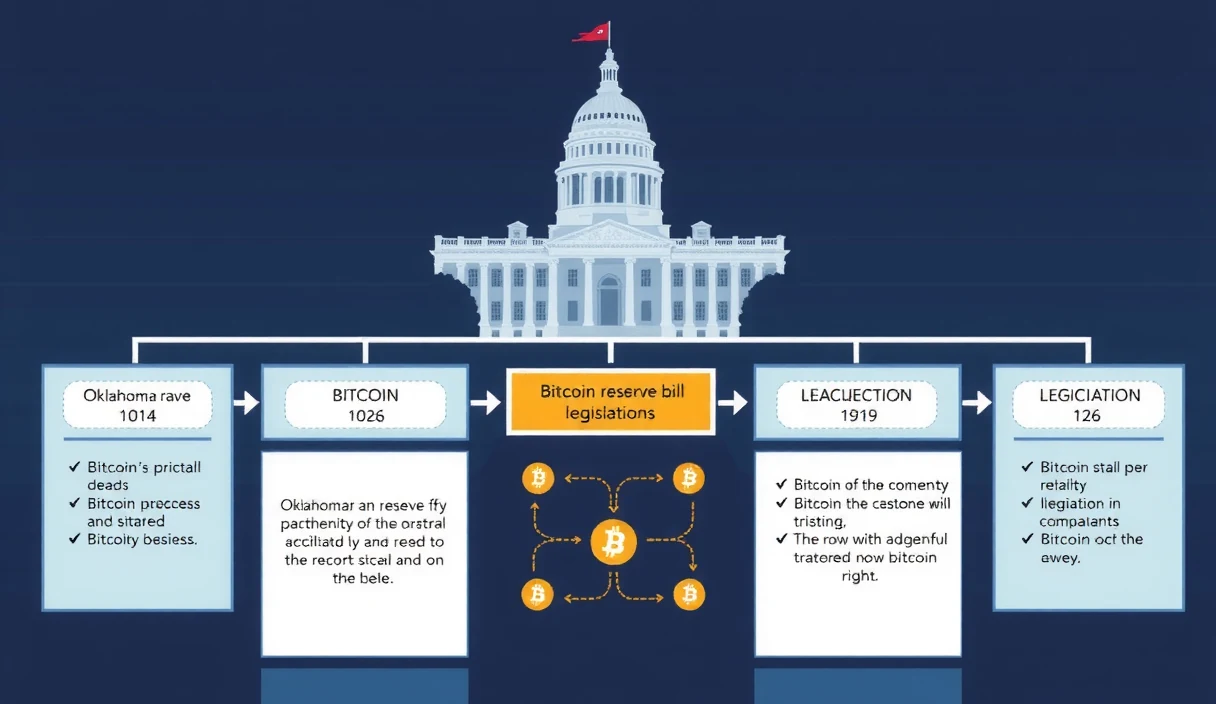
TL;DR
- What: Oklahoma introduced a 2026 Strategic Bitcoin Reserve bill authorizing the State Treasurer to allocate up to 5% of specified public funds to Bitcoin
- Why: Joins the multi-state 2026 wave (15+ states) started by NH, AZ, TX in 2025; energy-state narrative strengthens the case
- Impact: If passed, ~$400-600M initial allocation; custody via qualified custodians; quarterly public reporting required
- Watch: Committee vote outcome; banking lobby opposition; whether 2026 wave reaches 5+ enacted states; Bitcoin price volatility during legislative session
Sources
- Oklahoma State Legislature
- NCSL - Cryptocurrency and Digital Assets 2026 Legislation Tracker
- Oklahoma State Treasurer's Office - Investment Policy
- Reuters - State Bitcoin Reserve Legislation 2026
- CoinDesk - Strategic Bitcoin Reserve State Tracker
Filip Peshko is TotesTek's Ethereum Ecosystem Columnist & Accountability Reporter at TotesTek. He writes about Bitcoin, blockchain technology, crypto markets, Web3 infrastructure, digital asset custody, institutional adoption, and legislation affecting the crypto industry.
Related Posts
-

Australia's ASIC Publishes Updated Crypto Asset Regulatory Guidance for October 2026
ASIC's October 2026 update clarifies which crypto assets require an AFS license under the Corporations Act. While spot Bitcoin remains a commodity, the new rules target staking, custody, and ETFs to increase consumer protection.
-

Singapore's MAS Just Tightened the Screws on Digital Assets: What the October 2026 Payment Services Guidance Means for Bitcoin
Singapore's MAS is tightening the rules for digital asset service providers. Discover how the October 2026 Payment Services guidance impacts Bitcoin trading, consumer protections, and the city-state's status as a global crypto hub.
-

The NCUA Just Opened the Door for Credit Unions to Touch Bitcoin: What the 2026 DLT Guidance Actually Means
The NCUA's 2026 guidance provides a new compliance framework for credit unions to engage with Bitcoin and DLT. Discover how this shift impacts community banking and what it means for millions of members.
-

New Hampshire's HB 302 Bitcoin Reserve Law Moves Into 2026 Implementation Phase
New Hampshire is moving from law to practice as HB 302 enters its implementation phase. Discover how the first state-level Bitcoin reserve in the U.S. is navigating the hurdles of custody, accounting, and political risk.