

In 2026 the ENSIP Catalog Stamps ENSIP-2 Obsolete — and the Live ENSv2 Registrar Is the Reason Why
The ENS docs catalog republished in October 2026 stamps ENSIP-2, the spec behind the 2017 blind sha3-hash Vickrey auction for .eth names, as obsolete. This article uses that catalog entry as the starting point to examine the live 2026 ENSv2 ETH Registrar transition: commit-reveal is retained but fees move from ETH to USDC/DAI stablecoins, the expiry grace shrinks from 90 to 28 days, direct ETHRegistrarController.renew() calls now revert and must route via ETHRenewerV1 or the ENSv2 registrar, post-grace names face a 21-day decaying premium, and token IDs are mutable. A proprietary Registrar Transition Risk Score (about 4.9/10) shows the risk moved from auction design into integrator code.

In October 2026 the ENS documentation republished its complete ENSIP standards catalog, and one line in it says more about Ethereum's naming layer than any marketing deck: ENSIP-2, the spec behind the 2017 blind hash auction that first sold .eth names, is now stamped obsolete.
That stamp is not a footnote. It is the canonical marker of what is dead versus what is live — and what is live in 2026 is ENSv2's new ETH Registrar, which has permanently disabled new registrations through the old controllers: calling ETHRegistrarController.renew() now reverts. Renewals route to ETHRenewerV1 for unmigrated names or the new ENSv2 ETH Registrar for migrated and newly registered ones.
So the 2017 mechanism is dead. Its 2026 successor is on-chain and actively changing what integrators must do. The gap between them is where apps get hurt — a dapp that still assumes "registrar takes ETH and holds it" is building on a fossil.
Key Metrics at a Glance
| Metric | ENSIP-2 (2017, obsolete) | ENSv2 ETH Registrar (2026, live) |
|---|---|---|
| Spec status | Obsolete (ENSIP-2 / EIP-162) in the Oct 2026 catalog | Live; old controllers disabled for new registrations |
| Allocation | Blind sha3-label Vickrey auction, 72h bid / 48h reveal | Commit-reveal (unchanged) |
| Fee payment | ETH locked in per-name Deed contracts | Stablecoins: USDC / DAI (ETH no longer sent with tx) |
| Grace period on expiry | Sunset design: 4y auction stop, 8y fund lockout | 28 days (down from 90 days in ENSv1) |
| Post-grace re-registration | N/A (names migrated away) | Temporary premium from ~$2,000 decaying over 21 days |
| Short-name rule | 7+ chars enforced by 10% bounty (contract only sees hashes) | Pricing tiers instead: 3-char $640/yr, longer names $160/yr |
| Multi-year discount | None | 12.5% (2y), 31.25% (3y), 43.75% (6y) |
| Renewal path after ENSv2 | N/A | ETHRenewerV1 (unmigrated) or ENSv2 ETH Registrar (migrated); direct controller renew() reverts |
| Effect of expiry | Deed ether unreachable after year 8 | Expired names stop resolving immediately |
What the 2017 Machine Was — and Why It Still Matters as Design History
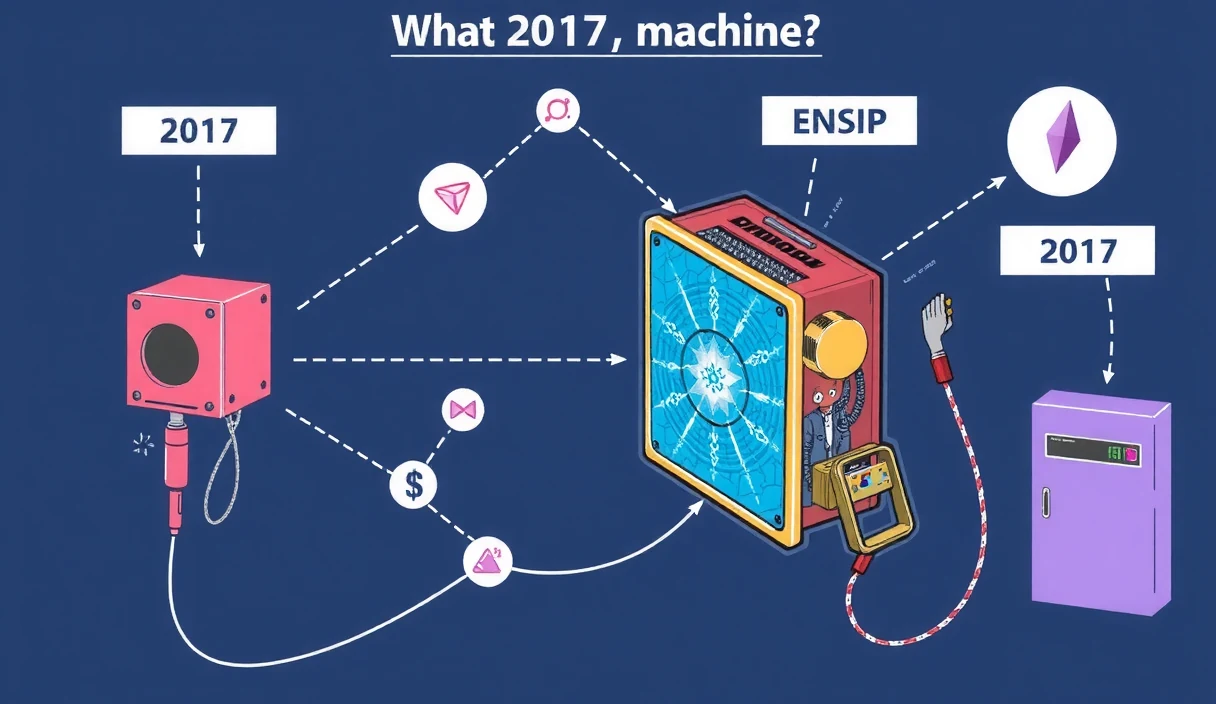
ENSIP-2 (formerly EIP-162) specified a registrar contract deployed to mainnet on 2017-05-04. Its job was to allocate .eth names while resisting two attackers at once: the squatter who grabs obvious names, and the front-runner who watches the mempool and outbids you in the same block.
The answer was to auction the hash of the label, not the label. Bids were sha3(hash, owner, value, salt). Only during reveal did names surface. That blinds the auction to the very thing people care about, which was exactly the point.
The registrar itself held no ETH. Every bid funded a per-name Deed contract, so a bug or compromise of the registrar could not drain an unlimited honeypot balance. The root node sat behind a multisig. And the whole thing was explicitly temporary: auctions stop after four years, deed ether becomes unreachable after eight.
Two 2017 details still deserve a hard look in 2026. The late-reveal deposit burn was not greed — it was an anti-extortion mechanism: without a hard reveal deadline, a losing bidder could threaten to reveal a new second-highest bid and squeeze the winner. And the Vickrey second-price rule — highest bidder wins, pays the second-highest bid — rewarded true-value bidding and punished bid-shading inflation. The 2026 registrar keeps commit-reveal but drops the Vickrey pricing, which is a real trade-off, not a pure upgrade.
What the 2026 Registrar Actually Changed
Every name under the 2017 machine moved through five modes: not-yet-available (gated by the most-significant byte of its sha3, dripping open over 8 weeks), open, auction (72h sealed bids), reveal (48h), and owned. The 2026 machine is simpler on the surface and sharper underneath.
The registrar could not enforce the 7-character minimum itself in 2017, because it only ever saw hashes — so it paid a 10% bounty of the deed value to anyone who reported a registered name of six characters or fewer. Social enforcement bolted onto a blind auction. In 2026 that problem is gone: pricing tiers replace bounties (3-char names $640/year, longer names $160/year).
Where the Risk Moved in the 2026 Transition
| Design choice | ENSIP-2 / ENSv1 (2017) | ENSv2 ETH Registrar (2026) | What changed for users |
|---|---|---|---|
| Who holds bid funds | Per-name Deed contracts | Registrar flow, fees in stablecoin | Less ETH exposure in auction contracts, but now a token-approval step |
| Fee asset | ETH | USDC / DAI | Gas + approval replaces raw ETH value transfer |
| Expiry grace | Permanent registrar: 90 days | 28 days | Much less slack to renew; expired names stop resolving |
| Re-registration after grace | Migration to permanent registrar | 21-day decaying premium (~$2,000 start) | Dutch-auction reopening, but bot-prone |
| Blind bidding | sha3 hash auction | Commit-reveal retained | Front-running still blocked, but no Vickrey pricing |
| Integrator calls | ETHRegistrarController.register/renew |
renew() reverts; route via ETHRenewerV1 or ENSv2 ETH Registrar | Breaking change — libraries and dapps must update renewal code |
| Token IDs | Stable | Mutable over name lifetime | Never cache token IDs; resolve at tx time |
Registrar Transition Risk Score (proprietary framework)
RTRS = (Integration update completeness × 0.30) + (Grace-period handling × 0.25) + (Fee-asset handling × 0.20) + (Token-ID freshness × 0.15) + (Migration path clarity × 0.10)
| Factor | Weight | 2026 reading |
|---|---|---|
| Integration update completeness (renew() rerouting) | 0.30 | Many dapps still call the old controller — direct renew() reverts (0.4) |
| Grace-period handling (90d → 28d) | 0.25 | Users lose the long safety net; expired names stop resolving (0.4) |
| Fee-asset handling (ETH → USDC/DAI approvals) | 0.20 | Adds an approval step and balance check (0.6) |
| Token-ID freshness (mutable IDs in v2) | 0.15 | Cached token IDs break silently (0.5) |
| Migration path clarity (ETHRenewerV1 vs v2 registrar) | 0.10 | Docs exist but routing logic is app-specific (0.6) |
ENSv2 registrar transition RTRS ≈ 0.49 (≈4.9/10). The 2026 registrar is better money engineering — stablecoin fees, no ETH honeypot, shorter but explicit grace. The risk did not disappear; it moved into integration code, where renew() now reverts and cached token IDs lie to you.

Decision Framework
Your app writes to ENS and you are migrating to ENSv2-era .eth (2026):
├── Renewing a .eth 2LD?
│   ├── Unmigrated ENSv1 name → route through ETHRenewerV1
│   └── Migrated / new name   → route through ENSv2 ETH Registrar
│   └── NEVER call ETHRegistrarController.renew() directly → it reverts
├── Paying registration fees?
│   └── Budget in USDC/DAI + an ERC-20 approval, not raw ETH value
├── Relying on expiry slack?
│   └── ENSv1 gave 90 days grace; ENSv2 gives 28 → renew early; expired names stop resolving
├── Caching token IDs?
│   └── v2 token IDs are mutable → resolve the name to its current token ID at tx time
└── Still modeling the 2017 auction?
    └── Use ENSIP-2 for the design lessons (blind bids, anti-extortion reveal, Deed custody),
        not as a live mechanism → the Oct 2026 catalog marks it obsolete for a reason
What To Watch
| Watch item | Why it matters |
|---|---|
Apps that still call ETHRegistrarController.renew() |
Direct call reverts after ENSv2 — broken renewals for users |
| 28-day grace vs old 90-day habits | Expired v2 names stop resolving; no long tail |
| 21-day decaying premium reopening | From ~$2,000, bot-sniped in 2017-style fashion on release |
| Mutable token IDs in ENSv2 | Cached IDs produce wrong-name writes |
| Stablecoin fee rails (USDC/DAI approvals) | Adds approval UX and balance checks vs plain ETH |
| ENSIP catalog maintenance | The Oct 2026 republication is the canonical dead-vs-live marker — watch for further deprecations |
TL;DR
- What: The October 2026 ENSIP catalog republish stamps ENSIP-2 (the 2017 Initial Hash Registrar) obsolete, while ENSv2's new ETH Registrar now handles live .eth registration and renewal in 2026
- Why: The 2017 blind sha3-hash Vickrey auction still holds the core anti-front-running and anti-extortion design lessons; the 2026 successor keeps commit-reveal but moves fees to stablecoins and cuts grace from 90d to 28d
- Edge: RTRS ≈ 4.9/10 —
ETHRegistrarController.renew()now reverts, expired names stop resolving, and v2 token IDs are mutable, so integrators must reroute calls and never cache token IDs - Watch: Broken renew() calls in existing dapps, the 21-day decaying premium, stablecoin approval friction, and any app still modeling 2017 auction assumptions
Sources
- ENSIP-2: Initial Hash Registrar — ENS Docs (status: obsolete)
- EIP-162 — Initial Hash Registrar
- ENSv2 ETH Registrar — pricing, 28-day grace, stablecoin fees
- ENSv2 migration — ETHRenewerV1 routing, renew() reverts
- ENSv2 readiness — write-support breaking changes
- ENSIP-1 — ENS registry specification
- ENS Docs — full LLM text reference
- ENS contracts (ethregistrar)
Zain Tran is TotesTek's Ethereum Ecosystem Columnist & Accountability Reporter at TotesTek.
Related Posts
-

Glamsterdam Just Hit the Brakes on Hoodi Because EIP-8037 and EIP-8038 Could Break Deployed Contracts — and Four Reports Already Proved It
The Ethereum Foundation has delayed the Hoodi hardfork after discovering that EIP-8037 and EIP-8038 could break critical invariants for deployed contracts. With four reports of potential breakages already confirmed, the pause aims to protect immutable funds.
-

Someone Walked Into a Wallet, Signed With the Owner's Key, and Left With $19K in Aave Positions — and the Destination Is a Receive-Only Black Hole
A wallet holding $19K in Aave positions was drained via simple transfer calls, signaling a total private key compromise. Discover why revoking approvals wouldn't have stopped this attack and how to protect your assets.
-

ENSIP-13 SAFE Authentication: Signing From a Hot Wallet Without Handing Over the Vault
Stop risking your cold storage with every signature. ENSIP-13 introduces SAFE Authentication, allowing users to link disposable hot wallets to their main ENS name to decouple signing keys from high-value vaults.
-

Arbitrum Security Council Executes Emergency Action on October 30, 2026
Arbitrum's Security Council acted fast to freeze $30.5 million in assets following a Binance hot-wallet exploit. Discover how a temporary contract rewrite allowed the council to secure the funds and what this means for L2 governance.