

Kusama Futures in the JAM Era: Five Structural Options and One Uncomfortable Math Problem
An SDFI BV discussion draft frames Kusama’s JAM-era problem as validator-cost burden: 700 validators at a $3,000 monthly working assumption imply about $25.2M a year, roughly 45.7% of a reference $55.1M market cap. It compares status quo, DOT/KSM merger, lightweight Kusama JAM, full Kusama JAM, and cohabitation with a DOT endowment, while a Kreivo reply argues market cap is the wrong yardstick and demand-side membership revenue is the unstudied fifth option.

I keep a mental note of governance papers that do the honest thing: show their assumptions, then stress-test them. The SDFI BV discussion draft "Five Structural Futures for KSM DAO," published on the Polkadot forum on August 24, 2026, does exactly that. Its central claim is uncomfortable: Kusama's independent validator set may be too expensive for an economy of Kusama's size, and the JAM upgrade opens a design space where "keep everything" may no longer be the default.
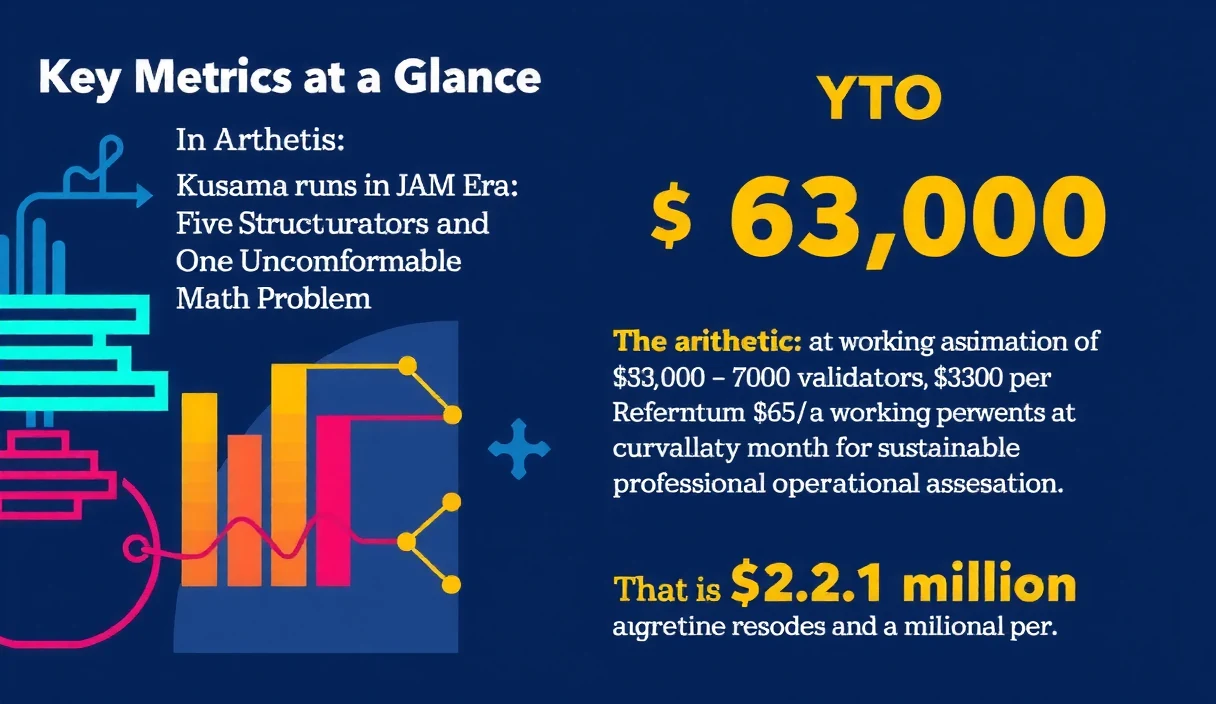
The arithmetic is the hook. Kusama runs 700 validators after Referendum #655. At a working assumption of $3,000 per validator per month for sustainable professional operation, that is $2.1 million per month, or $25.2 million per year. Against a reference KSM market capitalisation of roughly $55.1 million (August 12, 2026), the annual security bill equals about 45.7% of the network's entire market value. Fund that entirely with new KSM at an unchanged price and the monetary base expands approaching 46% per year. The paper is careful to call this a stress test, not a claim about current inflation — but it exposes a structural mismatch.
Key Metrics at a Glance
| Figure | Value (as stated in the draft) | Implication |
|---|---|---|
| Active validators | 700 (post-Referendum #655) | The cost driver OpenGov already cut once |
| Validator cost assumption | $3,000 / validator / month | Working assumption, not a benchmark |
| Annual security cost | $25.2M ($2.1M / month) | The burden being sized |
| Reference KSM market cap | ~$55.1M (Aug 12, 2026) | Annual cost ≈ 45.7% of market value |
| Implied money expansion | ~46% / year if fully inflation-funded | Why "status quo" is a bridge, not a plan |
| Annual KSM issuance (staking) | ~1.34M KSM / year | Counter-reply's baseline for demand-side absorption |
The Five Structural Futures
The paper lays out five scenarios and their trade-offs around sovereignty, security, and economic burden:
- Status quo — continue and progressively downsize the relay-chain Kusama. The draft's verdict: a bridge, not a destination.
- DOT/KSM economy merger or acquisition — consolidate the economies. Verdict: politically implausible, and effectively ends Kusama's existence as a distinct jurisdiction.
- Lightweight and/or low-latency Kusama JAM — an independent KSM-secured JAM with fewer active validators, Slipstream latency, or both. This is the WFC #573 path, which the draft calls the legitimate independent fallback — with caveats.
- Full Kusama JAM — a standard full-scale JAM under the KSM economy and governance. Verdict: least compatible with Kusama's economic scale.
- Kusama/Polkadot cohabitation JAM — two political and economic jurisdictions on one JAM, via recurring burden-sharing or a wholesale security-and-resource endowment. The draft's preliminary conclusion: this now deserves formal technical, economic, and constitutional study.
The framing matters as much as the options. The paper says Kusama's central JAM-era question is not whether to preserve every element of current infrastructure, but which arrangement can sustainably preserve Kusama as a distinct political, economic, and experimental jurisdiction. It explicitly does not request funds, authorize a migration, or supersede WFC #573.
The Counter-Analysis: Market Cap Is the Wrong Yardstick
The strongest reply in the thread (from Birdbrain, an on-chain collective on Kreivo) attacks the methodology head-on. Comparing validator cost to market cap, it argues, masks what is weak about the stronger network: Polkadot's validator bill is only ~1.52% of its market cap, but that cushion "is made of price rather than structure." Polkadot's supply is already voted down 13.14% every two years under WFC #1710, per-operator income is roughly half the $3,000 assumption (~$1,468/month from the direct validator incentive), and a price is not something governance can vote back up. Kusama's problem is a validator count OpenGov controls and has already cut — the fixable problem. The network with the worse ratio has the fix; the one with the better ratio is the network the paper proposes Kusama depend on.

Futures Compared
| Scenario | Economic burden | Sovereignty | Political feasibility | Draft's verdict |
|---|---|---|---|---|
| Status quo / downsize | Still high; shrinking | Full | Easy short-term | A bridge only |
| DOT/KSM merger or acquisition | Solved by consolidation | Ends Kusama as distinct jurisdiction | Implausible | Rejected |
| Lightweight low-latency Kusama JAM (WFC #573) | Cut validator set | Full, independent | Legitimate fallback | Viable with caveats |
| Full-scale Kusama JAM | Highest; mismatched to KSM scale | Full | Technically possible | Least compatible |
| Cohabitation JAM with DOT endowment | Shared / offloaded to DOT staking economy | Shared jurisdiction | Needs DOT DAO parallel approval | Deserves formal study |
| Demand-side revenue model (Kreivo reply) | Funded by membership revenue, not minting | Full | Already partially live on Kusama | The unstudied "fifth option" |
The "Fifth Option" Nobody Studied
Both the paper and its critics circle the same omission. The draft lists five levers: reduce the security system, share it, buy access to someone else's, consolidate economies, or generate sufficient non-inflationary revenue. Its scenarios cover the first four. The fifth — demand-side revenue — is already running on Kusama: Kreivo, a parachain with no token of its own, charges ~0.3 KSM per membership into a keyless treasury (482 KSM today), Kusama mints ~1.34M KSM a year, so ~4.5M memberships a year would absorb all issuance, and one company there (Bloque) has a stated year-end target worth 47% of that. The reply's point: grow the membership economy faster than issuance and supply tightens from the demand side — the outcome deflationists want, without legislating scarcity.
Decision Framework
- If KSM DAO wants maximum independence, the lightweight Kusama JAM (WFC #573) is the legitimate fallback — but price the validator set at realistic per-operator revenue, not network-level market cap.
- If the goal is sustainability without dilution, demand-side revenue (memberships, fees, services paid in KSM) is the lever both papers point to and neither fully models.
- Treat cohabitation/endowment as a serious option only after resource needs, control rights, security guarantees, and migration obligations are defined — and only with parallel DOT DAO approval.
- Reject full-scale Kusama JAM unless KSM's economy grows into it; the 45.7% stress test says it does not fit today.
- Before any referendum, demand hard numbers on validator count, per-operator break-even DOT/KSM price, and treasury runway — not market-cap ratios.
TL;DR
- What: An SDFI BV discussion draft (Aug 24, 2026) lays out five structural futures for Kusama in the JAM era, stress-tested on validator economics: $25.2M/year security cost ≈ 45.7% of a ~$55.1M market cap.
- Why: At ~46%/year implied monetary expansion if inflation-funded, "keep everything" is not sustainable; the choice is which arrangement preserves Kusama as a distinct jurisdiction.
- Verdict: Status quo is a bridge; merger ends Kusama; WFC #573 lightweight JAM is the credible independent fallback; cohabitation with a DOT endowment deserves formal study; full-scale JAM fits least.
- Watch: Whether KSM DAO studies the unstudied fifth option — demand-side revenue absorbing issuance — and whether any scenario gets hard per-operator economics before a vote.
Sources
- Polkadot Forum: Kusama Futures in the JAM Era (SDFI BV discussion draft, topic 18482)
- Polkadot Forum: Wish For Change #573 (lightweight Kusama JAM reference)
- Kusama OpenGov / Referendum #655 (validator set reduction context)
Gemma Nguyen is TotesTek's Content Lead & Journalist, writing about cryptocurrency, Web3, DeFi, and blockchain technology.
Related Posts
-

Lido Declares Its Mission Achieved — and Moves On to All of Onchain Finance
Lido DAO is proposing a massive pivot, declaring its decentralization mission achieved to focus on building the foundations of onchain finance. But does swapping a security mandate for a product mandate create dangerous concentration risks?
-
The Ethereum Foundation Wants to Swap Out the Math Under Everything — and It Is Not Waiting for Perfect
The Ethereum Foundation is planning a massive cryptographic overhaul to protect the network from quantum and AI threats. Described as harder than the Merge, this transition to hash-based signatures will affect every validator, wallet, and L2 operator.
-

Polkadot’s Permanent Burn Account Proposal: Freezing DOT Without Breaking the Issuance Cap
Polkadot is debating a proposal to introduce a permanent, keyless burn account to remove DOT from circulation. This strategic move aims to reduce supply without triggering the network's issuance cap to refill.
-

When AI Silences Users on a Polkadot Governance Forum: Spam Fighting Meets Accountability
When AI tools automatically silence users on a decentralized governance forum, the line between spam fighting and censorship blurs. Explore the tension between efficiency and accountability in Polkadot's latest moderation debate.