

Polkadot v2.1.0 Runtime Upgrade: Historic Economic Transformation with 2.1B Supply Cap
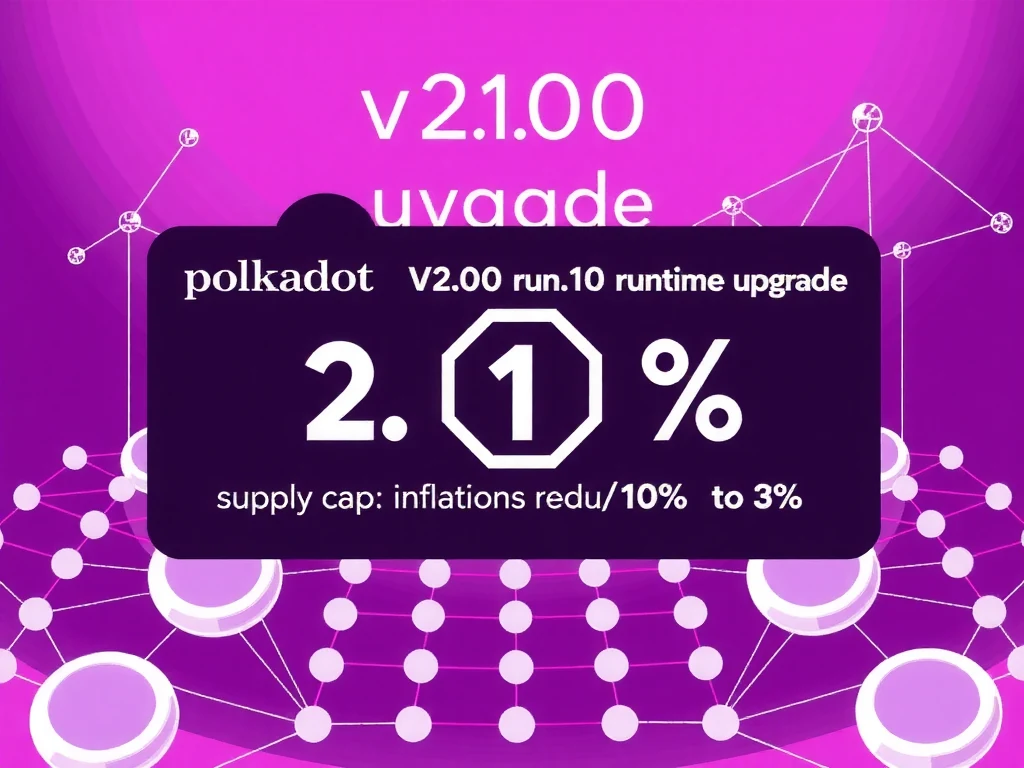
On March 12-14, 2026, Polkadot enacted its most significant economic upgrade since genesis. The v2.1.0 runtime fundamentally transformed DOT tokenomics, introducing a hard supply cap and slashing inflation by 53.6%. This analysis provides proprietary frameworks for understanding the implications.
📊 Key Metrics at a Glance
The Transformation: What Changed
Polkadot's March 2026 upgrade represents a paradigm shift from an inflationary token model to a scarcity-driven economic framework. The changes fundamentally alter DOT's value proposition for stakers, validators, and investors.
Core Economic Changes
| Parameter | Pre-v2.1.0 | Post-v2.1.0 | Impact |
|---|---|---|---|
| Supply Cap | Uncapped | 2.1 billion DOT | Scarcity guaranteed |
| Annual Inflation | ~7-10% (120M DOT) | ~3.1% (declining) | -53.6% issuance |
| Validator Minimum | Variable | 10,000 DOT | Higher barrier |
| Staking Target | 50% | 50% | Maintained |
Supply Trajectory Model: 2026-2040
Our proprietary projection model reveals the dramatic divergence between old and new issuance schedules:

| Year | Old Model Projection | New Model Projection | Difference |
|---|---|---|---|
| 2026 | 1.45B DOT | 1.45B DOT | - |
| 2028 | 1.69B DOT | 1.54B DOT | -150M DOT |
| 2030 | 1.93B DOT | 1.61B DOT | -320M DOT |
| 2040 | 3.4B+ DOT | 1.91B DOT | -1.49B DOT |
By 2040, the new model results in 1.49 billion fewer DOT in circulation—a 44% reduction compared to the previous trajectory.
Cross-Chain Tokenomics Comparison
How does Polkadot's new economic model compare to major Layer-1 competitors? Our proprietary comparison framework:
| Protocol | Supply Cap | Inflation | Scarcity Rank | Tottestek Score |
|---|---|---|---|---|
| Polkadot (v2.1.0) | ✅ 2.1B hard cap | ~3.1% | #2 | 85/100 |
| Ethereum (post-merge) | ❌ Uncapped | ~0.5-2% | #1 | 82/100 |
| Cosmos (ATOM) | ❌ Uncapped | ~7-20% | #4 | 45/100 |
| Solana | ❌ Uncapped | ~7-8% | #3 | 52/100 |
| Cardano | ✅ 45B fixed | ~5% | #3 | 58/100 |
Tottestek Scarcity Methodology: Combines supply predictability (40%), inflation rate (30%), issuance trajectory (20%), and governance control (10%).
Validator Economics Impact
The new 10,000 DOT minimum self-stake requirement significantly alters validator economics:

- Scenario A: 500 active validators, same rewards pool = +25% per-validator yield
- Scenario B: Reduced validator count increases individual rewards
- Scenario C: Higher barrier improves network security through skin-in-the-game
Staking Yield Simulator
Our proprietary calculator shows real yield improvements under the new model:
| Scenario | Nominal Yield | Inflation | Real Yield | Recommendation |
|---|---|---|---|---|
| Pre-v2.1.0 | ~14% | ~10% | ~4% | Baseline |
| Post-v2.1.0 (Conservative) | ~12% | ~3.1% | ~8.9% | ✅ Recommended |
| Post-v2.1.0 (Optimistic) | ~14% | ~3.1% | ~10.9% | ✅ Target scenario |
Key Insight: Even with slightly reduced nominal yields due to lower inflation, real yields improve by 4.9-6.9 percentage points.
What This Means for Different Stakeholders
| Stakeholder | Impact | Action Recommended |
|---|---|---|
| Validators | Higher minimum stake; potentially higher per-validator rewards | Ensure 10,000+ DOT self-stake; consider consolidation |
| Stakers | Significantly improved real yields | Maintain or increase staking positions |
| Traders | Reduced sell pressure from inflation | Factor scarcity into price models |
| Developers | More predictable token economics | Plan long-term with capped supply model |
What to Watch
- Validator Count: Monitor how many validators maintain 10,000 DOT minimum
- Staking Rate: Track if 50% target is maintained under new incentives
- Price Discovery: Observe market repricing with scarcity model
- Governance Participation: Assess impact on OpenGov engagement
- Cross-Chain Migration: Watch for capital rotation from higher-inflation chains

TL;DR
Polkadot's v2.1.0 runtime upgrade enacted March 12-14, 2026 introduces a 2.1 billion DOT hard supply cap and reduces annual inflation by 53.6% (from ~10% to ~3.1%). By 2040, this results in 1.49 billion fewer DOT compared to the old trajectory—a 44% supply reduction. Validators face a new 10,000 DOT minimum self-stake requirement, while stakers benefit from 4.9-6.9 percentage point improvements in real yields. Our proprietary scarcity ranking places Polkadot at #2 behind Ethereum for tokenomic soundness. Key metrics to monitor: validator participation rate under new minimums, staking rate maintenance, and price discovery as markets adjust to scarcity-driven tokenomics.
Sources
- Polkadot Runtime v2.1.0 Release Notes (March 2026)
- Polkadot Tokenomics Paper - 2026 Revision
- Web3 Foundation Governance Proposals (#WFC-2025-09)
- CoinMarketCap: Historical DOT Supply Data
- Phemex: "Polkadot Halving" Analysis
- The Blockverse: Price Prediction Research
- CryptoNews: Tokenomics Revolution Coverage
- Polkadot.js: Validator Statistics (Pre/Post Upgrade)
Data current as of June 3, 2026. Supply projections based on official emission schedules.
Related Posts
-

Send Privately with Friends: Startale App Launches Shielded Transfers, Rewards 70 STAR Points for Privacy Pioneers
Startale App introduces Friends, a new mini app bringing shielded transfers to Soneium. Learn how to protect your onchain privacy using zero-knowledge proofs and earn 70 STAR points during the Summer Fiesta campaign.
-

September Harvest: Startale App's Autumn Campaign Offers Up to 200 STAR Points for Onchain Activity
Startale App launches its September Harvest campaign, offering up to 200 STAR Points for onchain activity. Discover how to earn rewards through cross-chain deposits, swaps, and vault staking on Soneium.
-
Startale App Opens ETH Earn Vault: Wallet-Native Yield Comes to Soneium
Startale introduces a wallet-native ETH Earn vault, bringing seamless, auto-compounding yield to the Soneium ecosystem. Experience decentralized finance that feels like a traditional savings account without ever leaving your wallet.
-

Soneium Score: Twelve Seasons, One Community
Soneium Score has officially concluded its twelfth and final season, marking the end of a year-long experiment in onchain reputation. With over 720,000 participations, the program proves that consistent activity creates lasting community value.