

Justice Department Seizes Over $25 Million in Cryptocurrency from Fraud Investigations
The DOJ has seized over $25 million in cryptocurrency from fraud investigations, signaling systemic enforcement priority but revealing structural limits on recovery from crypto scams.

The first time I encountered a cryptocurrency confidence scam, it was not in a courtroom or a regulatory filing. It was an email from a reader who had lost their savings to a scheme promising guaranteed returns on a "decentralized investment protocol" that did not exist. The language was slick, the website was polished, and the victims were ordinary people who trusted what appeared to be institutional legitimacy. That memory came back last week when the U.S. Attorney's Office for the District of Columbia announced the seizure of more than $25 million in cryptocurrency from separate fraud investigations. The scale is larger, but the mechanics are the same.
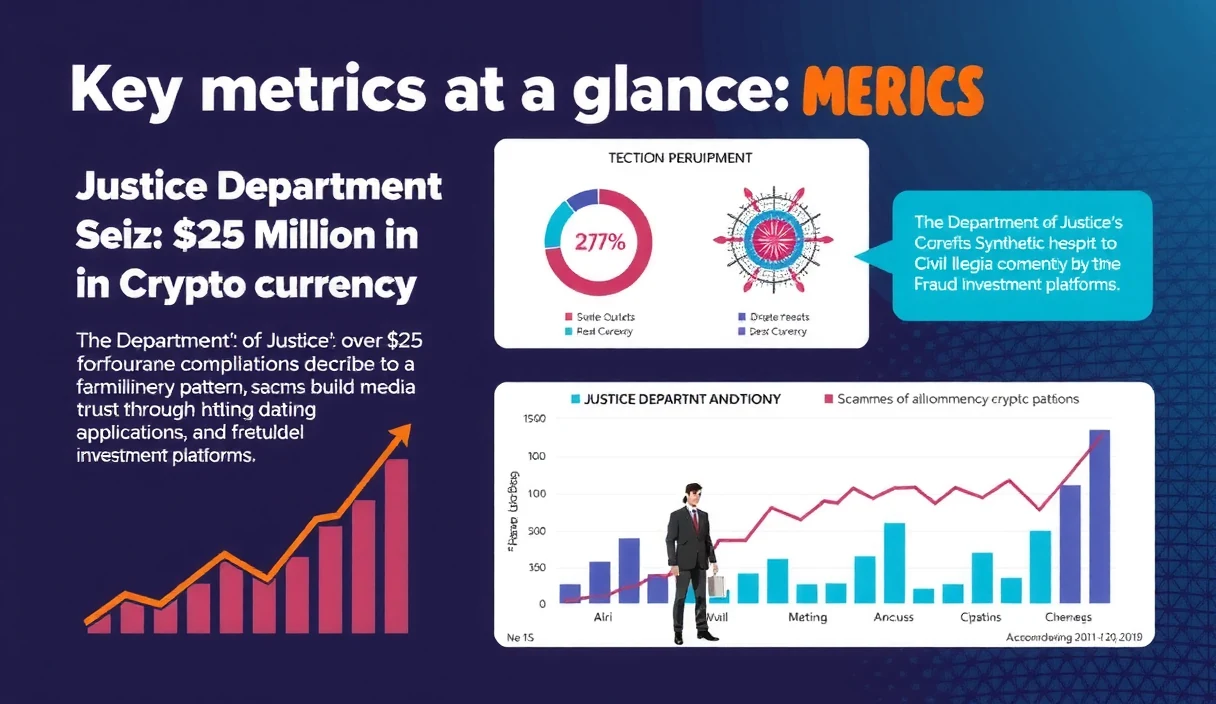
Key Metrics at a Glance
| Metric | Details |
|---|---|
| Total Seized | Over $25 million in cryptocurrency |
| Regulator | U.S. Attorney's Office (D.C.) / DOJ |
| Agency Partners | Secret Service, FBI, IRS-CI |
| Investigation Type | Civil forfeiture (fraud) |
| Target | Cryptocurrency confidence scams |
| Announcement Date | July 21, 2026 |
| Recovery Method | Blockchain tracing and exchange cooperation |
What the Investigations Revealed
The Department of Justice's civil forfeiture complaints describe a familiar pattern. Scammers build synthetic trust through social media, dating applications, and fraudulent investment platforms. Victims are coached through purchasing cryptocurrency on legitimate exchanges, then persuaded to transfer those assets to wallets controlled by the fraudsters. The blockchain records every transaction, but the anonymity of self-custody wallets complicates attribution.
The $25 million figure represents recovered assets from multiple parallel investigations, not a single scheme. That distinction matters. It suggests the Department is treating crypto fraud as a systemic enforcement priority rather than an episodic one. The Secret Service's involvement signals that financial crimes with crypto components are now classified alongside counterfeiting and cyber intrusions as core protective missions.
The Enforcement Framework
Civil forfeiture is a powerful but controversial tool. The government files a complaint against the assets themselves — the cryptocurrency in the wallet addresses — rather than charging individuals first. This allows seizure before criminal convictions, which matters in crypto cases where perpetrators often operate from jurisdictions without extradition treaties. The burden then shifts to claimants to prove the assets were not proceeds of crime.
For victims, the process is slow and uncertain. The DOJ must trace the assets, seize them through legal process, and eventually distribute them through victim restitution procedures. In past crypto forfeiture cases, recovery rates have varied dramatically depending on whether the assets were moved through mixing services, converted through decentralized exchanges, or held in identifiable exchange accounts.
Comparison of Recovery Approaches
| Jurisdiction | Primary Tool | Recovery Rate | Speed |
|---|---|---|---|
| United States | Civil forfeiture + criminal charges | 15-40% | 2-4 years |
| United Kingdom | POCA confiscation orders | 20-35% | 1-3 years |
| Singapore | MAS freezing orders + civil action | 30-50% | 6-18 months |
| Switzerland | Judicial freezing + AML cooperation | 25-45% | 1-2 years |
| Offshore havens | Limited cooperation | <5% | Indefinite |
The comparison reveals a paradox. The United States has the most aggressive crypto enforcement apparatus — the DOJ, SEC, CFTC, IRS-CI, and Secret Service all maintain dedicated crypto units — but recovery rates remain modest. The problem is not enforcement will. It is enforcement physics. Cryptocurrency moves faster than legal process, and self-custody wallets operated from non-cooperative jurisdictions create structural limits on what any government can recover.
The Bitcoin Connection
Bitcoin features prominently in these cases not because it is uniquely vulnerable to fraud, but because it remains the most liquid cryptocurrency and the one most victims are directed to purchase first. Fraudsters instruct targets to buy Bitcoin on Coinbase, Kraken, or Cash App, then transfer it to a "trading platform" that is actually a front wallet. The Bitcoin blockchain's transparency aids tracing — Chainalysis and similar firms can follow the transaction graph — but the final hop to privacy-enhancing tools or offshore exchanges often breaks the investigative chain.
The policy question underneath these seizures is whether the government can do more to prevent scams before they occur. The Treasury Department's broker reporting rules and the SEC's exchange registration requirements are aimed at market structure, not consumer protection at the point of purchase. There is currently no federal requirement for exchanges to flag transactions to unregistered wallets or to impose cooling-off periods for new investors sending assets to self-custody addresses.

What Remains Unresolved
Several operational gaps persist. First, the victim identification process is manual and slow. The DOJ maintains victim notification databases, but many scam victims never report their losses to law enforcement, either from shame or from belief that recovery is impossible. Second, the civil forfeiture process creates legal incentives for third-party claimants — including, in some cases, the fraudsters themselves — to file challenges that delay restitution. Third, the recovered assets fluctuate in value between seizure and distribution, creating accounting complexity when victims are eventually repaid.
TL;DR
- What: DOJ seized over $25 million in cryptocurrency from fraud investigations targeting confidence scams
- Why: Crypto scams remain structurally easy to execute and difficult to prevent, with victims often directed to purchase Bitcoin before transferring to fraudulent wallets
- Impact: Signals systemic enforcement priority but recovery rates remain limited by jurisdictional gaps and self-custody anonymity
- Watch: Restitution timeline for victims, whether exchanges implement pre-transfer risk warnings, and international cooperation on crypto fraud recovery
Sources
- U.S. Attorney's Office D.C. Press Release
- DOJ Criminal Division Crypto Enforcement Framework
- Secret Service Financial Crimes Task Forces
- IRS-CI Virtual Currency Investigations
Filip Peshko is Senior Opinion Columnist & Blockchain Technology Analyst at TotesTek. He writes about Bitcoin, blockchain technology, crypto markets, Web3 infrastructure, digital asset custody, institutional adoption, and legislation affecting the crypto industry.
Related Posts
-

Chairman of Prince Group Indicted for Operating Cambodian Forced Labor Scam Compounds Engaged in Cryptocurrency Fraud
The Justice Department unsealed an indictment on September 10, 2026, charging the chairman of Prince Group with operating Cambodian forced labor scam compounds where individuals held against their will engaged in cryptocurrency investment fraud schemes. The indictment exposes the
-
Justice Department Announces Seizure of Over $2.8 Million in Cryptocurrency Linked to Ransomware Scheme
The Department of Justice announced in September 2026 the seizure of over $2.8 million in cryptocurrency linked to a ransomware scheme targeting U.S. critical infrastructure. The seizure is notable not merely for its size but for its method: it represents one of the first major o
-

Man Sentenced to 20 Years in Prison for Role in $73 Million Global Cryptocurrency Investment Scam
A dual national of China and St. Kitts and Nevis was sentenced to 20 years in prison on February 9, 2026, for his role in a $73 million international cryptocurrency investment conspiracy carried out from scam centers in Cambodia. The sentence represents one of the longest prison
-

CFTC Staff Issues No-Action Position to Self-Custodial Crypto Asset Wallet Software Provider
The Commodity Futures Trading Commission's Market Participants Division issued a no-action letter on March 17, 2026, to Phantom Technologies Inc., a developer of self-custodial cryptocurrency wallet software. The letter states that CFTC staff will not recommend enforcement agains