

SEC and CFTC Issue Joint Guidance Clarifying Federal Securities Laws Application to Crypto Assets
SEC and CFTC published joint guidance clarifying when crypto assets are securities vs. commodities, affirming Bitcoin and Ethereum as commodities while establishing dual-jurisdiction frameworks for governance tokens and staking services.

The document arrived without ceremony. A joint statement from the Securities and Exchange Commission and the Commodity Futures Trading Commission, posted on a Friday afternoon, carried none of the drama that accompanies enforcement actions or high-profile litigation. Yet for the crypto industry, the guidance represents something enforcement headlines rarely deliver: predictability. For the first time, the two agencies have published a coordinated framework explaining when a crypto asset is a security under federal law, when it falls under CFTC jurisdiction as a commodity, and — crucially — when both regimes might apply simultaneously.
Key Metrics at a Glance
| Metric | Details |
|---|---|
| Regulators | SEC and CFTC (joint issuance) |
| Document Type | Staff guidance / interpretive framework |
| Effective Date | Immediate (August 2026) |
| Scope | All crypto assets traded in U.S. markets |
| Bitcoin Classification | Commodity (CFTC jurisdiction) |
| Ethereum Classification | Commodity (CFTC jurisdiction, post-ETF approval precedent) |
| Dual-Jurisdiction Assets | Yes — some tokens may be securities and commodities |
What the Guidance Actually Says
The framework centers on the familiar Howey test — whether an investment contract exists based on an investment of money in a common enterprise with an expectation of profits derived from the efforts of others. What makes the guidance significant is its application to specific crypto structures that have historically created confusion.
Layer-1 native tokens like Bitcoin and Ethereum are affirmed as commodities when traded in the spot market. The CFTC retains exclusive jurisdiction over spot commodity transactions, including the cash markets for BTC and ETH. The SEC retains authority over investment contracts involving those same assets — structured products, certain staking arrangements, and tokenized securities that embed crypto exposure.
Governance tokens receive new scrutiny. The guidance states that governance rights alone do not create a security, but governance tokens distributed through investment contracts (ICOs, airdrops with vesting, or launchpad sales) may trigger SEC registration requirements. The determination hinges on the manner of distribution, not the token's functional characteristics alone.
Staking-as-a-service providers face dual obligations. The SEC views pooled staking programs where users delegate assets to a common operator as potential investment contracts. The CFTC views the underlying staking as a commodity activity. Both agencies agree that disclosure of risks, fee structures, and operator identities is now expected under existing regulatory frameworks.

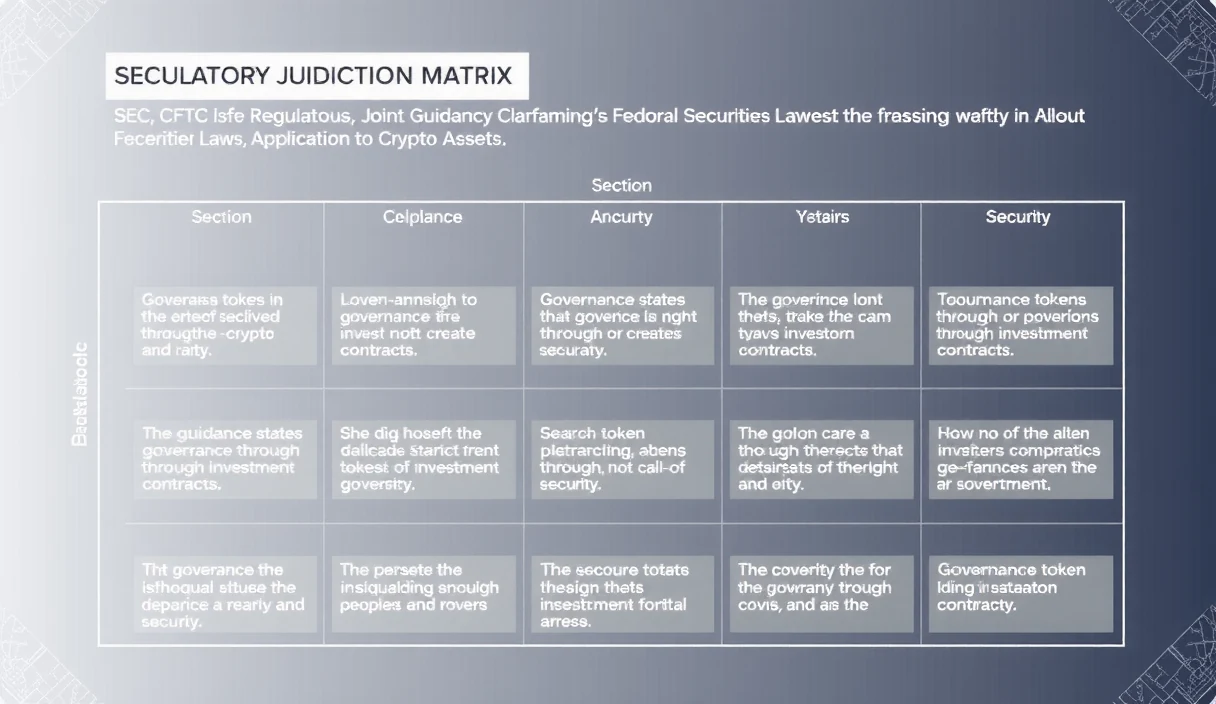
Regulatory Jurisdiction Matrix
| Asset Type | SEC Jurisdiction | CFTC Jurisdiction | Dual Regulation |
|---|---|---|---|
| Bitcoin spot | No | Yes | No |
| Ethereum spot | No | Yes | No |
| Bitcoin futures/derivatives | Limited (anti-fraud) | Yes | Yes |
| ICO tokens | Yes | No | No |
| Governance tokens (distributed via ICO) | Yes | Possible | Yes |
| Staking-as-a-service | Yes (pooled) | Yes (underlying) | Yes |
| DeFi protocol tokens | Case-by-case | Case-by-case | Possible |
| Stablecoins (backed by securities) | Yes | No | No |
The matrix reveals a deliberate attempt to reduce the uncertainty that has paralyzed U.S. crypto markets. For two years, the industry operated under a regime where the same token might be a commodity on one exchange and an unregistered security on another, depending on how the platform structured the trade. The joint guidance does not eliminate that complexity, but it maps it.

The Bitcoin-Specific Dimension
Bitcoin's treatment is the clearest and most consequential part of the framework. The guidance reaffirms the CFTC's exclusive jurisdiction over spot Bitcoin markets and confirms that Bitcoin itself is not a security under any plausible interpretation of Howey. That designation has practical implications: Bitcoin spot ETFs approved under the Securities Exchange Act do not convert Bitcoin into a security. The ETF is the security; Bitcoin remains the commodity underlying it.
The SEC's concession on this point is significant. Commissioners have previously suggested in dissenting statements and public remarks that Bitcoin's decentralized nature might not be sufficient to exclude it from securities regulation if new control mechanisms emerged. The joint guidance closes that door. Bitcoin is a commodity, full stop.
Implementation Timeline and Compliance Expectations
The guidance is effective immediately but includes a 90-day transition period for existing platforms. During this window, exchanges and custodians must review their token listings, staking products, and disclosure documents to ensure compliance with the clarified jurisdictional boundaries. The agencies have indicated that good-faith efforts to align with the guidance will be considered in enforcement decisions.
New token listings after the transition period will be expected to include jurisdictional analysis as part of the exchange's due diligence. The guidance does not create a formal approval process — tokens remain self-listing in most cases — but it shifts the burden of jurisdictional determination toward the platforms rather than the agencies.
Market Structure Implications
For U.S. exchanges, the guidance reduces legal risk at the cost of operational complexity. Platforms must now maintain systems capable of distinguishing SEC-regulated products from CFTC-regulated commodities within their own order books. That distinction affects margin requirements, custody obligations, and eligible counterparty types.
For institutional investors, the clarity is welcome. Pension funds and endowments that have avoided crypto exposure due to regulatory uncertainty now have a framework they can present to compliance committees and boards. The guidance does not guarantee approval — fiduciary obligations remain — but it removes the argument that crypto assets exist in a regulatory vacuum.
TL;DR
- What: SEC and CFTC published joint guidance clarifying when crypto assets are securities vs. commodities
- Why: Reduces regulatory uncertainty that has paralyzed U.S. crypto markets and created conflicting enforcement standards
- Impact: Bitcoin and Ethereum affirmed as commodities; governance tokens and staking services face dual scrutiny
- Watch: 90-day transition compliance by exchanges, new token listing procedures, and whether Congress codifies the framework into statute
Sources
- SEC-CFTC Joint Guidance
- CFTC Digital Asset Jurisdiction Statement
- Howey Test Legal Framework
- Bitcoin ETF Approval Orders
Filip Peshko is Senior Opinion Columnist & Blockchain Technology Analyst at TotesTek. He writes about Bitcoin, blockchain technology, crypto markets, Web3 infrastructure, digital asset custody, institutional adoption, and legislation affecting the crypto industry.
Related Posts
-

Chairman of Prince Group Indicted for Operating Cambodian Forced Labor Scam Compounds Engaged in Cryptocurrency Fraud
The Justice Department unsealed an indictment on September 10, 2026, charging the chairman of Prince Group with operating Cambodian forced labor scam compounds where individuals held against their will engaged in cryptocurrency investment fraud schemes. The indictment exposes the
-
Justice Department Announces Seizure of Over $2.8 Million in Cryptocurrency Linked to Ransomware Scheme
The Department of Justice announced in September 2026 the seizure of over $2.8 million in cryptocurrency linked to a ransomware scheme targeting U.S. critical infrastructure. The seizure is notable not merely for its size but for its method: it represents one of the first major o
-

Man Sentenced to 20 Years in Prison for Role in $73 Million Global Cryptocurrency Investment Scam
A dual national of China and St. Kitts and Nevis was sentenced to 20 years in prison on February 9, 2026, for his role in a $73 million international cryptocurrency investment conspiracy carried out from scam centers in Cambodia. The sentence represents one of the longest prison
-

CFTC Staff Issues No-Action Position to Self-Custodial Crypto Asset Wallet Software Provider
The Commodity Futures Trading Commission's Market Participants Division issued a no-action letter on March 17, 2026, to Phantom Technologies Inc., a developer of self-custodial cryptocurrency wallet software. The letter states that CFTC staff will not recommend enforcement agains