

peaq Introduces peaqOS Monetize to Turn Idle Machines into Money Makers
peaq launches peaqOS Monetize, enabling robots and machines to generate passive income from idle resources such as compute, storage, and bandwidth through autonomous on-chain transactions.

I remember watching a server room at full capacity during a workday, then returning at midnight to find the same racks humming at 15% utilization. The hardware was paid for, the power was running, and the cooling was active, yet most of that capacity sat idle. On July 29, 2026, peaq introduced peaqOS Monetize, a system designed to solve exactly this inefficiency by enabling machines to generate passive income from their unused resources.
Key Metrics at a Glance
| Metric | Current Value | Context |
|---|---|---|
| peaqOS Functions | 5 (including Monetize) | Complete machine operating system stack |
| Estimated Idle Machine Capacity | 60-80% | Typical during off-peak hours |
| Monetizable Resources | Compute, storage, bandwidth | Core machine capabilities |
| peaq Network Devices | 3.2 million+ | Active DePIN participants |
What Is peaqOS Monetize
peaqOS Monetize is the fifth function in peaq's operating system for machines, joining Control, Stream, Store, and Process. Its purpose is straightforward: convert idle machine resources into revenue-generating assets through autonomous on-chain transactions.
The system targets three primary resource categories:
Compute: Unused processing cycles from robots, vehicles, and industrial equipment. A warehouse robot's CPU sits largely idle between picking tasks. An autonomous vehicle's onboard computer does nothing while parked. peaqOS Monetize makes these cycles discoverable and rentable.
Storage: Excess disk space across connected devices. Think of it as Airbnb for machine storage, where devices with spare capacity host data for others and receive automatic compensation.
Bandwidth: Unused network throughput. This applies particularly to devices with high-capacity connections that experience demand spikes rather than constant utilization, such as fleet vehicles with 5G modems or smart city infrastructure.
How It Works
The monetization flow operates through four automated stages:
-
Resource Detection: Machines scan their own capabilities and publish available capacity to peaq's on-chain registry. A robot might report 4 CPU cores and 500GB storage available during nighttime hours.
-
Demand Matching: Other machines or human operators query the registry for resources they need. A researcher running distributed computing tasks might search for available compute cycles within a specific geographic area.
-
Smart Contract Execution: Upon match, a smart contract automatically handles terms, pricing, and escrow. No human negotiates the deal. The machine publishes its rate, the consumer accepts, and execution begins.
-
Settlement: Upon completion, payment transfers automatically in peaq's native token. The provider's wallet balance increases, and the transaction is immutably recorded for audit purposes.
Competitive Landscape: Machine Resource Marketplaces
| Platform | Resource Type | Pricing Model | On-Chain Settlement | Autonomous Contracts |
|---|---|---|---|---|
| peaqOS Monetize | Compute, storage, bandwidth | Dynamic/market-based | Native | Yes |
| Golem | Compute only | Manual bidding | Ethereum-based | No |
| Filecoin | Storage only | Storage deal | Native | Partial |
| Akash | Compute only | Reverse auction | Cosmos-based | No |
| Render Network | GPU compute | Fixed tiers | Ethereum-based | No |
peaqOS Monetize distinguishes itself through breadth (multiple resource types), autonomy (no human intermediaries), and native economic infrastructure purpose-built for machines rather than adapted from human-centric marketplaces.
The Economics of Idle Machines
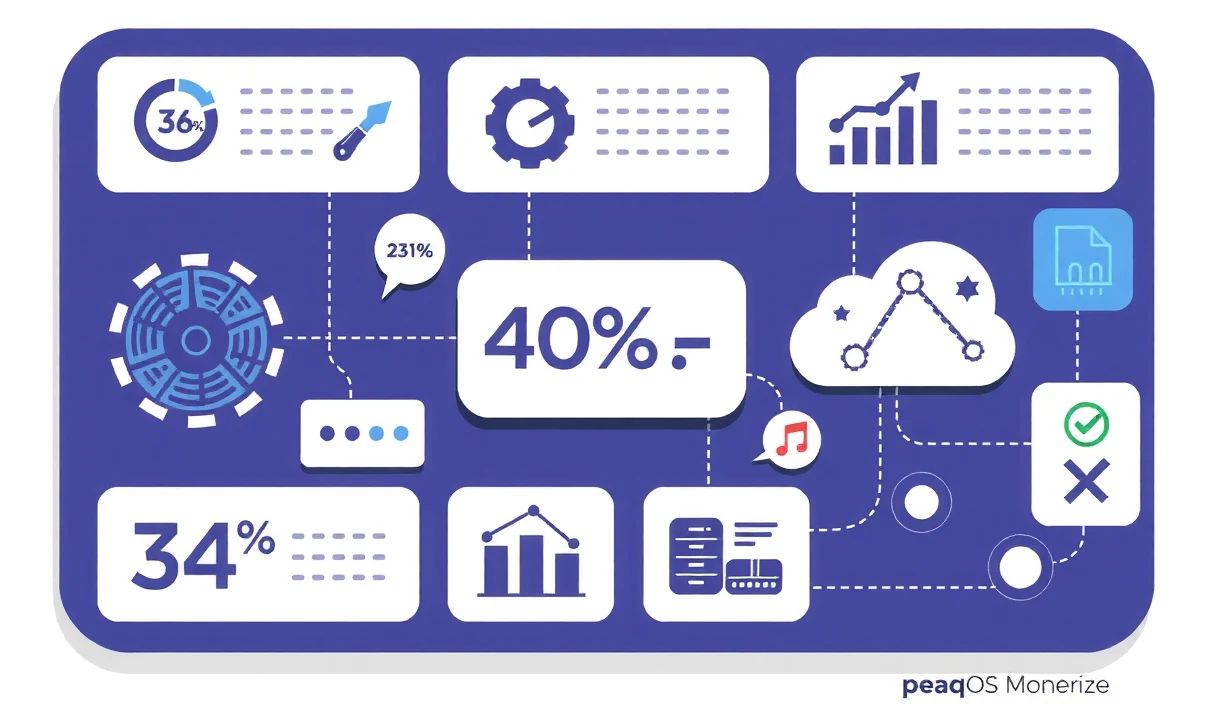
Consider the numbers. An industrial robot costs between $50,000 and $150,000. It operates perhaps 16 hours per day in a three-shift factory, leaving 8 hours of downtime. During those 8 hours, its compute, storage, and connectivity remain active but unused.
If that robot could rent its idle compute for even $2 per hour, that's $16 per day, $5,840 per year, or roughly 4-12% of its capital cost in additional annual revenue. Scale that across a factory with 50 robots, and you're looking at $292,000 in recovered value from what was previously waste.
The economics improve with higher-value resources. A fleet of autonomous vehicles equipped with high-bandwidth 5G modems could generate significantly more during parked hours by serving as edge computing nodes for nearby applications requiring low latency.
Implementation and Integration
peaqOS Monetize integrates with the broader peaq ecosystem through several mechanisms:
peaqID: Every participating machine requires a decentralized identity. peaqID provides this, ensuring reputation tracking and accountability across transactions.
peaqOS Stream: Resource availability data flows through the Stream layer, enabling real-time updates as machines join, leave, or adjust their capacity offerings.
peaq Pay: The payment rail handles micro-transactions at scale, essential for a system where individual resource rentals might generate fractions of a cent per minute.
Machine NFTs: Each machine receives a non-fungible token representing its ownership, capabilities, and transaction history. This enables secondary markets for machine assets and verifiable provenance for resource consumers.
Strategic Implications
The introduction of Monetize marks a transition in how we think about machines. Previously, they were cost centers, purchased for a specific purpose and generating return only during active use. peaqOS Monetize reframes them as revenue-generating assets that work around the clock.
This shift carries broader implications for capital allocation. If idle machine time generates income, the business case for automation strengthens. A warehouse might justify additional robots not just for throughput during peak hours, but for their monetizable capacity during off-peak periods.
It also creates network effects. The more machines join peaq's network, the more diverse the available resources become, attracting more consumers, which increases machine earnings, which incentivizes further participation.
Risks and Considerations

Resource Quality Variance: Not all idle compute is equal. A robot's embedded processor differs fundamentally from a data center GPU. Consumers need quality signals, and the marketplace must develop reputation mechanisms to prevent adverse selection.
Security Exposure: Renting machine resources to external parties introduces attack surfaces. A compromised compute tenant could potentially access the host machine's other functions. peaq addresses this through sandboxing and permission isolation, but the risk is non-zero.
Price Volatility: Resource pricing in a dynamic marketplace fluctuates with supply and demand. Machines relying on Monetize revenue for operational budgets face earnings uncertainty, potentially complicating financial planning.
Regulatory Ambiguity: Machine-to-machine transactions occupy unclear territory in many jurisdictions. Tax treatment, liability frameworks, and consumer protection rules designed for human commerce may not cleanly apply.
Decision Framework
Deploy peaqOS Monetize when:
- Your fleet experiences predictable idle periods with underutilized compute, storage, or bandwidth
- You operate in the peaq ecosystem or plan to integrate with DePIN infrastructure
- Your machines already use peaqOS for other functions, minimizing integration costs
Consider alternatives when:
- Your machines operate near continuous capacity with minimal downtime
- Regulatory uncertainty in your jurisdiction creates compliance risk
- Your resources require specialized hardware that doesn't map cleanly to marketplace categories
TL;DR
- What: peaqOS Monetize enables machines to generate passive income from idle compute, storage, and bandwidth
- Why: Typical machines sit 60-80% idle during off-peak hours, representing billions in wasted capacity globally
- How: Four-stage automated flow (resource detection, demand matching, smart contract execution, settlement)
- Edge: Native on-chain settlement with autonomous contracts, purpose-built for machines rather than adapted human marketplaces
- Watch: Network effects as provider density attracts consumers, creating self-reinforcing ecosystem growth
Sources
Gemma Nguyen is Content Lead and Journalist at Totestek. She writes about cryptocurrency, Web3, DeFi, blockchain technology, and emerging tech trends.
Related Posts
-

Supersized August: Startale Pushes 100 STAR Points to Drive Soneium Ecosystem Engagement
Last month, I spent twenty minutes trying to redeem airline miles for a flight I no longer needed. The points had technically expired, the redemption portal was broken, and the customer service chatbot kept sending me in circles. It was a familiar frustration, one that loyalty pr
-
Ethereum Foundation's zkAPI Wants to Pay for APIs Without Showing Your ID. Here Is What the Contract Actually Does.
Last Tuesday, a developer in Berlin sent her first prompt to an AI model without attaching a name, an email, or a credit card. She deposited USDC into a smart contract on Ethereum. The contract did not ask who she was. It only asked if she had enough money. Then it let her talk t
-

The Ethereum Foundation Published Its Q2 2026 Numbers. Here Is Where the Money Went.
On July 15, the Ethereum Foundation released its quarterly allocation update. The document ran 14 pages. The headlines focused on the totals. What mattered more was the distribution — who got funded, who did not, and what the percentages say about the Foundation's priorities. Key
-

The Ethereum Foundation Picked a Date for Quantum Resistance. December 2028 Is Either Ambitious or Alarming.
On September 7, the Ethereum Foundation's Protocol cluster published a priorities document that included something the ecosystem had been hearing about in theory but never on a timeline: make Ethereum L1 quantum-resistant across execution, consensus, and data layers by December 2