

Polkadot Statement Store: How Decentralized Messaging Works Without a Blockchain
Parity Technologies introduces the Polkadot Statement Store (Celerity), a network-layer publish/subscribe protocol for signed off-chain messages that propagates through a P2P gossip network without writing to blockchain storage.

I sat through the Web3 Summit presentation in Berlin last month waiting for the usual blockchain pitch. Instead, Parity Technologies demoed something genuinely different: a messaging protocol that does not write anything to a blockchain, does not rely on a central server, and still guarantees that every message came from whoever claims to have sent it.
That protocol is the Polkadot Statement Store, also known as Celerity. And it is worth understanding because it solves a problem most decentralized projects pretend does not exist: how do you communicate before you are on-chain?
Key Metrics at a Glance
| Property | Value | Implication |
|---|---|---|
| Protocol name | Statement Store (Celerity) | Network-layer messaging |
| Message type | Signed off-chain statements | Cryptographic authenticity |
| Distribution | P2P gossip (best-effort) | No central server |
| Recommended payload | ~512 bytes | Efficient propagation |
| Storage | Local node, not blockchain | No chain bloat |
| Typical latency | Near-real-time | Faster than block finality |
| Use cases | Chat, WebRTC signaling, notifications | Serverless communication |
What the Statement Store Actually Does
The Statement Store is a network-layer publish/subscribe protocol for signed off-chain messages. Here is what that means in practice.
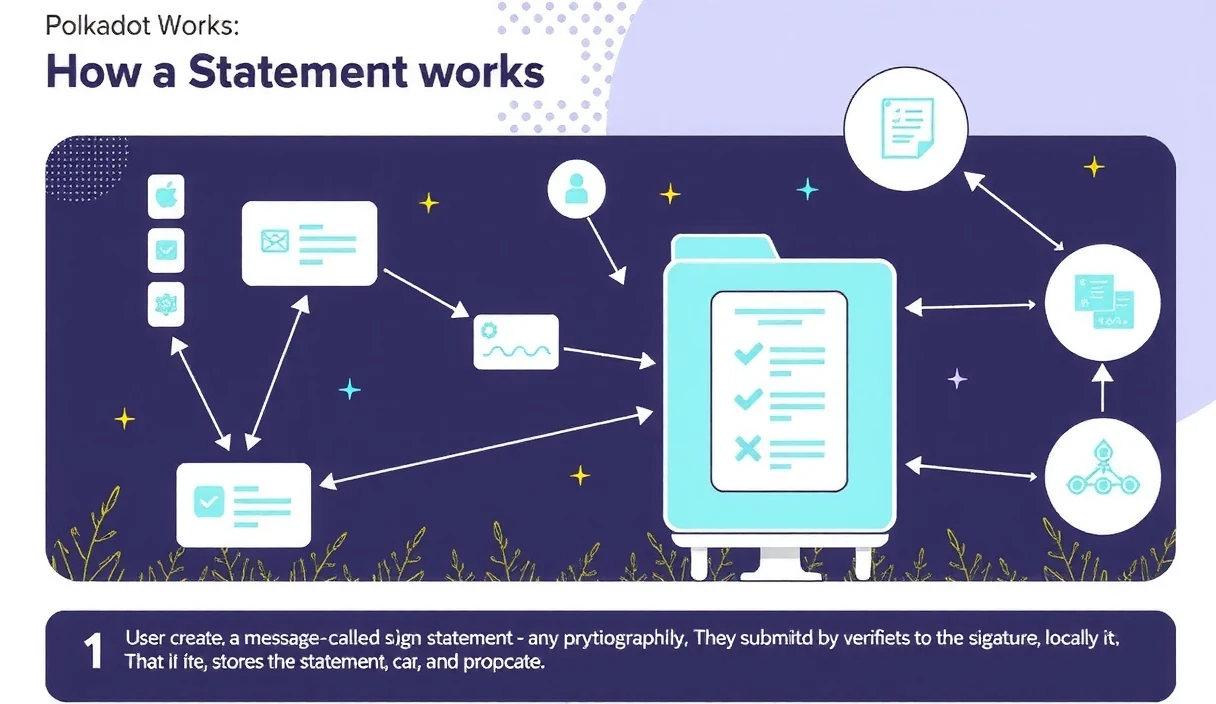
A user creates a message — called a statement — and signs it cryptographically. They submit it to any participating node. That node verifies the signature, stores the statement locally, and propagates it to its peers through a gossip network. Other nodes receive it, verify it, store it, and forward it again. Eventually, the statement spreads across the network without ever touching a blockchain or a central database.
The design makes a deliberate trade-off. Delivery is best-effort, not guaranteed. Two nodes can hold different views of the current state at any given moment. There are no acknowledgments, no ordering guarantees, and no delivery receipts. In exchange, the protocol achieves something centralized messaging systems cannot: it works without any server infrastructure at all.
This is not a bug. It is the point. The Statement Store is designed for decentralized, short-lived signaling rather than centralized-service delivery guarantees.
How a Statement Works
A statement consists of several fields:
Topic: A categorical identifier that helps nodes filter which statements they care about. A node subscribed to a specific topic receives statements tagged with that topic and ignores the rest.
Channel: A more specific identifier within a topic, allowing applications to create sub-conversations or direct message threads.
Expiry: Each statement carries a time-to-live. After expiry, nodes can prune it from local storage. This prevents indefinite accumulation of stale messages.
Allowance: A rate-limiting mechanism that prevents spam by restricting how many statements a given identity can submit within a time window.
Payload: The actual message content, recommended at approximately 512 bytes to keep propagation efficient. The protocol does not encrypt payloads, so applications that need privacy must add their own encryption on top.
Use Cases: What You Can Build
The Statement Store is a transport layer, not a complete application. But that minimalism is what makes it flexible.
Decentralized Chat: Two users exchange public keys, subscribe to a shared channel, and send encrypted statements to each other. No server logs the conversation. No company controls the infrastructure. The chat works as long as both users are connected to the P2P network, even if they never interact with a blockchain.
WebRTC Signaling: WebRTC requires a signaling channel to establish direct peer-to-peer connections. Most applications use a centralized server for this initial handshake. The Statement Store can carry the SDP offer and answer instead, removing the need for any centralized infrastructure before the direct connection is established.
Notifications and Alerts: Applications can broadcast alerts to subscribers without maintaining a push notification server. A DeFi protocol could notify users about liquidation risks, governance votes, or protocol changes directly through the Statement Store.
Identity and Discovery: As part of Parity's broader Trinity vision, the Statement Store can support decentralized identity lookups and service discovery, letting users find each other and establish communication channels without relying on centralized directories.
Competitive Landscape: Decentralized Messaging
| Platform | Architecture | Blockchain Required | Encryption | Use Case Focus |
|---|---|---|---|---|
| Polkadot Statement Store | P2P gossip | ❌ No | Application-layer | General transport |
| Signal | Centralized servers | ❌ No | ✅ Native | Consumer chat |
| Matrix | Federated servers | ❌ No | ✅ Optional | Open communication |
| Status | P2P (Waku) | ❌ No | ✅ Native | Web3 messaging |
| XMTP | Decentralized network | ❌ No | ✅ Native | Web3 messaging |
| Telegram | Centralized servers | ❌ No | ❌ Optional | Consumer chat |
The Statement Store differentiates itself through its position in the stack. It is not an application like Signal or Status. It is a network-layer protocol that other applications can build on, similar in philosophy to how TCP underpins HTTP rather than competing with it.
Status and XMTP are closer comparisons — both provide decentralized messaging infrastructure for Web3. The Statement Store's distinguishing feature is its integration with the Polkadot network layer, letting parachains and validators participate in message propagation natively rather than through a separate overlay network.
Why Best-Effort is the Right Design
The temptation with decentralized protocols is to replicate every guarantee that centralized services provide. The Statement Store deliberately avoids this.
Guaranteed delivery requires either a centralized queue or complex consensus among nodes. Ordering guarantees require consensus on message sequence. Delivery acknowledgments require nodes to track which peers have received which messages. Each of these adds complexity, latency, and state that must be synchronized across the network.
By relaxing these guarantees, the Statement Store achieves something more valuable for its intended use cases: simplicity and speed. A chat message that arrives slightly out of order or after a brief delay is still usable. An SDP offer for WebRTC that propagates in seconds rather than milliseconds is still fast enough for human-perceived real-time communication.
The applications that need stronger guarantees — financial transactions, governance votes, identity attestations — should still use the blockchain. The Statement Store handles everything else.
Strategic Implications
The Statement Store matters for Polkadot's ecosystem strategy because it fills a gap that has existed since decentralized networks began: communication infrastructure that is as decentralized as the chains themselves.
Today, most Web3 applications rely on centralized messaging for their UX. Notifications go through Firebase. Chat goes through Discord or Telegram. Signaling goes through WebSocket servers. The blockchain layer is decentralized, but everything around it is not.
Parity's Trinity vision — combining messaging, payments, identity, and other capabilities through a common interface — recognizes that users do not experience decentralization as a single layer. They experience it as a stack. If the communication layer is centralized, the stack is centralized regardless of what the base layer does.
The Statement Store is the first component of that stack. By separating messaging from consensus, Parity creates a design where each layer can optimize for its specific requirements rather than forcing everything through the same bottleneck.

What to Watch
Trinity integration. The Statement Store was presented as part of Trinity, Parity's broader vision for decentralized messaging, payments, and identity. How the other components integrate with the Statement Store will determine whether this becomes a production-ready stack or an interesting research prototype.
Adoption by parachains. For the network effects to materialize, parachain teams need to build applications that use the Statement Store. Early indicators will be wallets, governance interfaces, and DeFi protocols that integrate off-chain notifications.
Spam and abuse. Best-effort propagation with rate-limiting allowances is a starting point, not a complete anti-spam solution. As adoption grows, the protocol will face the same spam challenges that have plagued email, XMPP, and other open messaging systems.
TL;DR
- What: Polkadot Statement Store (Celerity) is a P2P gossip protocol for signed off-chain messages
- How: Messages propagate node-to-node without blockchain storage or central servers
- Edge: Best-effort design trades guaranteed delivery for simplicity and decentralization
- Impact: Enables serverless chat, WebRTC signaling, and notifications in the Polkadot ecosystem
- Watch: Trinity integration, parachain adoption, and spam mitigation as usage scales
Sources
- Parity Technologies: What is Polkadot Statement Store
- Web3 Summit 2026 Presentations
- Polkadot Network Documentation
Gemma Nguyen is TotesTek's Content Lead and Journalist, covering the intersection of decentralized infrastructure, protocol design, and the communication layers that make both sustainable.
Related Posts
-

How Polkadot Proof of Personhood Works: Recognition Games and Ring-VRF Privacy
I have watched the same Twitter account post the same conspiracy theory under three different handles in the same thread. I have seen bot farms amplify political messages until the platform itself could not distinguish organic from artificial engagement. And I have watched develo
-

Why Polkadot is Not Just Another Blockchain: Architecture, Security, and Interoperability
I have watched builders evaluate Layer 1 chains for years, and the conversation usually follows the same pattern. Transactions per second. Finality time. Token price. The assumption is that blockchains are essentially interchangeable, differentiated only by speed and cost. That a
-

The Hidden Philosophy Behind Polkadot's Design: Products for People, Not Platforms
I have read a lot of blockchain whitepapers. Most of them open with technical abstractions: consensus mechanisms, throughput numbers, token economics. Very few begin with the question that actually matters: who is this for? Polkadot's philosophy page on polkadot.com answers that
-

The Race to Build JAM: 43 Teams, 15 Languages, and Polkadot's Next Protocol
I opened the JAM testnet dashboard on a Tuesday afternoon expecting the usual incremental progress report. Instead I found something genuinely unusual: 43 independent teams, working in 15 different programming languages, all racing to build the exact same protocol from the same s