

UK Financial Conduct Authority Updates Cryptoasset Regulatory Framework Guidance for October 2026
The UK Financial Conduct Authority (FCA) has published updated guidance on its cryptoasset regulatory framework in October 2026, clarifying registration requirements, financial promotion rules, and the perimeter of regulated activities for Bitcoin and other digital assets. The update affects firms operating in the UK crypto market and reflects the regulator's evolving approach to consumer protection and market integrity in digital assets.

I was on a call with a London crypto compliance lawyer in late September when she said, "The FCA has finally decided what Bitcoin is — and it's not what the Americans think." She was referring to the regulator's long-awaited clarification of the cryptoasset perimeter, published in full this month. The October 2026 update to the FCA's cryptoasset framework is the most consequential UK crypto policy move since the financial promotion regime took effect in 2023 — and it lands hardest on Bitcoin firms that assumed London would follow Washington's lead. It won't.
The FCA is not the SEC. Where American regulators have fought over whether Bitcoin is a security, the UK has taken a cleaner path: Bitcoin is a cryptoasset, full stop, and the firms that deal in it must register, promote responsibly, and prove they can protect consumers. The October 2026 update tightens every one of those obligations.
Key Metrics at a Glance
| Metric | Value | Context |
|---|---|---|
| FCA-registered cryptoasset firms | ~120 | Out of ~900 applicants since 2020 |
| UK crypto holders (est.) | 6.7 million | ~12% of UK adults (FCA survey 2026) |
| Financial promotion regime live | Since Oct 2023 | Applies to all cryptoasset communications |
| October 2026 guidance focus | Perimeter, registration, promotion rules | Clarifies regulated vs. unregulated activity |
| Rejection rate for crypto registration | ~85% | FCA has rejected most applications |
| Penalties for unregistered dealing | Unlimited fine + up to 2 years | Criminal liability under FSMA 2000 |
| Bitcoin's UK classification | Exchange token (cryptoasset) | Not a security, not e-money |
| UK share of European crypto volume | ~28% | London remains Europe's largest hub |
What the October 2026 Guidance Actually Changes
The FCA's updated cryptoasset framework guidance doesn't create new law — the Financial Services and Markets Act 2023 already brought cryptoassets into the regulatory perimeter. What the October 2026 update does is clarify where the lines are, in four areas:
-
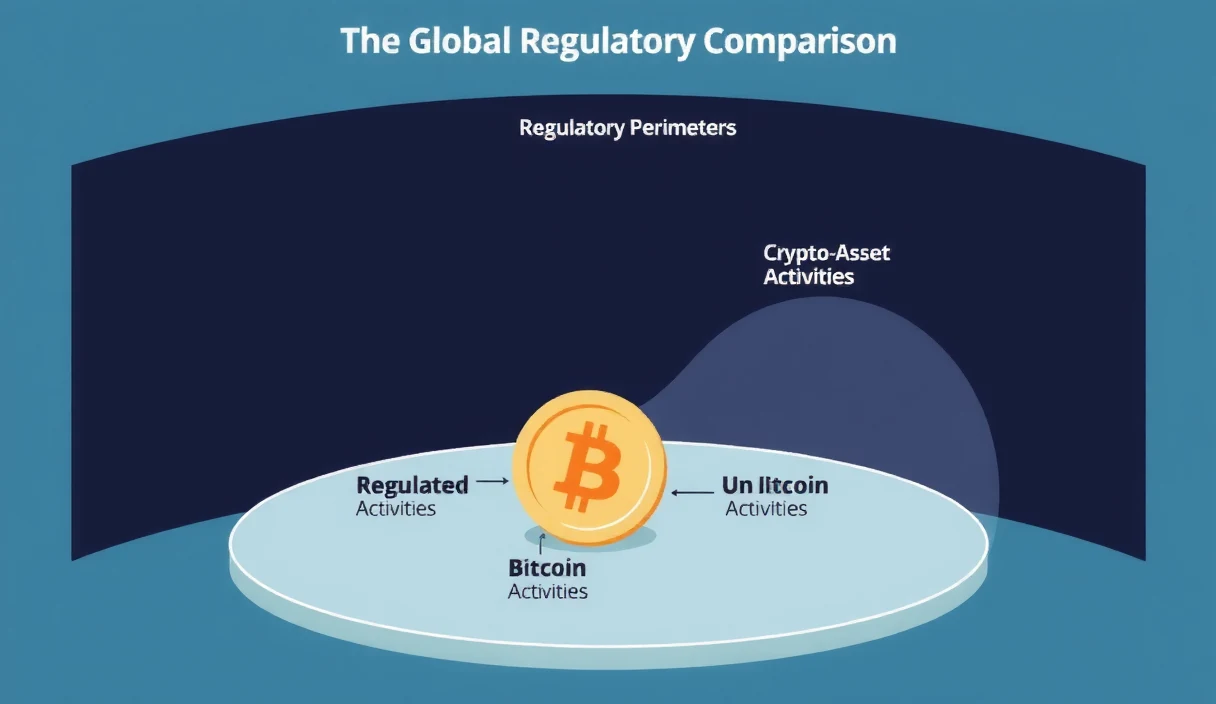
The perimeter: The FCA has sharpened which activities are "regulated". Dealing in Bitcoin as principal, arranging deals, safeguarding, and operating a trading platform all require registration. Pure software development (non-custodial wallets, node operation) remains outside the perimeter — a deliberate contrast with US enforcement theories.
-
Registration standards: The FCA has raised the bar on what it takes to be registered. Firms must now demonstrate robust systems for market abuse surveillance, blockchain analytics for AML, and wind-down plans. The ~85% historical rejection rate reflects this; the October guidance makes the expectations explicit.
-
Financial promotion rules: Any communication inviting UK consumers to acquire Bitcoin — including from overseas firms — must be approved by an FCA-authorised person or fall within an exemption. Social media influencers promoting Bitcoin products without approval face criminal liability. The FCA has already prosecuted several high-profile cases.
-
Custody and safeguarding: Firms holding client Bitcoin must segregate it, use qualified custodians, and provide clear risk disclosures. The FCA has made clear that "not your keys, not your coins" is a disclosure requirement, not a slogan — but the keys must be held by someone the FCA trusts.

The Global Regulatory Comparison
How does the UK's approach compare to other major jurisdictions?
| Jurisdiction | Regulator | Framework | Bitcoin Treatment | Retail Access Model |
|---|---|---|---|---|
| United Kingdom | FCA | FSMA 2023 + registration (updated Oct 2026) | Exchange token; registration required | FCA-registered firms only; strict promotion rules |
| United States | SEC/CFTC | Securities laws + Commodity Exchange Act | Commodity (CFTC); spot ETFs SEC-regulated | Exchange-traded; broker-dealer custody |
| European Union | ESMA/NCAs | MiCA (fully applicable Dec 2024) | Crypto-asset; unified EU passport | Licensed CASPs; retail access with safeguards |
| Australia | ASIC | Corporations Act (updated Oct 2026) | Commodity; derivatives/ETFs regulated | Licensed exchanges + AFS-licensed products |
| Singapore | MAS | Payment Services Act (updated 2026) | Digital payment token | MAS-licensed DPT providers; retail permitted |
| Hong Kong | SFC | SFO Type 7 license + VA framework (updated 2026) | Virtual asset; licensed platforms only | Licensed VATPs; retail permitted with conduct rules |
| Canada | CSA/OSFI | Securities laws + capital guidance (2026) | Commodity; derivatives regulated | CSA-registered platforms; custody rules |
The UK's model is distinctive: it regulates the firms rather than the asset. Bitcoin itself is not banned or restricted — but only registered firms may market or deal in it with UK consumers. This is stricter than the US on marketing, looser than the EU on asset classification.
Scenario Analysis: Where UK Crypto Goes
Three plausible paths for the UK cryptoasset market over the next 24 months:
| Scenario | Probability | Description | Impact on Bitcoin Firms |
|---|---|---|---|
| Regulated Consolidation | 55% | ~150-200 firms achieve registration; unregistered players exit or go offshore; UK becomes the "compliance-first" European hub | Moderate; surviving firms gain legitimacy and institutional access |
| Perimeter Creep | 25% | FCA extends registration to DeFi front-ends, staking services, and NFT platforms; compliance costs rise sharply for smaller firms | Significant; consolidation accelerates |
| US Alignment Drift | 20% | UK loosens promotion rules to compete with US spot ETF market; retail access expands via approved ETPs | Moderate growth; but risks regulatory arbitrage reputation |

Why This Matters for Bitcoin's Global Structure
London remains Europe's largest crypto hub by volume, and the FCA's October 2026 update is an attempt to make that legitimate rather than tolerated. For Bitcoin firms, the message is clear: if you want UK customers, you need FCA registration, approved promotions, and proper custody. The firms that navigate this will have a defensible moat; the ones that don't will face criminal liability, not just fines.
The deeper question is whether the UK's firm-based approach can coexist with the EU's asset-based MiCA. A Bitcoin exchange registered with the FCA but not MiCA-authorised can serve UK customers but not EU ones — and vice versa. The result is a fragmented European market, with London betting that compliance credibility beats passporting.
The Promotion Rules Are the Real Teeth
The FCA's financial promotion regime is where most Bitcoin firms will feel the October 2026 update. Every tweet, YouTube video, or app notification that could induce a UK consumer to buy Bitcoin must be approved by an FCA-authorised firm. Influencers face up to two years in prison for unapproved promotions. This has already chilled retail marketing — and the October guidance closes remaining loopholes around "educational" content that functions as promotion.
For Bitcoin specifically, this means the UK retail market will look more like institutional channels — approved ETPs, registered brokers — and less like the open, influencer-driven market of 2021. Whether that protects consumers or just pushes them offshore is the question regulators and industry will argue about for years.
TL;DR
- What: The UK FCA published updated cryptoasset regulatory framework guidance in October 2026, sharpening the perimeter, registration standards, financial promotion rules, and custody requirements for Bitcoin firms
- Why: The update operationalizes FSMA 2023 for cryptoassets — Bitcoin is an "exchange token," and only FCA-registered firms may market or deal in it with UK consumers
- Impact: ~120 registered firms face higher compliance bars; ~85% historical rejection rate signals tougher registration; unapproved Bitcoin promotions carry criminal liability (up to 2 years)
- Watch: Number of registrations approved in Q1-Q2 2027; FCA enforcement against unregistered overseas firms; whether UK drifts toward US-style ETP access for retail; MiCA vs. FCA passporting conflicts
Sources
- UK FCA - Cryptoassets
- UK FCA - Financial Promotions for Cryptoassets
- FCA - Register of Cryptoasset Firms
- HM Treasury - FSMA 2023 Cryptoasset Provisions
- Reuters - UK FCA Crypto Regulation October 2026
- The Block - FCA Registration Analysis
Filip Peshko is TotesTek's Ethereum Ecosystem Columnist & Accountability Reporter at TotesTek. He writes about Bitcoin, blockchain technology, crypto markets, Web3 infrastructure, digital asset custody, institutional adoption, and legislation affecting the crypto industry.
Related Posts
-

Hong Kong SFC Updates Virtual Asset Regulatory Framework Guidance in October 2026
Hong Kong's SFC has updated its virtual asset regulatory framework to tighten licensing and investor protection. Discover how these changes aim to secure the city's position as Asia's most credible regulated crypto hub.
-

Australia's ASIC Publishes Updated Crypto Asset Regulatory Guidance for October 2026
ASIC's October 2026 update clarifies which crypto assets require an AFS license under the Corporations Act. While spot Bitcoin remains a commodity, the new rules target staking, custody, and ETFs to increase consumer protection.
-

Oklahoma Introduces Strategic Bitcoin Reserve Bill in 2026 State-Level Crypto Legislation Wave
Oklahoma is joining a growing wave of states proposing strategic Bitcoin reserves. A new 2026 bill would allow the state treasurer to allocate up to 5% of public funds into the digital asset.
-

Singapore's MAS Just Tightened the Screws on Digital Assets: What the October 2026 Payment Services Guidance Means for Bitcoin
Singapore's MAS is tightening the rules for digital asset service providers. Discover how the October 2026 Payment Services guidance impacts Bitcoin trading, consumer protections, and the city-state's status as a global crypto hub.