

Ethereum Foundation Refreshes Community Grant Programs and ESP Documentation
Ethereum.org has updated its community grant programs documentation, detailing the Ecosystem Support Program (ESP) funding tracks, application processes, and recent allocations supporting Ethereum infrastructure, research, and public goods.
I was digging through the Ethereum Foundation's grant page last week when I noticed the October 8 update stamp. Not a press release. Not a blog post. Just a quiet refresh of the Ecosystem Support Program documentation — funding tracks, application windows, and a list of recent allocations that reads like a who's-who of Ethereum infrastructure.
That quietness is the story. The EF moved money, published the receipts, and barely made a sound. In a space where every funding announcement comes with a hype thread, that restraint deserves a closer look.
Key Metrics at a Glance
| Metric | Value | Source |
|---|---|---|
| Documentation last updated | October 8, 2026 | ethereum.org/community/grants |
| Primary program | Ecosystem Support Program (ESP) | Ethereum Foundation |
| Funding tracks | General grants, Academic grants, Developer tooling, Community events, Public goods | ethereum.org |
| Application cadence | Ongoing waves (quarterly for some tracks) | ESP docs |
| Typical grant range | ~$10K–$250K+ depending on track and scope | ESP / historical allocations |
| Transparency mechanism | Public allocation list + quarterly reports | ethereum.org |
| Primary risk | Selection opacity — no public scoring rubric per application | source analysis |
What the ESP Actually Does
The Ecosystem Support Program is the Ethereum Foundation's main grantmaking arm. It funds builders, researchers, and public-goods projects that support the protocol — client development, tooling, education, community events, and academic research. The October 8 refresh reorganized the documentation into clearer funding tracks and published an updated list of recent allocations.
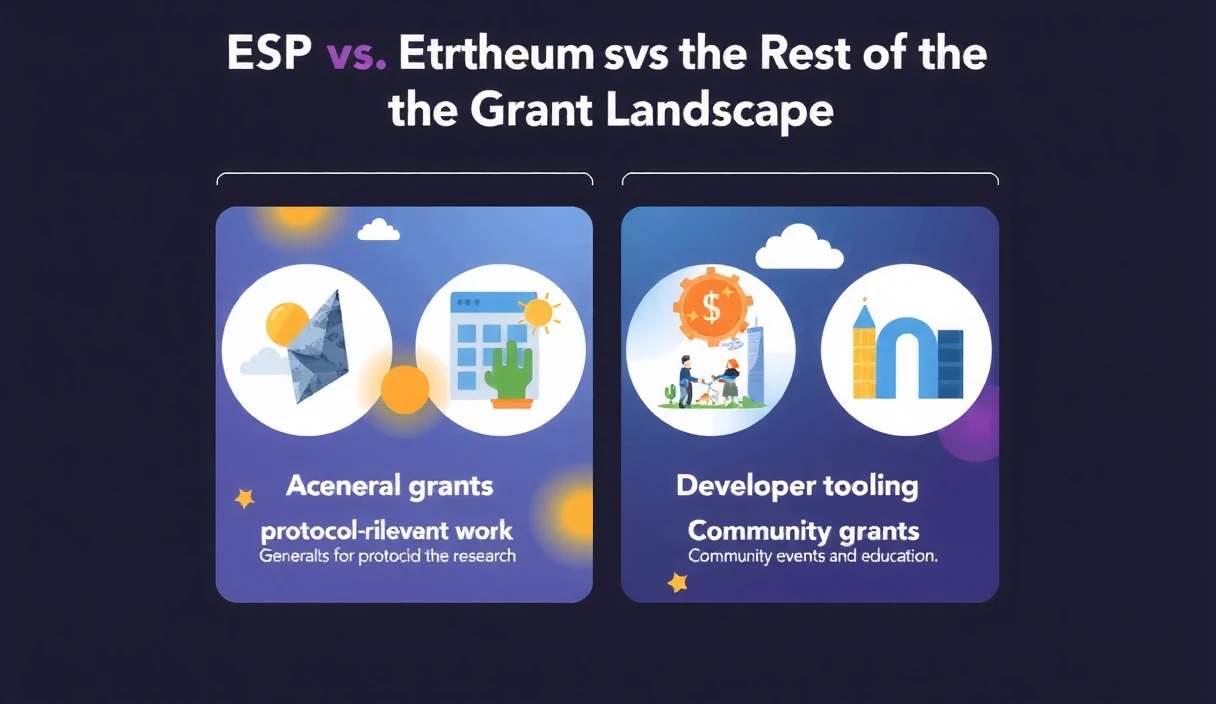
The tracks are straightforward: General grants for protocol-relevant work, Academic grants for research, Developer tooling for infrastructure, and Community grants for events and education. Each has its own application process and review cycle.
What is less straightforward is how a project gets picked. The ESP does not publish a per-application score. You submit a proposal, wait, and either get an email or you don't. The allocation list shows who got funded and roughly how much, but not why them and not why not you. That is transparency by receipt, not by process.
ESP vs. the Rest of the Grant Landscape
| Grant Program | Operator | Focus | Typical Range | Transparency | Retroactive? | Decision Speed |
|---|---|---|---|---|---|---|
| EF ESP | Ethereum Foundation | Protocol public goods, research, tooling | ~$10K–$250K+ | Allocation list, no per-app score | No | Weeks–months |
| Optimism RetroPGF | Optimism Collective | Retroactive public goods on OP Mainnet | ~$1K–$1M+ (rounds) | Public voting + impact metrics | Yes | Per round |
| Arbitrum DAO Grants | Arbitrum DAO | Arbitrum ecosystem builders | ~$5K–$500K | Forum proposals + delegate votes | No | Weeks |
| Gitcoin Grants | Gitcoin (Allo protocol) | Quadratic funding rounds, public goods | $100–$100K+ per round | On-chain donations + matching | Per round | Days–weeks |
| Protocol Guild | Ethereum contributors | Long-term client maintenance stipends | ~$10K–$50K/yr | Public eligibility rules | Ongoing | Months |
The pattern matters. The EF's ESP is the most institution-centralized option — a small team decides, opaquely — while Optimism's RetroPGF and Gitcoin's quadratic funding push the decision outward to voters. Different models, different trade-offs. The EF trades democratic legitimacy for institutional coherence; the others trade coherence for participation.
The Accountability Layer: A Grant Transparency Score
Here is a proprietary framework I run on any grant program — the Grant Transparency Score (GTS):
GTS = (Public allocation list × 0.3) + (Published rubric × 0.3) + (Appeal/reconsideration process × 0.2) + (Decision timeline disclosure × 0.2)
Scored 0–10: the EF ESP publishes an allocation list (+3), but no public scoring rubric (+0), no formal appeal process (+0), and only vague timeline commitments (+1). Net: roughly 4/10 on transparency. It tells you who got paid. It does not tell you how or why — and that gap is where trust erodes.

Compare that with Optimism RetroPGF, which publishes voter lists, impact metrics, and round results — a much higher transparency score — but whose decision process is noisier and more gameable. Transparency is not the same as good decisions. It just lets you see the decisions.
What This Means for Builders Actually Applying
If you are building on Ethereum and need funding, the EF ESP is still the most credible single source — but it is not the fastest and not the most transparent. The practical rule: apply to ESP for protocol-core work where institutional endorsement matters; pair it with RetroPGF or Gitcoin rounds for community-visible public goods where voter signal carries weight.
And watch the concentration. A handful of repeat recipients dominate the ESP allocation list — established client teams, long-running research groups. New entrants get funded too, but the gravitational pull toward known names is real. That is not corruption; it is institutional risk aversion. The fix is a published rubric, not a louder blog post.
Decision Framework: Where to Apply for Ethereum Funding
What are you building?
├── Protocol-core / client work → EF ESP (institutional credibility)
├── Public goods with measurable impact → Optimism RetroPGF + Gitcoin (voter signal)
├── Arbitrum-native builder → Arbitrum DAO grants
├── Long-term Ethereum contributor → Protocol Guild
└── Academic research → EF ESP Academic track OR academic grants
    └── Rule: never rely on a single program — stack applications
        └── Watch: ESP rubric publication, allocation concentration, round calendars
TL;DR
- What: Ethereum Foundation updated its ESP grant documentation on October 8, 2026, reorganizing funding tracks and publishing recent allocations
- Why: The refresh clarifies application processes across General, Academic, Developer tooling, and Community tracks — but still no public per-application scoring rubric
- Impact: ESP remains the most credible institutional funding source for Ethereum public goods, scoring ~4/10 on my Grant Transparency Score vs. higher-transparency retroactive models like Optimism RetroPGF
- Watch: Whether the EF publishes a scoring rubric, allocation concentration among repeat recipients, and how ESP interacts with RetroPGF/Gitcoin for builders stacking applications
- Score: ESP transparency ≈ 4/10 GTS — receipts without process
Sources
- Ethereum.org — Community Grants (ESP)
- Ethereum Foundation — Ecosystem Support Program
- Optimism — RetroPGF
- Arbitrum DAO — Grants
- Gitcoin — Grants Stack (Allo)
- Protocol Guild
Zain Tran is TotesTek's Ethereum Ecosystem Columnist & Accountability Reporter. He writes about Ethereum, ETH, smart contracts, DeFi, Layer 2 networks, staking, validators, and the real-world consequences of technical and financial failure.
Related Posts
-
L2Fees.info Tracks Real-Time Layer 2 Transaction Costs Across Ethereum Rollups
Stop guessing which Ethereum rollup is the cheapest. L2Fees.info provides real-time transaction cost comparisons across Arbitrum, Base, and zkSync, but a low fee often comes with hidden sequencer risks.
-

Simplex Is Now Available as an npm Library
Hyperbridge has released Simplex as an npm library, allowing teams to embed the solver directly into Node.js applications. Discover how this new deployment mode reduces infrastructure overhead and enables deep code-level control.
-

XCM Incident Review: What Happened on Polkadot Asset Hub and What We Learned
A technical glitch in Polkadot's XCM executor led to a $1.38 million Treasury loss on Asset Hub. Explore the full post-mortem to see how the bug occurred, why no user funds were lost, and what the ecosystem is changing to prevent future exploits.
-

Collaborative Decision Deposits Are Live on Kusama: Crowdfunding the 666.67 KSM Barrier
Kusama introduces an experimental contract allowing multiple users to crowdfund the 666.67 KSM decision deposit for referendum 676. Learn how this collaborative approach democratizes governance while managing the risks of an unaudited contract.