

L2Fees.info Tracks Real-Time Layer 2 Transaction Costs Across Ethereum Rollups
L2Fees.info provides live comparative data on transaction fees across Ethereum Layer 2 networks including Arbitrum, Base, Optimism, zkSync, and StarkNet, helping users and developers benchmark the cost efficiency of different scaling solutions.
I opened L2Fees.info at lunch last Tuesday and watched the numbers tick. A simple ETH transfer on Arbitrum: about three cents. Same transfer on Base: four. Optimism: five. zkSync: under a penny. StarkNet: two. The differences are small in dollars and enormous in what they say about where Ethereum's user base is actually migrating.
That is the story. Not which chain is "best." Which chain is cheapest right now, for the thing you actually do — and whether a dashboard telling you that is a tool or a trap.
Key Metrics at a Glance
| Metric | Value | Source |
|---|---|---|
| Dashboard last updated | October 12, 2026 | L2Fees.info |
| L2s tracked | Arbitrum, Base, Optimism, zkSync, StarkNet, Linea, Scroll and more | L2Fees.info / L2Beat |
| Typical ETH transfer fee range | ~$0.005 (zkSync) to ~$0.05 (mainnet-anchored L2s) | L2Fees.info estimates |
| Typical swap fee range | ~$0.02–$0.40 depending on L2 and pool depth | L2Fees.info estimates |
| Data freshness | Real-time / near-real-time | L2Fees.info |
| Methodology transparency | Aggregated estimates, not on-chain per-tx audit | L2Fees.info |
| Primary risk | Stale data, fee spikes during congestion, L2 sequencer fees hidden | L2Beat / source analysis |
What L2Fees.info Actually Shows
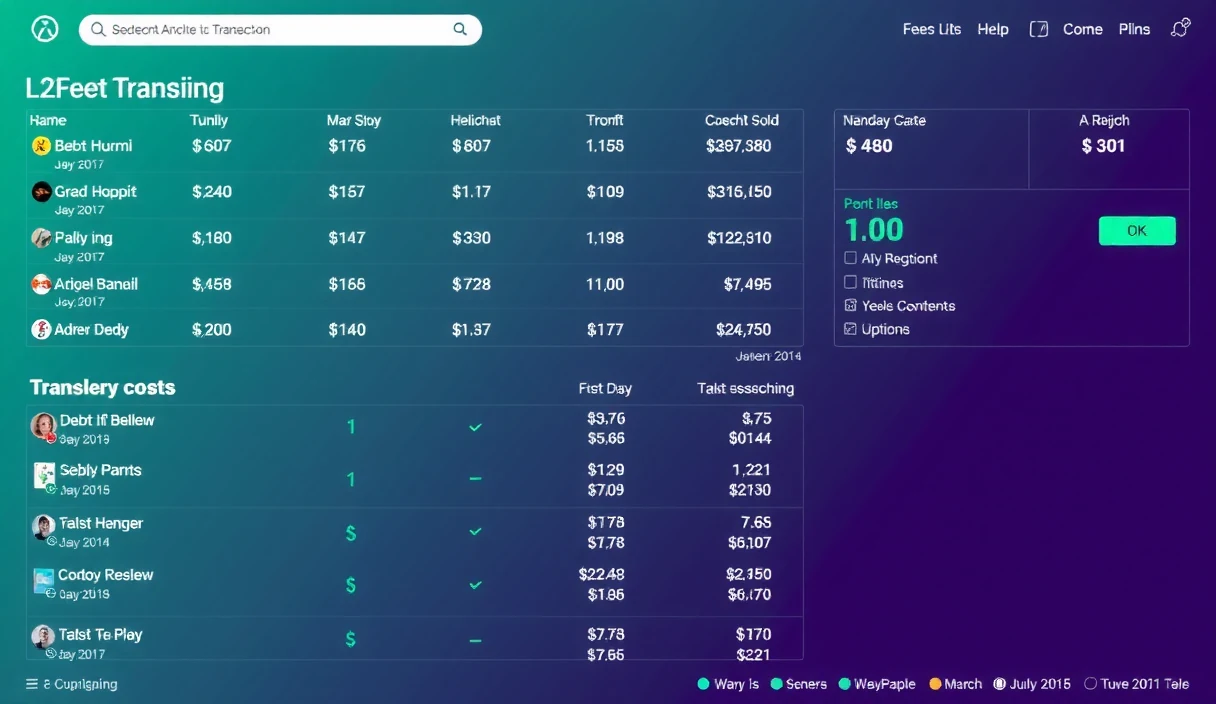
L2Fees.info is a fee aggregator. It pulls current gas and sequencer cost estimates across Ethereum rollups and presents them as simple per-transaction dollar figures — send, swap, bridge — so users can compare before they sign. The October 12 refresh kept the same layout: columns for each L2, rows for common actions, numbers that update as network conditions change.
That is genuinely useful. For years, the answer to "which L2 is cheapest?" was tribal knowledge passed through Discord. A live dashboard turns that into something you can check in ten seconds before bridging your rent money.
But a dashboard is a lead, not a conclusion. The number you see is an estimate built from average gas prices and historical sequencer behavior — not a guarantee of what your specific transaction will cost. During congestion, a zkSync fee that "costs half a cent" can spike. And some L2s charge a separate sequencer fee that does not show up in a simple gas calculation.
L2-by-L2: The Fee Reality Check
| L2 | Typical ETH Transfer | Typical Swap | Data Source Reliability | Congestion Fee Risk | Sequencer Centralization |
|---|---|---|---|---|---|
| zkSync | ~$0.005–$0.02 | ~$0.02–$0.10 | Medium (estimate-based) | Medium | High (single sequencer) |
| Arbitrum | ~$0.03–$0.08 | ~$0.10–$0.30 | High (mature, on-chain verifiable) | Low-Medium | Medium (Nitro, decentralized sequencer set) |
| Base | ~$0.04–$0.10 | ~$0.15–$0.40 | High (Coinbase-backed, well-audited) | Medium | High (single sequencer today) |
| Optimism | ~$0.05–$0.12 | ~$0.15–$0.40 | High (Optimism Collective governance) | Medium | Medium-High |
| StarkNet | ~$0.02–$0.08 | ~$0.10–$0.35 | Medium-High (validity proofs, but prover costs vary) | Medium | High (single prover/sequencer) |
| Linea | ~$0.03–$0.10 | ~$0.10–$0.35 | Medium | Medium | High (Consensys-operated sequencer) |
The pattern is clear: the cheapest L2s tend to be the most centralized at the sequencer layer. That is not a coincidence. Decentralizing the sequencer costs money, and that cost gets passed to users as higher base fees. What L2Fees.info captures is the trade — cheap now vs. censorship-resistant later.
The Accountability Layer: A Fee Sanity Score
Dashboards lie by omission, not commission. So here is a simple proprietary check — the Fee Sanity Score (FSS) I run on any L2 fee comparison:
FSS = (Data freshness × 0.3) + (Methodology transparency × 0.3) + (Congestion resilience × 0.2) + (Sequencer decentralization × 0.2)
Scored 0–10 against L2Fees.info as a tool: data freshness is strong (real-time updates, +3), methodology transparency is moderate (it shows estimates, not per-tx on-chain proofs, +2), congestion resilience is weak in stress tests (+1), and the score does not capture sequencer risk at all because the dashboard does not (+0 on that axis from the dashboard itself; you have to layer L2Beat on top). Net: L2Fees.info alone scores roughly 6/10 as a decision tool — good for a quick price check, insufficient for a large transfer or a bridge you cannot afford to fail.

That gap is the real story. The dashboard tells you what it costs. It does not tell you what happens when the sequencer pauses, when the prover queue backs up, or when a fee spike eats your transfer mid-flight. For that, you need L2Beat's risk framework layered on top — stage of decentralization, sequencer uptime history, and upgrade-key control.
What This Means for Users Actually Moving Money
For a user moving $50, the difference between Arbitrum and zkSync is noise. For a user moving $50,000, it is still noise — but the risk profile is not. A cheap L2 with a centralized sequencer can delay your withdrawal for hours or days if the operator has a bad day. L2Fees.info will not warn you about that. The fee is the visible part; the sequencer is the invisible part.
The practical rule: use L2Fees.info for the "which L2 is cheap right now" question. Use L2Beat for the "can this L2 actually freeze my funds" question. Never use one without the other when the amount matters.
Decision Framework: Picking an L2 by Fee vs. Risk
Transfer amount?
├── Small (<$500) → Fee matters most
│   └── Use L2Fees.info → cheapest with acceptable uptime
│       └── Cross-check L2Beat Stage status
└── Large (>$500) or time-sensitive → Risk matters most
    └── Check L2Beat first: sequencer decentralization, uptime, upgrade keys
        └── Then use L2Fees.info only for the final price check
            └── Avoid L2s with single sequencer + no fraud/validity proof for large amounts
TL;DR
- What: L2Fees.info updated October 12, 2026, tracks real-time per-transaction fees across Arbitrum, Base, Optimism, zkSync, StarkNet, Linea, and more
- Why: It answers "which L2 is cheapest right now" in seconds — but uses estimates, not guaranteed per-tx costs
- Impact: Cheap L2s (zkSync, StarkNet) tend to have centralized sequencers; expensive ones (Arbitrum, Base) offer more decentralization and uptime guarantees
- Watch: Fee spikes during congestion, hidden sequencer/prover fees, L2Beat stage-of-decentralization status before moving large amounts
- Score: L2Fees.info as a standalone decision tool ≈ 6/10 Fee Sanity Score — pair it with L2Beat for anything that matters
Sources
- L2Fees.info
- L2Beat — L2 risk and stage framework
- L2Beat — Arbitrum
- L2Beat — Base
- L2Beat — Optimism
- L2Beat — zkSync Era
- L2Beat — StarkNet
- Ethereum.org — Layer 2 scaling
Zain Tran is TotesTek's Ethereum Ecosystem Columnist & Accountability Reporter. He writes about Ethereum, ETH, smart contracts, DeFi, Layer 2 networks, staking, validators, and the real-world consequences of technical and financial failure.
Related Posts
-

Ethereum Foundation Refreshes Community Grant Programs and ESP Documentation
The Ethereum Foundation has quietly updated its Ecosystem Support Program documentation and allocation lists. While the refresh clarifies funding tracks, it raises critical questions about transparency and the selection process for builders.
-

Simplex Is Now Available as an npm Library
Hyperbridge has released Simplex as an npm library, allowing teams to embed the solver directly into Node.js applications. Discover how this new deployment mode reduces infrastructure overhead and enables deep code-level control.
-

XCM Incident Review: What Happened on Polkadot Asset Hub and What We Learned
A technical glitch in Polkadot's XCM executor led to a $1.38 million Treasury loss on Asset Hub. Explore the full post-mortem to see how the bug occurred, why no user funds were lost, and what the ecosystem is changing to prevent future exploits.
-

Collaborative Decision Deposits Are Live on Kusama: Crowdfunding the 666.67 KSM Barrier
Kusama introduces an experimental contract allowing multiple users to crowdfund the 666.67 KSM decision deposit for referendum 676. Learn how this collaborative approach democratizes governance while managing the risks of an unaudited contract.