

Acurast Supercomputing Upgrade: How Mobile DePIN Compute is Breaking Data Center Monopolies
I was skeptical when I first heard the claim. A decentralized compute network running on smartphones could match data center performance for certain workloads? It sounded like the kind of marketing hy...

I was skeptical when I first heard the claim. A decentralized compute network running on smartphones could match data center performance for certain workloads? It sounded like the kind of marketing hyperbole that floods crypto Twitter. But Acurast's February 2026 Supercomputing Upgrade with native Cray support made me dig deeper. What I found challenges fundamental assumptions about where computation can happen.
Key Metrics at a Glance
| Metric | Acurast Supercomputing | Traditional Cloud |
|---|---|---|
| Compute Nodes | 50,000+ smartphones | Centralized data centers |
| Architecture | Decentralized DePIN | Corporate-controlled |
| Native Support | Cray supercomputing libraries | Vendor-specific |
| Latency | Edge-distributed | Regional concentration |
| Cost Model | Token-incentivized resource sharing | Hourly billing |
The DePIN Compute Revolution
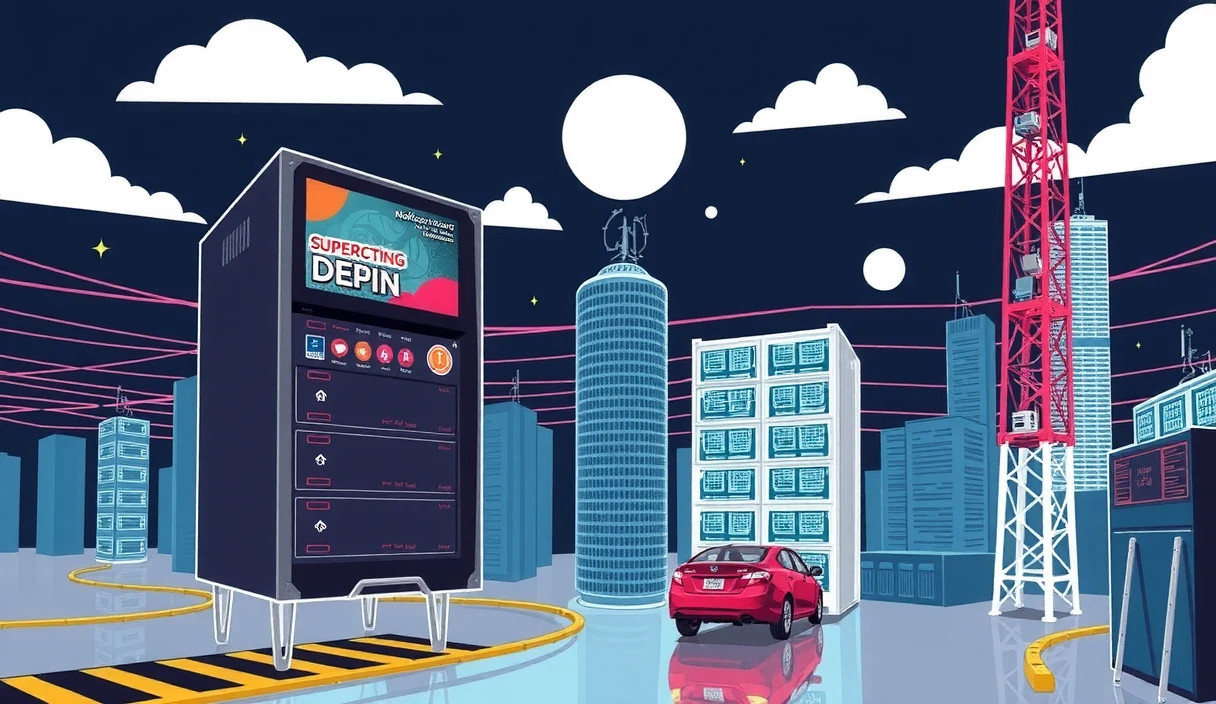
Decentralized Physical Infrastructure Networks (DePIN) have emerged as one of the most compelling blockchain use cases. Instead of corporations building and controlling infrastructure—cell towers, compute clusters, energy grids—DePIN coordinates individual contributors who share resources in exchange for token rewards.
Acurast applies this model to computation. The network turns consumer smartphones into compute nodes capable of handling workloads traditionally requiring data center resources. The February 2026 upgrade adds native Cray support, bringing high-performance computing (HPC) capabilities to a decentralized mobile network.
This matters because computational power has become concentrated. AWS, Google Cloud, and Azure control the majority of global compute capacity. Their data centers centralize risk, create geographic bottlenecks, and extract monopoly rents. Acurast proposes an alternative: distributed computation at the network edge.
What Cray Support Actually Means
Cray supercomputers have defined high-performance computing since the 1970s. The Cray brand represents specialized hardware, optimized compilers, and parallel processing architectures that power weather forecasting, nuclear simulations, and AI training.
Acurast's "native Cray support" doesn't mean smartphones have become Crays. The upgrade brings Cray-optimized software libraries and compilation targets to the Acurast runtime. Workloads written for Cray architectures can now execute across Acurast's distributed network with minimal porting effort.
Performance Characteristics: Individual smartphones remain less powerful than data center servers. But Acurast aggregates thousands of devices into virtual supercomputers. Parallel workloads—matrix operations, Monte Carlo simulations, batch AI inference—can distribute across the network.
Energy Efficiency: Smartphones are designed for energy efficiency. Acurast nodes use ARM processors optimized for battery life rather than x86 server chips designed for throughput. For certain workloads, the energy-per-computation ratio favors mobile devices.
Geographic Distribution: Unlike centralized data centers, Acurast nodes exist wherever smartphones exist. This creates natural edge computing capabilities with minimal latency to end users.
DePIN Compute Platform Comparison
| Platform | Infrastructure | Compute Type | HPC Support | Geographic Distribution |
|---|---|---|---|---|
| Acurast | Mobile devices | Decentralized | ✅ Cray native | Global edge |
| Render Network | GPU rigs | Decentralized | ⚠️ Rendering only | Varies by supply |
| Filecoin Compute | Storage providers | Decentralized | ❌ Limited | Storage-aligned |
| Akash Network | Data centers | Decentralized | ⚠️ Basic | Provider-dependent |
| AWS EC2 | AWS data centers | Centralized | ✅ Full HPC | Regional |
Real-World Workloads
The theoretical framework becomes concrete with specific applications:
Scientific Simulations: Molecular dynamics, fluid dynamics, and climate modeling often require massive parallel computation but minimal inter-node communication. These workloads map well to Acurast's distributed architecture.
AI Inference at Edge: Large language models require GPU acceleration for training, but inference can run on optimized CPU clusters. Acurast nodes can handle edge inference for localized AI applications.
Cryptographic Operations: Zero-knowledge proof generation, blockchain validation, and cryptographic verification are computationally intensive but parallelizable. The ACU token economics align incentives for these workloads.
Media Processing: Video transcoding, image manipulation, and audio processing distribute naturally across many cores. Acurast's Cray libraries optimize these operations for ARM architectures.
The Mobile Advantage
Why smartphones rather than dedicated servers? Several factors create unexpected advantages:
Hardware Refresh Cycle: Smartphones upgrade every 2-3 years. The network automatically incorporates newer, more efficient processors without capital expenditure from Acurast.
Idle Capacity: Most smartphones sit unused during sleeping hours. Acurast monetizes this idle capacity without requiring dedicated hardware purchases.
Power Infrastructure: Smartphones charge from existing electrical infrastructure. Contributors don't need to install specialized power or cooling systems.
Network Effects: More nodes improve geographic distribution and fault tolerance. Acurast benefits from smartphone ubiquity—billions of potential nodes worldwide.
Technical Architecture
Acurast's supercomputing upgrade implements several technical innovations:
Milestone Cray Runtime: Acurast's execution environment now includes Cray-optimized libraries for linear algebra, parallel I/O, and message passing (MPI). Workloads compile once and distribute across heterogeneous mobile hardware.
Secure Enclaves: Mobile processors include Trusted Execution Environments (TEEs) like ARM TrustZone. Acurast leverages these for computation verification without exposing contributor data.
Dynamic Scheduling: The network matches workloads to available nodes based on capability, proximity, and current load. This optimizes for both performance and energy efficiency.
Verification Layer: Computations execute redundantly across multiple nodes. Results must agree before payment. This prevents malicious nodes from returning incorrect answers.
Economic Model
Acurast runs on the ACU token with a dual-sided marketplace:
Compute Consumers: Organizations or individuals needing computation purchase ACU and submit workloads. Pricing reflects computational complexity, urgency, and geographic requirements.
Compute Providers: Smartphone owners install the Acurast client and contribute idle processing power. They earn ACU proportional to computation contributed and verified.
Validator Network: Specialized nodes verify computation results and enforce network rules. Validators stake ACU and risk slashing for incorrect verification.
The token economics aim for equilibrium where consumer demand matches provider supply. The Supercomputing Upgrade increases demand by enabling HPC workloads, potentially creating supply pressure that drives token value.
Competitive Positioning
Acurast occupies a unique position in the decentralized compute landscape:
vs. Traditional Cloud: Acurast offers distribution and edge proximity that AWS cannot match. However, cloud providers maintain advantages for latency-sensitive interactive workloads and massive single-node computations.
vs. Other DePIN Compute: Render Network focuses specifically on GPU rendering. Filecoin Compute targets storage-adjacent workloads. Akash uses traditional data center infrastructure. Acurast's mobile-first approach and Cray support differentiate it.
vs. Edge Computing: Cloudflare Workers, AWS Lambda@Edge, and similar services offer edge execution but within centralized frameworks. Acurast provides truly decentralized edge infrastructure.
Implications for Scientific Computing
The scientific community has always struggled with compute access. University researchers wait months for supercomputer time allocation. Independent researchers lack access entirely.
Acurast democratizes access. Anyone with ACU tokens can submit workloads to a globally distributed supercomputer. The verification layer provides confidence in results without requiring institutional gatekeepers.
For reproducibility, the blockchain records computation parameters, node selection, and result verification. This creates auditable scientific pipelines that improve research integrity.
Challenges and Limitations
The Supercomputing Upgrade doesn't solve every computational problem:
Inter-Node Communication: Workloads requiring frequent synchronization between nodes suffer from smartphone network latency. Acurast excels at embarrassingly parallel problems, struggles with tightly coupled simulations.
Memory Constraints: Smartphones have limited RAM compared to servers. Large-scale simulations requiring terabytes of memory remain impractical.
Power and Thermal Throttling: Mobile processors throttle performance when overheated. Sustained computation degrades over time as devices heat up.
Regulatory Uncertainty: Decentralized computation raises questions about data sovereignty, export controls, and liability. Jurisdictions haven't clarified how DePIN compute fits existing frameworks.
The Decentralization Thesis
Acurast's Supercomputing Upgrade represents a bet on decentralization. The thesis holds that distributed computation at the edge—despite individual node limitations—can collectively rival centralized infrastructure for specific workloads.
The Cray support signals ambition. Acurast isn't positioning as a niche crypto project but as legitimate HPC infrastructure. The network competes for scientific workloads that might otherwise run on university clusters or national supercomputers.
For Polkadot, Acurast demonstrates the ecosystem's diversity. While some parachains focus on DeFi or governance, Acurast pursues infrastructure—raw computation made accessible through blockchain coordination.
TL;DR
- What: Acurast Supercomputing Upgrade brings Cray HPC support to mobile DePIN compute network
- How: 50,000+ smartphones coordinated into virtual supercomputer with Cray-optimized libraries
- Edge: Decentralized edge computation with native Cray compatibility for scientific workloads
- Impact: Democratizes access to high-performance computing without data center infrastructure
- Token: ACU powers dual-sided marketplace connecting compute consumers and mobile providers
Sources
- Acurast Official Blog - Mainnet TGE Announcement (2026)
- Cray Supercomputing Documentation (Technical reference)
- DePIN Research Hub (Industry analysis)
- Acurast Network Statistics (On-chain metrics)
- ARM TrustZone Documentation (Security architecture)
Gemma Nguyen is Totestek's DePIN Infrastructure Analyst & Distributed Compute Correspondent. She writes about decentralized infrastructure, edge computing, and the hardware democratizing access to computational resources.
Related Posts
-

Soneium Score: Twelve Seasons, One Community
I was scrolling through my wallet history last week when I realized something unexpected. Between the airdrop claims and the bridge transactions, there was a steady rhythm of small interactions that had accumulated over months. Quest completions, streak badges, daily check-ins. I
-
Doosan Robotics and peaq Partner on Physical AI to Finance Robots and Monetize Their Spare Capacity
I have written about automated finance for years, but I have rarely seen a partnership that treats a machine as its own balance sheet. Most industrial robots are financed against the buyer's credit rating, depreciating on a schedule that has little to do with what the machine act
-

Startale July Missions Offer Up to 80 STAR Points for Active Ecosystem Engagement
I have a drawer full of loyalty cards from coffee shops, airlines, and grocery stores. None of them talk to each other, and most of the points expire before I remember to use them. When Startale announced its July Missions campaign offering up to 80 STAR Points for active ecosyst
-

The Machine Economy Needs Better Token Models
I still remember the first time I tried to understand Helium's tokenomics. I was staring at a whitepaper filled with burn mechanisms, mint schedules, and governance rights, convinced I was looking at the future of decentralized infrastructure. Six months later, the token had shed