

Bifrost Announces vETH and vMANTA Recovery Timeline with July-August 2026 Distribution Plan
Bifrost released the recovery timeline for vETH and vMANTA holders, with an on-chain snapshot scheduled for July 15, 2026, and a registration-based claim channel opening in August 2026, allowing holders to recover value on Ethereum.

Bifrost Finance has released a detailed recovery timeline for vETH and vMANTA holders, marking the resolution of one of the more complex liquidation events in liquid staking protocol history. The plan includes an on-chain snapshot scheduled for July 15, 2026, followed by a registration-based claim channel opening in August 2026.
I've been following Bifrost's evolution since their early liquid staking experiments on Kusama. This recovery process demonstrates both the challenges of cross-chain liquid staking and the protocol's commitment to user protection even in adverse scenarios.
Key Metrics at a Glance
| Milestone | Date | Action Required |
|---|---|---|
| Snapshot | July 15, 2026 | On-chain balance recorded |
| Registration Opens | August 2026 | Claim channel activation |
| Distribution | August 2026 | Recovery value transferred |
| Chain | Ethereum | Recovery on ETH mainnet |
| Asset Type | vETH, vMANTA | Liquid staking derivatives |
Background: The Liquidated Positions
The vETH and vMANTA recovery stems from positions that became undercollateralized during market volatility:
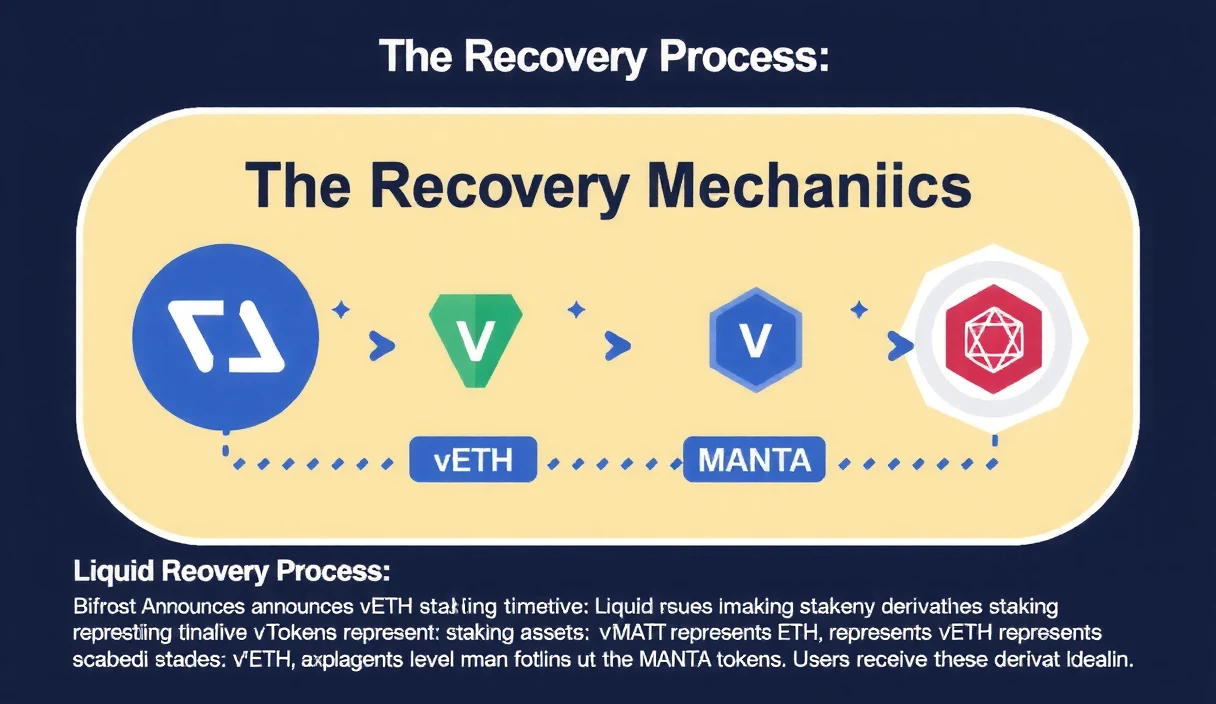
Liquid Staking Mechanics: Bifrost issues liquid staking derivatives (vTokens) representing staked assets. vETH represents staked ETH; vMANTA represents staked MANTA tokens. Users receive these derivatives while their underlying assets earn staking rewards.
Collateralization Events: Extreme market conditions caused some positions to drop below required collateral ratios. Automated liquidation mechanisms triggered, converting staked assets to protect protocol solvency.
Recovery Eligibility: Not all vETH/vMANTA holders are affected. Only holders of positions that were liquidated during specific market events qualify for recovery distribution.
The Recovery Process
Bifrost structured the recovery in distinct phases:
Phase 1: Snapshot (July 15, 2026)
An on-chain snapshot captures all qualifying vETH and vMANTA balances at a specific block height. This establishes the distribution baseline and prevents manipulation through last-minute transfers.
Phase 2: Registration (August 2026)
Affected holders must register their claim through an official Bifrost channel. This likely involves wallet signature verification to prove ownership of snapshot-era addresses.
Phase 3: Distribution (August 2026)
Following successful registration, recovery value transfers to Ethereum mainnet wallets. The exact amount depends on liquidation proceeds and protocol reserves allocated to recovery.

Technical Considerations
Several technical factors affect the recovery:
Cross-Chain Complexity: Bifrost operates across multiple chains (Polkadot, Ethereum, others). Recovery distribution occurs on Ethereum, requiring cross-chain coordination for verification and settlement.
Smart Contract Verification: The registration process likely involves cryptographic proofs—holders signing messages with snapshot-era wallets to verify legitimate claims without exposing private keys.
Gas and Fees: Ethereum mainnet distributions incur gas costs. Bifrost may implement meta-transactions or subsidized claims to ensure small holders aren't priced out.
Timing Precision: Snapshot timing matters significantly for DeFi participants. Users with active positions—lending, liquidity provision, or yield farming—must understand how snapshot balances are calculated.
Implications for Liquid Staking
This recovery process highlights important dynamics in liquid staking protocols:
Risk Disclosure: Liquid staking derivatives carry risks beyond underlying asset volatility. Collateralization mechanisms, liquidation thresholds, and cross-chain bridge dependencies create complex risk profiles.
Protocol Reserves: Bifrost's ability to offer recovery depends on treasury reserves and fee accumulation. Protocols with insufficient reserves cannot make holders whole after liquidation events.
Governance Role: Recovery plans typically require governance approval, demonstrating how decentralized governance responds to crisis scenarios. Token holders vote on recovery allocations and implementation details.
Cross-Chain Fragility: Multi-chain liquid staking creates additional failure modes. Bridge security, chain finality, and interoperability standards all affect recovery feasibility.

Holder Action Items
For vETH and vMANTA holders potentially affected:
Verify Eligibility: Check Bifrost's official announcements and documentation to confirm if your specific holdings qualify for recovery. Not all positions are affected.
Snapshot Preparation: Ensure your tokens are in wallets you control (not centralized exchanges) before July 15, 2026. Exchange-held assets may not be captured in the snapshot.
Registration Ready: Prepare Ethereum mainnet wallets for August registration. The recovery distribution occurs on Ethereum, requiring ETH addresses for receipt.
Stay Updated: Follow official Bifrost channels—blog, Discord, Twitter—for specific registration instructions and any timeline adjustments.
Security Awareness: Recovery events attract scammers. Verify all communications through official channels; never share private keys or seed phrases.
Competitive Context
Other liquid staking protocols have faced similar challenges:
Lido's stETH: The largest liquid staker experienced depegging events during market stress but maintains collateral through diversified validator sets and insurance mechanisms.
Rocket Pool's rETH: Minimizes liquidation risk through overcollateralization requirements, accepting lower capital efficiency for reduced holder exposure.
Bifrost's Approach: The recovery plan demonstrates commitment to user protection, but also reveals protocol design choices that created liquidation vulnerability.
Industry Learning: Each liquidation event provides data for improving liquid staking risk models. Future protocols implement more conservative collateralization ratios and circuit breakers.
Broader DeFi Implications
The Bifrost recovery touches on several DeFi themes:
Derivatives Risk: Liquid staking derivatives represent claims on underlying assets. When collateralization fails, derivative holders may not recover full value—a form of counterparty risk in supposedly decentralized systems.
Protocol Solvency: Automated liquidation protects protocol solvency but creates user losses. The tradeoff between protocol health and individual holder protection remains contentious.
Regulatory Scrutiny: Liquid staking events attract regulatory attention. Authorities evaluate whether derivatives qualify as securities and whether liquidation mechanisms protect retail investors adequately.
Insurance Evolution: Some protocols experiment with decentralized insurance for liquidation events. Bifrost's recovery plan may inform future insurance product design.
TL;DR
- What: Bifrost recovery plan for liquidated vETH and vMANTA positions
- When: Snapshot July 15, 2026; Registration and distribution August 2026
- How: On-chain snapshot establishes eligibility; registration channel opens for claims; Ethereum mainnet distribution
- Who: Holders of liquidated positions (not all vETH/vMANTA holders)
- Action: Verify eligibility; ensure wallet control before snapshot; prepare for August registration
Sources
- Bifrost Official Blog (Recovery timeline announcement) - PRIMARY SOURCE
- Bifrost Documentation (Technical specifications)
- Liquid Staking Risks (Educational context)
- DeFi Liquidation Mechanics (Industry standards)
- Cross-Chain Bridge Security (Risk analysis)
Gemma Nguyen is Totestek's Liquid Staking and DeFi Risk Correspondent. She writes about staking derivatives, protocol design, and risk management in decentralized finance.
Related Posts
-

The Ethereum Protocol Attackathon Is Live: Who Profits When Hackers Attack Ethereum's Core?
Immunefi has launched a $2M bounty competition targeting Ethereum's core protocol code. Is this a genuine push for security or a strategic narrative play ahead of the Glamsterdam upgrade?
-

JPYSC Puts Yen to Work: How Japan's Biggest Bank Is Quietly Building Onchain Finance
Japan's largest financial conglomerate is moving beyond pilots. By deploying JPY 1 billion into tokenized government bonds, SBI is creating a production-grade blueprint for regulated onchain finance.
-

When Yen Meets Dollar Onchain: SBI and Startale's Bet on Frictionless Cross-Border Settlement
SBI and Startale are partnering with the Open Standard alliance to enable real-time settlement between JPYSC and OUSD. This move aims to eliminate 48-hour banking delays and revolutionize how yen and dollars move onchain.
-

Lido's stVaults Is Here: Who Actually Controls Your Staked ETH When You Don't
Lido launches stVaults to offer institutional-grade staking with native DeFi integration. While it promises greater control over validators, the hidden risks of liquidation and protocol upgrades deserve a closer look.