

Peaq Machine RWA Framework Enables Tokenization of Physical Robots as On-Chain Yield Assets
Peaq introduced its Machine RWA Framework on February 25, 2026, enabling tokenization of physical robots and machines as on-chain yield-bearing assets, allowing manufacturers to sell productive capacity instead of equipment and operators to refinance based on performance history.
The convergence of physical infrastructure and blockchain finance reached a significant milestone when Peaq introduced its Machine RWA Framework on February 25, 2026. This infrastructure enables manufacturers to tokenize physical robots and machines, transforming productive equipment into on-chain yield-bearing assets with verifiable performance history.
I've been tracking the evolution of real-world asset tokenization since early experiments with real estate and commodities. What Peaq is building represents a fundamentally different approach—rather than tokenizing static assets, they're creating infrastructure for productive machines that generate ongoing value through actual work.
Key Metrics at a Glance
| Aspect | Traditional Equipment Financing | Peaq Machine RWA |
|---|---|---|
| Asset Type | Static collateral | Productive capacity |
| Yield Source | Interest payments | Machine productivity |
| Performance Tracking | Manual reporting | On-chain telemetry |
| Liquidity | Illiquid/long-term | Tokenized/tradable |
| Access | Institutional only | Permissionless |
| Settlement | Days/weeks | Minutes |
The Machine RWA Framework
Peaq's framework creates a complete stack for bringing physical machines onto the blockchain:
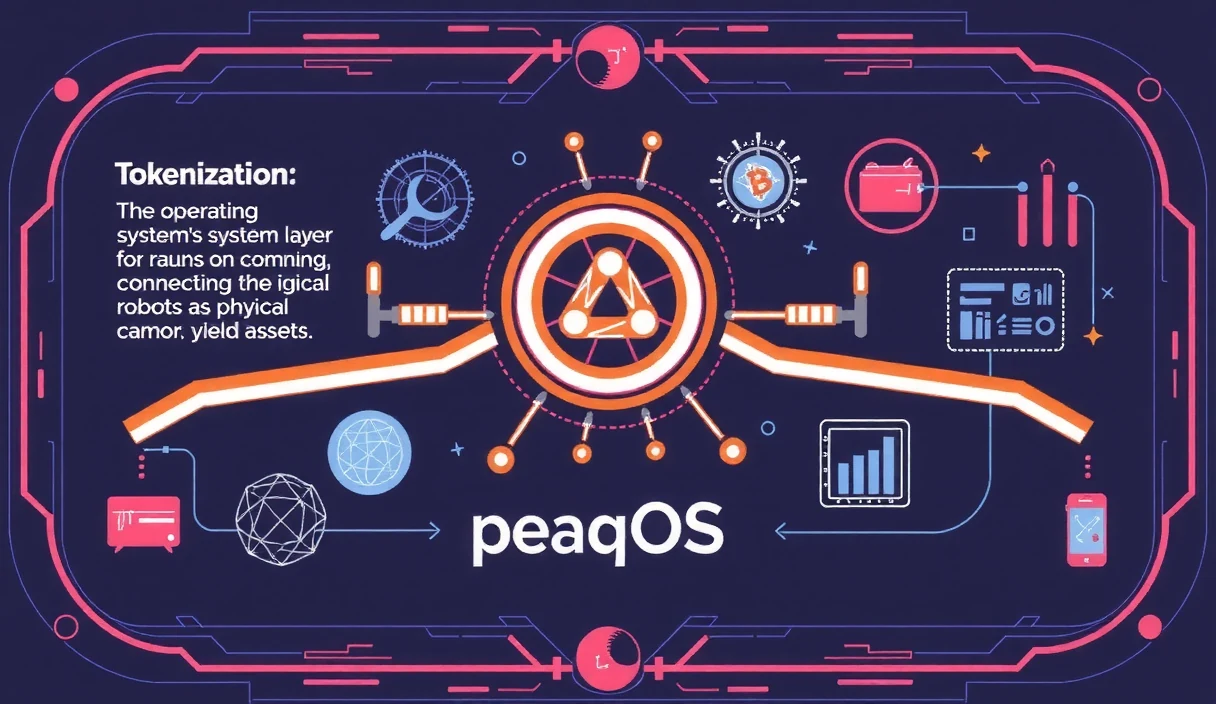
peaqOS: The operating system layer that runs on machine hardware, connecting physical devices to the Peaq network. It handles identity, payments, and data streaming without requiring manufacturers to build custom blockchain integrations.
Machine Identity: Each robot receives a decentralized identifier (DID) that persists across ownership changes. This creates verifiable history of maintenance, performance, and operational status.
Payment Rail: Native payment infrastructure enables machines to receive payment directly for services rendered. A delivery robot can autonomously manage its own wallet and settle transactions without human intervention.
Data Verification: Telemetry from machines feeds into on-chain records, creating immutable performance history that investors can audit before purchasing machine tokens.
Tokenization Mechanics
The framework enables two primary tokenization models:
Revenue Sharing: Machine owners tokenize future revenue streams. Investors purchase tokens representing rights to a percentage of machine earnings. This resembles traditional asset-backed securities but with real-time performance verification.
Productive Capacity: Manufacturers sell access to machine capabilities rather than the machines themselves. A warehouse robot's picking capacity becomes a tradeable commodity, with pricing reflecting demand and operational efficiency.
Refinancing Based on History: As machines accumulate performance data on-chain, owners can refinance based on demonstrated productivity rather than static collateral value. A robot with six months of verified uptime commands better terms than unproven equipment.
Target Use Cases
The framework addresses several concrete market opportunities:
Autonomous Delivery: Last-mile delivery robots can tokenize their routes, allowing investors to purchase rights to future delivery fees. The robot's peaqOS integration automatically distributes revenue to token holders.
Warehouse Automation: Material handling equipment represents substantial capital expenditure. Tokenization allows warehouses to sell productive capacity while retaining operational control, turning CapEx into tradeable revenue streams.
Manufacturing Equipment: High-value manufacturing robots with predictable output can be tokenized, creating liquid markets for industrial machinery exposure without requiring physical possession.
Renewable Energy Infrastructure: Solar installations and battery storage systems can tokenize energy production, with yields automatically distributed based on actual generation data.
Competitive Positioning
The Machine RWA space includes several approaches:
vs. Centrifuge: Centrifuge focuses on traditional asset securitization with off-chain collateral. Peaq targets productive machines with native blockchain connectivity and real-time performance data.
vs. RealT: RealT tokenizes real estate—static assets with predictable yields. Peaq handles dynamic assets whose productivity varies with utilization, maintenance, and market demand.
vs. Maple Finance: Maple provides institutional lending against various collateral types. Peaq creates infrastructure for machines to participate directly in financial markets without intermediary lending relationships.
vs. Traditional Equipment Leasing: Conventional leasing involves complex contracts and illiquid positions. Tokenization creates immediately tradable exposure to machine productivity.
Technical Architecture
Peaq's implementation on Polkadot provides specific advantages:
Scalability: Machine telemetry requires high-throughput data processing. Peaq's parachain architecture handles transaction volume that would congest general-purpose chains.
Interoperability: Machines can interact with other parachains—settling payments via Asset Hub, accessing decentralized storage, or integrating with DeFi protocols for yield optimization.
Cost Structure: Polkadot's fee model accommodates microtransactions from machine operations without prohibitive gas costs.
Security: Relay chain validation provides security guarantees appropriate for high-value industrial equipment without requiring separate validator infrastructure.
Economic Implications
The Machine RWA framework creates several economic shifts:
Capital Efficiency: Manufacturers can deploy equipment faster by tokenizing productive capacity rather than seeking traditional financing. This reduces time-to-revenue and working capital requirements.
Fractional Ownership: Small investors gain exposure to industrial assets previously accessible only to institutions. A $100 investment can represent fractional ownership of a warehouse robot.
Price Discovery: Token markets create continuous pricing for machine productivity, revealing real-time valuations that inform deployment and maintenance decisions.
Automated Compliance: On-chain performance history creates audit trails for regulatory compliance, particularly relevant as jurisdictions develop frameworks for tokenized assets.
Challenges and Considerations
No infrastructure is without challenges:
Hardware Reliability: Token values depend on physical machine performance. Hardware failures, maintenance issues, or operational disruptions affect yields.
Oracle Trust: Data feeds from machines require trusted verification. Compromised sensors or manipulated telemetry could mislead investors.
Regulatory Uncertainty: Machine tokenization sits at the intersection of securities law, IoT regulation, and blockchain governance. Frameworks vary significantly across jurisdictions.
Adoption Curve: Manufacturers must integrate peaqOS, representing upfront technical investment. Network effects require critical mass to achieve liquidity and price stability.
The Broader DePIN Context
Peaq's Machine RWA fits into the emerging decentralized physical infrastructure (DePIN) landscape:
Beyond Digital Assets: While most crypto focuses on purely digital applications, DePIN creates blockchain interfaces for physical world assets.
Infrastructure Tokenization: Beyond robots, DePIN encompasses energy grids, wireless networks, transportation systems—any physical infrastructure that generates measurable value.
Web3 Business Models: Traditional business models require legal entities and banking relationships. Machine RWA enables autonomous economic agents—devices that earn, spend, and manage their own finances.
Polkadot Positioning: As a parachain specialized for machine connectivity, Peaq complements Polkadot's broader ecosystem of finance, identity, and interoperability parachains.
TL;DR
- What: Peaq's Machine RWA Framework enables tokenization of physical robots and machines as on-chain yield-bearing assets
- How: peaqOS connects machines to blockchain, creating verifiable identity, payment rails, and performance history
- Edge: Native blockchain connectivity for physical assets; real-time productivity verification; fractional ownership
- Applications: Autonomous delivery, warehouse automation, manufacturing equipment, renewable energy infrastructure
- Impact: Transforms equipment financing from static collateral to productive capacity markets
Sources
- Peaq Official Announcement (February 2026) - PRIMARY SOURCE
- Peaq Documentation (Technical specifications)
- DePIN Industry Analysis (Market context)
- Polkadot DePIN Landscape (Ecosystem positioning)
- Real-World Asset Tokenization Standards (Industry frameworks)
Gemma Nguyen is Totestek's DePIN and Physical Infrastructure Correspondent. She writes about the intersection of blockchain, IoT, and real-world asset tokenization.
Related Posts
-

JPYSC Puts Yen to Work: How Japan's Biggest Bank Is Quietly Building Onchain Finance
Japan's largest financial conglomerate is moving beyond pilots. By deploying JPY 1 billion into tokenized government bonds, SBI is creating a production-grade blueprint for regulated onchain finance.
-
When Yen Meets Dollar Onchain: SBI and Startale's Bet on Frictionless Cross-Border Settlement
SBI and Startale are partnering with the Open Standard alliance to enable real-time settlement between JPYSC and OUSD. This move aims to eliminate 48-hour banking delays and revolutionize how yen and dollars move onchain.
-

Send Privately with Friends: Startale App Launches Shielded Transfers, Rewards 70 STAR Points for Privacy Pioneers
Startale App introduces Friends, a new mini app bringing shielded transfers to Soneium. Learn how to protect your onchain privacy using zero-knowledge proofs and earn 70 STAR points during the Summer Fiesta campaign.
-

September Harvest: Startale App's Autumn Campaign Offers Up to 200 STAR Points for Onchain Activity
Startale App launches its September Harvest campaign, offering up to 200 STAR Points for onchain activity. Discover how to earn rewards through cross-chain deposits, swaps, and vault staking on Soneium.