

Phala Turbine on TEE Enables Verifiable Trading Infrastructure for Decentralized Finance
Phala Network introduces Turbine, a trusted execution environment (TEE) powered solution for verifiable trading infrastructure, enabling secure and confidential decentralized finance operations with provable execution integrity.

Phala Network introduced Turbine, a trusted execution environment (TEE) powered solution for verifiable trading infrastructure in decentralized finance. The system enables secure and confidential DeFi operations with provable execution integrity, addressing the persistent challenge of verifying that trading algorithms execute as claimed without exposing proprietary strategies.
I've watched DeFi trading evolve from simple automated market makers to sophisticated algorithmic strategies. The fundamental tension—traders need to prove execution integrity without revealing strategies—has limited institutional participation. Phala's Turbine approach using hardware-backed verification offers a pragmatic middle ground.
Key Metrics at a Glance
| Capability | Traditional DeFi | Phala Turbine TEE |
|---|---|---|
| Execution Verification | Public mempool | Cryptographic attestation |
| Strategy Confidentiality | Transparent | Hardware-isolated |
| MEV Protection | None | Enforced by TEE |
| Settlement Finality | Block confirmation | Immediate within enclave |
| Audit Trail | On-chain events | Attestation records |
| Performance Overhead | None | 3-8% for TEE operations |
Turbine Architecture
Phala's Turbine system combines several technical components:
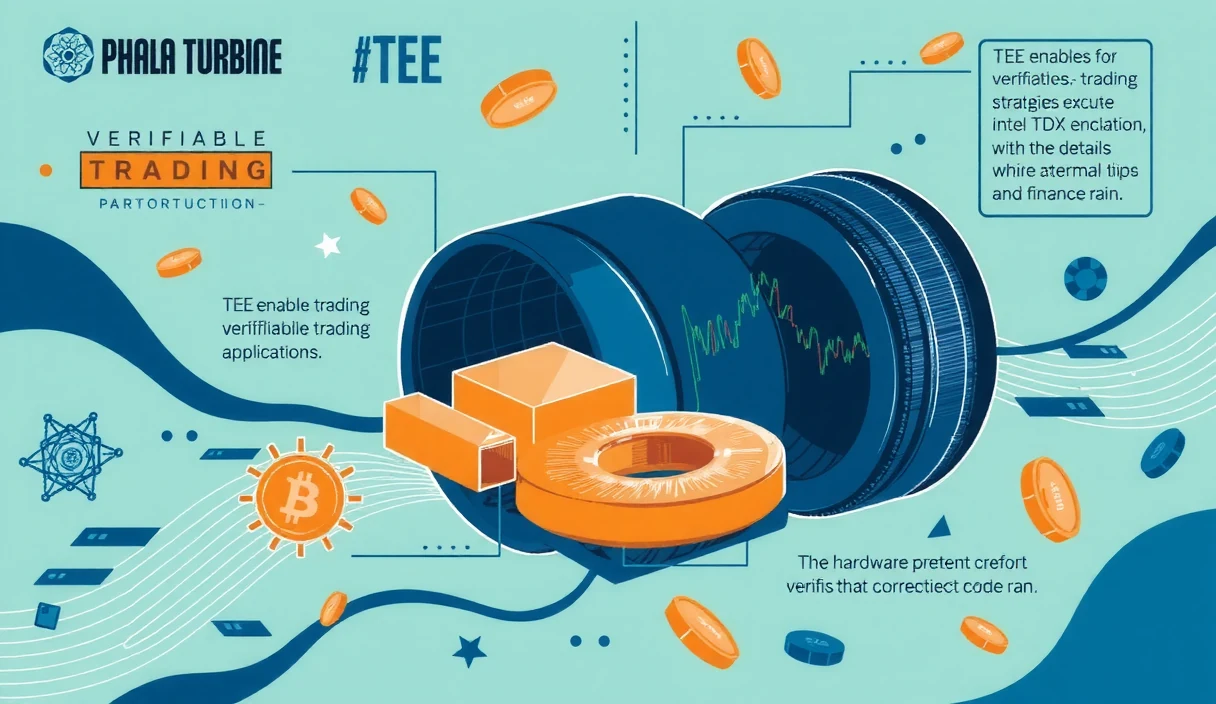
TEE-Powered Execution: Trading strategies execute within Intel SGX or TDX enclaves. The hardware prevents external observation of execution details while enabling verification that correct code ran.
Attestation Verification: Each trading execution produces a cryptographic attestation proving the strategy ran untampered. These attestations anchor to Phala's blockchain, creating immutable audit trails.
Confidential Input Handling: Price feeds, signals, and strategy parameters enter the TEE through encrypted channels. Even Phala's infrastructure operators cannot observe trading signals.
MEV-Resistant Settlement: Because transaction ordering occurs within the TEE, external actors cannot front-run or sandwich trades by observing mempool activity.

Verifiable Trading Applications
Turbine enables specific DeFi use cases:
Institutional Algorithmic Trading: Quantitative funds deploy proprietary strategies on-chain while proving execution integrity to investors. The TEE attestation replaces expensive third-party audit processes.
Lending Risk Assessment: Credit algorithms evaluate borrower risk using confidential data sources. Attestations prove the assessment occurred without revealing the underlying data or methodology.
Derivatives Pricing: Options and futures pricing models execute privately while producing verifiable outputs. Market makers can prove fair pricing without exposing their models.
Cross-Chain Arbitrage: Strategies exploiting price differences between chains execute within TEEs, preventing MEV extraction while maintaining execution proof.
Competitive Landscape
Verifiable DeFi execution has several approaches:
vs. Zero-Knowledge Proofs: ZK proofs offer mathematical verification but impose 100x-1000x computational overhead. TEE provides practical performance for latency-sensitive trading.
vs. Multi-Party Computation: MPC distributes trust across parties but requires coordination overhead. TEE centralized execution with hardware trust is simpler for single-organization strategies.
vs. Traditional Custody: Off-chain execution through centralized exchanges eliminates verification entirely. Turbine provides on-chain attestations without sacrificing confidentiality.
vs. Public MEV-Boost: MEV-Boost auctions extract value transparently. Turbine prevents extraction by concealing transactions until execution completes.
Technical Implementation
Deploying Turbine involves several steps:
Enclave Provisioning: Organizations provision TEE-capable infrastructure or utilize Phala's hosted enclaves. The network manages attestation infrastructure and verification services.
Strategy Packaging: Trading algorithms compile to WebAssembly and package with cryptographic manifests. The manifest specifies expected execution behavior for attestation comparison.
Encrypted Input Channels: Price feeds and signals enter through TLS connections terminated within the TEE. External observers see only encrypted traffic.
Continuous Verification: The system continuously validates enclave integrity throughout execution, detecting runtime compromises that startup attestation would miss.
Risks and Considerations
Several limitations apply to TEE-based trading:
Hardware Trust Assumptions: Security ultimately depends on Intel's hardware manufacturing and microcode updates. Historical side-channel vulnerabilities remind us that hardware trust is imperfect.
Performance Constraints: TEE operations incur measurable overhead. High-frequency strategies may find latency unacceptable compared to bare-metal execution.
Regulatory Uncertainty: Regulators have not yet ruled on TEE-based financial infrastructure. Compliance requirements may evolve as the technology matures.
Adoption Barriers: Traders must adapt existing strategies for TEE execution. The learning curve and tooling limitations slow initial adoption.
TL;DR
- What: Phala Turbine enables verifiable confidential trading through TEE infrastructure
- How: Hardware-isolated execution with cryptographic attestation and MEV-resistant settlement
- Edge: Practical performance vs. ZK proofs; on-chain verification vs. centralized custody
- Use Cases: Institutional algo trading, lending risk assessment, derivatives pricing, cross-chain arbitrage
- Context: Addresses DeFi's trust gap that limits institutional participation
Sources
- Phala Network Official Blog (Turbine announcement) - PRIMARY SOURCE
- Intel SGX Documentation (TEE technical specifications)
- DeFi MEV Research (MEV context)
- Confidential Computing Consortium (Industry standards)
- Institutional DeFi Adoption (Market analysis)
Gemma Nguyen is Totestek's Confidential DeFi Correspondent. She writes about verifiable computation, hardware-backed security, and the infrastructure enabling trustworthy decentralized finance.
Related Posts
-

Independent Research Publishes Liquidation-Capacity Stress Test for Ethereum DeFi: When the Safety Net Has Holes in It
The research paper appeared on a preprint server in September 2026 with the dry title of a financial engineering document that had been produced by people who had watched liquidation cascades destroy leveraged positions across Ethereum DeFi and decided to measure exactly how bad
-

Developer Releases Open-Source TypeScript Toolkit for Deterministic Aave V3 Health Factor Evaluation: When a GitHub Repo Promises to Save Your Collateral
The repository appeared on GitHub in September 2026 with the quiet confidence of a developer who had watched liquidation cascades wipe out millions and decided the problem was not price volatility—it was math visibility. The toolkit is a TypeScript library that deterministically
-

Phala Explores How Confidential AI Lets Lawyers Stop Choosing Between Compliance and Productivity
I watched a senior partner at a mid-sized law firm last month spend three hours redacting client documents before feeding them into an AI contract analysis tool. The irony was painful: she was using AI to save time, but spending more time preparing the data than the analysis itse
-

ERC-8274 Proposes Standardized Interfaces to Bridge AI Inference Verification Networks and Agentic Smart Contracts: When the EVM Starts Trusting Neural Networks
The proposal appeared on the Ethereum Magicians forum in September 2026 with the quiet ambition of developers who had watched the AI agent boom from the sidelines and decided it was time to give smart contracts a way to verify what neural networks actually computed. ERC-8274 intr