

Bifrost vDOT Dominates Polkadot Liquid Staking with 60% Market Share in 2026

When I first started exploring DeFi on Polkadot in 2022, staking was a simple but frustrating choice. You could lock up your DOT tokens to secure the network and earn rewards, but those tokens became illiquid—unusable for anything else until you unstaked them, a process that could take days or even weeks. It felt like being forced to choose between earning yield and maintaining flexibility.
That changed with the rise of liquid staking derivatives, and no project has embraced this opportunity more successfully than Bifrost. Their vDOT token has become the dominant liquid staking solution on Polkadot, capturing over 60% market share with more than $90 million in total value locked as of 2026. But how did they get here, and what does their dominance mean for the broader Polkadot DeFi ecosystem?
What Is Liquid Staking?
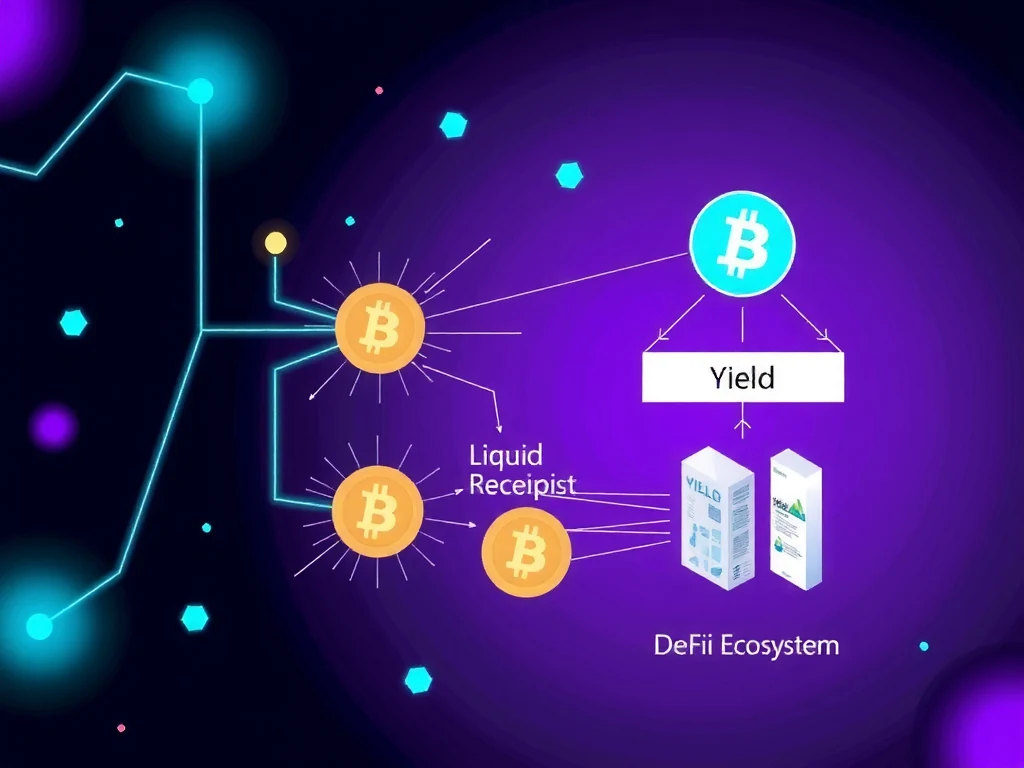
Traditional proof-of-stake networks require validators to lock up tokens as collateral. In exchange, they earn staking rewards for helping secure the network. The problem? Those locked tokens can't be used elsewhere in the ecosystem. If you want to participate in DeFi—lending, borrowing, providing liquidity—you have to unstake first, sacrificing those rewards.
Liquid staking solves this by issuing receipt tokens (like vDOT) that represent your staked position. These tokens trade at a discount to the underlying asset because they include the accumulated staking rewards. You can use them in DeFi protocols, collateralize loans, or provide liquidity while continuing to earn staking rewards. When you want your original tokens back, you simply redeem the receipt tokens.
The concept isn't unique to Polkadot. Ethereum has Lido and Rocket Pool. Solana has Marinade and Jito. But Bifrost has managed to achieve something rare in the fragmented multi-chain landscape: true dominance on a major network.
Why Bifrost Won Polkadot
Several factors contributed to Bifrost's success on Polkadot. First, they were early. While other liquid staking protocols focused on Ethereum's larger market, Bifrost recognized Polkadot's potential and built specifically for its architecture. This gave them a head start and allowed them to integrate deeply with the ecosystem.
Second, Bifrost operates as a Polkadot parachain, which provides significant advantages. Parachains benefit from Polkadot's shared security model, meaning they don't need to bootstrap their own validator set. They also enjoy seamless interoperability with other parachains through Polkadot's cross-chain messaging (XCM) protocol. This composability is crucial—vDOT can move frictionlessly between DeFi protocols across the entire ecosystem.
Third, Bifrost's technical approach emphasizes security and decentralization. Unlike some competitors that rely on permissioned validator sets, Bifrost allows users to choose their validators or let the protocol optimize for yield and security automatically. This flexibility appeals to both retail users and institutions with specific validator preferences.
The vDOT Ecosystem in 2026

Bifrost's 60% market share isn't just a number—it reflects real utility and integrations across the Polkadot ecosystem. vDOT has become a fundamental building block for DeFi on the network. Here's where you'll find it:
Decentralized Exchanges: vDOT trading pairs on platforms like StellaSwap, Beamswap, and HydraDX provide liquidity and price discovery. These DEX integrations ensure users can enter and exit vDOT positions efficiently.
Lending Protocols: Users can deposit vDOT as collateral on lending platforms like Parallel Finance and Starlay. This unlocks leveraged staking strategies—borrow against your vDOT, use the borrowed assets to buy more DOT, stake it for more vDOT, and repeat.
Liquidity Provision: vDOT/DOT pools on automated market makers generate trading fees while maintaining exposure to staking rewards. Some sophisticated strategies involve pairing vDOT with stablecoins to create delta-neutral positions.
Cross-Chain Bridges: Through Bifrost's cross-chain capabilities, vDOT has extended beyond Polkadot to Ethereum, Moonbeam, and other networks. This interoperability maximizes capital efficiency for multi-chain DeFi participants.
Technical Developments
Bifrost hasn't rested on its market dominance. The team has continued shipping features that strengthen their position. In early 2026, they released a new SDK that makes it easier for developers to integrate vDOT into their applications. This lowers the barrier to entry for new DeFi protocols wanting to support liquid staking tokens.
They've also improved their redemption mechanism. Early liquid staking derivatives sometimes traded at significant discounts to their underlying assets because redemption was slow or uncertain. Bifrost has implemented faster unbonding periods and more predictable redemption windows, helping vDOT maintain a tighter peg to DOT.
Perhaps most importantly, Bifrost has leaned into Polkadot's unique features. Their implementation takes advantage of Polkadot's nomination pools, allowing even small DOT holders to participate in staking and receive vDOT. This democratizes access to liquid staking in ways that aren't possible on networks with higher minimum staking requirements.
Competitive Landscape

Bifrost isn't without competition. Several other protocols offer liquid staking on Polkadot:
Parallel Finance: Offers sDOT and cDOT with their own DeFi integrations. They've focused heavily on lending and money markets.
Stafi: A cross-chain liquid staking protocol that supports multiple networks including Polkadot. Their rDOT competes directly with vDOT.
Lido: The Ethereum liquid staking giant has shown interest in expanding to Polkadot, though their progress has been slower than anticipated.
Despite these challengers, Bifrost has maintained its lead. The combination of first-mover advantage, deep ecosystem integrations, and continuous technical improvements has created strong network effects. Users go where the liquidity is, and liquidity follows users—a virtuous cycle that benefits market leaders.
Risks and Considerations
Liquid staking isn't risk-free. The smart contracts that manage the staking and derivative issuance are critical infrastructure—any vulnerability could affect significant value. Bifrost has undergone multiple audits, but users should understand that liquid staking introduces additional technical risk compared to native staking.
There's also the question of centralization. While Bifrost distributes staking across multiple validators, concentrated market share in a single liquid staking protocol creates systemic risk for the ecosystem. Some Polkadot governance participants have discussed whether to encourage more diversity in liquid staking providers.
Finally, vDOT's price relative to DOT can fluctuate based on market conditions and redemption demand. Users need to understand that vDOT is not a stablecoin—it's a claim on staked DOT plus accumulated rewards.
What This Means for Polkadot DeFi
Bifrost's dominance reflects the maturation of Polkadot's DeFi ecosystem. Liquid staking is a fundamental primitive—the ability to maintain staked exposure while using capital elsewhere unlocks tremendous efficiency. The $90M+ TVL in vDOT represents capital that can simultaneously secure the network and power DeFi applications.
For Polkadot to compete with Ethereum and other mature DeFi ecosystems, efficient capital allocation is essential. Bifrost's success demonstrates that Polkadot's architecture supports sophisticated financial products. The question now is how the ecosystem will build on this foundation.
What to Watch
Several developments could affect Bifrost's position and the broader liquid staking landscape:
Governance changes: Polkadot governance could implement mechanisms to encourage more liquid staking diversity, potentially capping any single protocol's market share.
Competition: New entrants with novel approaches could challenge Bifrost's dominance. Restaking—using staked assets to secure additional protocols—is gaining traction on Ethereum and could come to Polkadot.
Cross-chain expansion: As Polkadot's XCM protocol matures, vDOT could find utility in other ecosystems, expanding its addressable market beyond Polkadot-native DeFi.
Institutional adoption: If institutions increase their Polkadot allocations, liquid staking becomes more attractive for treasury management. Bifrost's security model and validator selection could become significant competitive advantages.
TL;DR
Bifrost's vDOT has captured over 60% of Polkadot's liquid staking market with $90M+ in TVL, becoming a fundamental building block for the ecosystem's DeFi infrastructure. As a Polkadot parachain, Bifrost benefits from shared security and cross-chain interoperability that enable deep integrations across DEXs, lending protocols, and liquidity pools. While competitors exist, Bifrost's first-mover advantage, technical improvements like faster redemptions, and new SDK releases have strengthened its network effects. However, concentrated market share raises systemic risk concerns, and users should understand the smart contract risks and price dynamics of liquid staking derivatives.
Sources
- Bifrost Official Website: https://bifrost.io
- Bifrost Blog and Documentation: https://bifrost.io/blog
- Polkadot Parachain Documentation: https://polkadot.network
- DefiLlama TVL Data for Bifrost
- Polkadot DeFi Ecosystem Reports (2026)
— Gemma Nguyen, Content Lead & Journalist at Totestek
Related Posts
-

Supersized August: Startale Pushes 100 STAR Points to Drive Soneium Ecosystem Engagement
Last month, I spent twenty minutes trying to redeem airline miles for a flight I no longer needed. The points had technically expired, the redemption portal was broken, and the customer service chatbot kept sending me in circles. It was a familiar frustration, one that loyalty pr
-

Bridged USDC Lands on Astar: What Swapper's Stablecoin Layer Means for Polkadot DeFi
The first time I tried to use a stablecoin on a Polkadot parachain, I spent twenty minutes searching for a bridge that actually worked. Most routes required Ethereum mainnet gas fees that made a simple $50 transfer uneconomical. I ended up leaving the transaction half-finished an
-

Astar Fi, Explained: How Polkadot's Onchain Personal Finance Manager Could Change DeFi
I still remember the first time I tried to track my onchain net worth. I had tokens scattered across three wallets, staked positions on Astar, liquidity on Hydration, and a few NFTs I had forgotten about entirely. By the time I cobbled together a spreadsheet, half the numbers wer
-

Soneium Score: Twelve Seasons, One Community
I was scrolling through my wallet history last week when I realized something unexpected. Between the airdrop claims and the bridge transactions, there was a steady rhythm of small interactions that had accumulated over months. Quest completions, streak badges, daily check-ins. I