

Hydration Launches Juicer: Automated Yield on ETH and BTC Without IL or Liquidation Risk
Hydration launched Juicer on November 6, 2026, an automated strategy that borrows discounted HOLLAR against deposited ETH or BTC and loops it into the PRIME yield position while keeping the original principal outside the liquidation path, so users earn yield without impermanent loss or direct liquidation risk to their collateral.

I have manually babysat a looping position before: borrow the stablecoin, swap, supply, borrow again, watch the health factor, and hope nothing liquidates while you sleep. It works until it does not. Hydration's new Juicer product, announced on November 6, 2026, is built precisely for that pain: an automated strategy that squeezes yield out of your ETH and BTC spot while keeping the deposited principal out of the liquidation path.
Key Metrics at a Glance
| Metric | Detail |
|---|---|
| Product | Juicer, by Hydration (Polkadot parachain) |
| Announcement date | November 6, 2026 |
| Launch collateral | ETH and BTC spot |
| Debt asset | HOLLAR, borrowed at a discounted rate |
| Yield engine | Shared PRIME looping strategy (loops to a target health factor) |
| Impermanent loss | None - no liquidity pool is used |
| Principal in liquidation path | No - synthetic backing covers the HOLLAR debt threshold value |
| Exit cooldown | seven days, governance-configurable |
| Future collateral candidates | Tokenized gold, SPY-linked tokenized equities (subject to markets, pricing, liquidity, governance) |
| Access | https://app.hydration.net/strategies/juicer |
How Juicer Works
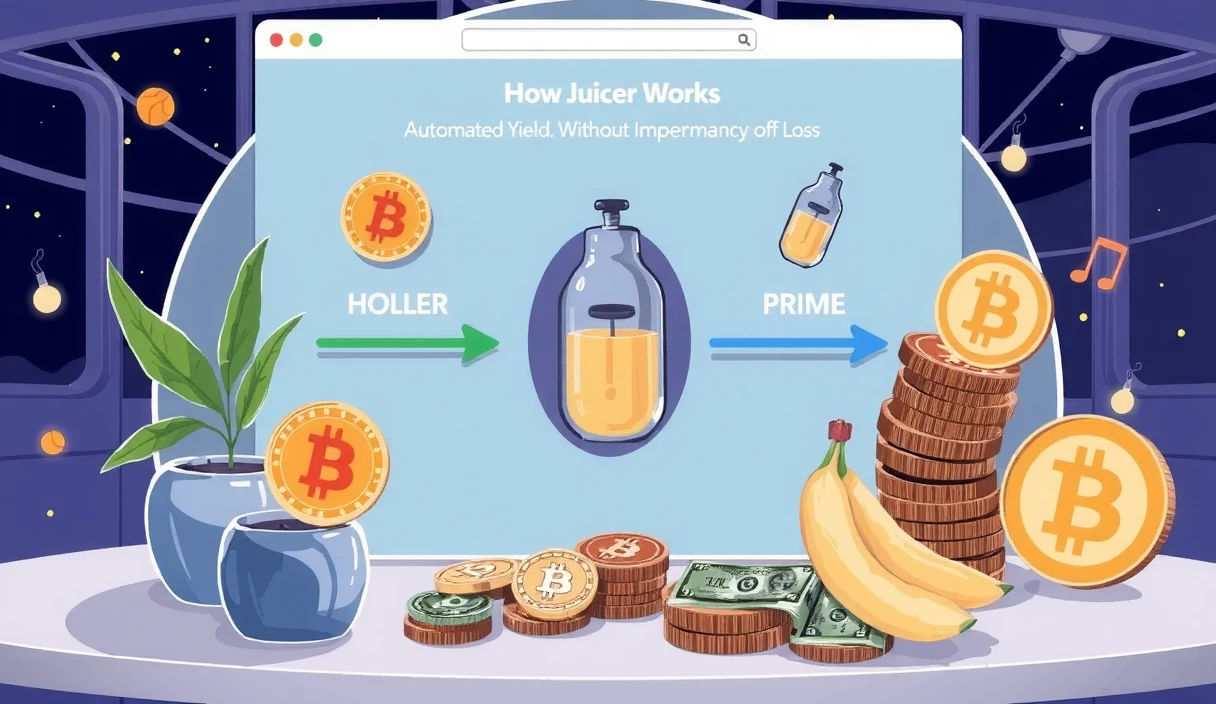
Under the hood, Juicer uses the borrowing capacity of your deposited collateral to borrow HOLLAR at a discounted rate and deploy it into a yield-generating PRIME looping strategy. The Main position holds your ETH or BTC; the looping exposure sits in the separate PRIME strategy.

Inside the PRIME strategy, HOLLAR is swapped into PRIME and supplied to the money market. The position then borrows additional HOLLAR and repeats the process until it reaches its target health factor. When the strategy generates a surplus, Juicer harvests it, allocates it back to participating vaults, converts each share into the originally deposited asset, and compounds it into your position. Permissionless keepers handle deleveraging at the safety threshold and partial unwinds when collateral prices call for less Main borrowing.
Juicer vs. Doing It Yourself
| Dimension | Juicer | Manual HOLLAR loop | Leveraged LP yield |
|---|---|---|---|
| Principal in liquidation path | No (synthetic backing) | Partially | Usually yes |
| Impermanent loss | None | None | Yes |
| Operational complexity | One deposit, keepers automate | High (borrow, swap, loop, monitor, harvest, rebalance) | Medium-high |
| Loop parameters | Protocol-configured target health factor | Self-chosen, self-managed | Pool-dependent |
| Exit | Managed withdrawal, seven-day cooldown | Instant but manual | Queue and pool dependent |
| Loss waterfall | Strategy surplus absorbs losses first; residual shortfall is a governance obligation | Your collateral | LP position |
The Risk Model Is the Story
The design choice that matters is separation. Your deposited ETH or BTC stays in the Main position, and Juicer adds synthetic backing alongside it covering the liquidation-threshold value of the HOLLAR debt. That backing does not create extra borrowing power; its job is to protect Main while the borrowed HOLLAR works elsewhere.
If the strategy runs into trouble, earned strategy value absorbs losses before original principal backing is touched. Any remaining shortfall becomes a governance recovery obligation with unpaid claims preserved - worth reading carefully: that means the protocol explicitly acknowledges a tail risk where users could be owed rather than instantly made whole.
Juicer Safety Score
A simple lens I would apply before depositing:
| Factor | Weight | Why it matters |
|---|---|---|
| Principal outside liquidation path | 30% | Core promise of the product |
| Loss waterfall clarity | 20% | Surplus-first absorption is explicit; tail is a governance obligation |
| Exit mechanics | 15% | Seven-day cooldown is finite but delays unwinds in stress |
| Governance configurability | 15% | Harvest share, cooldown, and thresholds can change |
| Automation reliability | 10% | Keepers must delever at the safety threshold |
| Market risk passthrough | 10% | Your position's dollar value still follows ETH/BTC prices |
Use This When / Consider Alternatives When
- Use Juicer when: you want yield on long-held ETH or BTC, do not want impermanent loss, do not need to exit instantly, and accept a seven-day managed withdrawal.
- Consider alternatives when: you need immediate liquidity, want full control of loop parameters, or prefer supplying your own strategy in a money market directly.
What to Watch
- Governance changes to the harvest share, the seven-day cooldown, or the target health factor.
- Queue progress and available liquidity during large unwinds - the cooldown is the earliest point an unwind can begin, not a completion guarantee.
- Expansion of collateral beyond ETH and BTC: tokenized gold and SPY-linked assets are named as candidates, each requiring lending-market support, reliable pricing, sufficient liquidity, and governance approval.
- The governance recovery obligation mechanics if the PRIME strategy ever runs a shortfall.
TL;DR
- What: Hydration launched Juicer on November 6, 2026, an automated yield strategy for ETH and BTC spot.
- Why: It loops discounted HOLLAR borrowing into the PRIME strategy while synthetic backing keeps your principal outside the liquidation path - yield without impermanent loss.
- Impact: A one-click leveraged loop with keepers handling deleveraging, harvesting, and compounding; exits go through a seven-day governance-configurable cooldown.
- Watch: Governance parameter changes, unwind queue liquidity, tail-risk recovery obligations, and future collateral types such as tokenized gold and SPY-linked assets.
Sources
Gemma Nguyen is TotesTek's Content Lead & Journalist, covering cryptocurrency, Web3, DeFi, blockchain technology, and emerging tech trends.
Related Posts
-

Lighthouse Consensus Client Publishes New Release for Ethereum Staking Validators
Sigma Prime has released a critical update for the Lighthouse consensus client, bringing essential security patches and performance boosts for Ethereum validators. Discover why this update is vital for avoiding slashing risks and optimizing attestation rewards.
-

Help shape Kusama’s Cypherpunk future: Apply
Kusama is consolidating its vision bounties into the new Cypherpunk Vision Fund, focusing on privacy and digital sovereignty. As applications open, the community is debating whether the network should pivot to this new mission or pursue an orderly wind-down.
-

Kusama Shields Mixie Brings Payments and Offramps to Telegram and Signal
Kusama Shields launches Mixie, a new Telegram and Signal mini app enabling private crypto invoices, untraceable sends, and no-KYC fiat offramps. Discover how this tool protects seller addresses while supporting over 60 tokens.
-

Kusama JAM Prime vs. WFC #573/#1926: Mapping the Governance Conflicts
Kusama faces a pivotal governance crossroads as new JAM Prime proposals clash with existing referenda. Discover how these conflicts impact validators, KSM holders, and the future of network security before the November 3 vote.